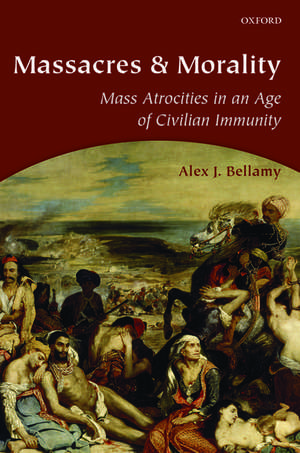
Massacres and Morality: Mass Atrocities in an Age of Civilian Immunity
Autor Alex J. Bellamyen Limba Engleză Hardback – 27 sep 2012
Preț: 952.21 lei
Preț vechi: 1381.12 lei
-31%
Puncte Express: 1428
Carte tipărită la comandă
Livrare economică 06-17 noiembrie
Livrare prin curier în România Termenul estimat este afișat lângă disponibilitate.
Transport gratuit pentru acest produs Plată online sau ramburs, în funcție de opțiunile comenzii.
Retur gratuit în 14 zile Comandă securizată și suport în română.
Specificații
ISBN-13: 9780199288427
ISBN-10: 0199288429
Pagini: 460
Dimensiuni: 167 x 244 x 32 mm
Greutate: 0.82 kg
Editura: OUP OXFORD
Colecția OUP Oxford
Locul publicării:Oxford, United Kingdom
ISBN-10: 0199288429
Pagini: 460
Dimensiuni: 167 x 244 x 32 mm
Greutate: 0.82 kg
Editura: OUP OXFORD
Colecția OUP Oxford
Locul publicării:Oxford, United Kingdom
V-ar putea interesa
-
 International Society and its CriticsAlex J. Bellamy-28%Preț: 394.67 lei548.88 lei
 -
 International Security: A Very Short IntroductionChristopher S. Browning-21%Preț: 55.29 lei69.65 lei
 -
 Machiavelli on International RelationsMarco Cesa-31%Preț: 740.93 lei1076.46 lei
 -
 The Changing Character of WarHew Strachan-16%Preț: 375.41 lei445.96 lei
 -
 -31%Preț: 903.30 lei1310.69 lei
 -
 Bargaining with a Rising India: Lessons from the MahabharataAmrita Narlikar-29%Preț: 538.28 lei753.25 lei
 -
 Preț: 407.38 lei
 -
 Preț: 79.62 lei
 -
 Just War and International OrderNicholas RenggerPreț: 218.76 lei
 -
 A Precariat Charter: From Denizens to CitizensProf. Guy Standing-19%Preț: 184.53 lei227.58 lei
 -
 -17%Preț: 156.45 lei188.29 lei
 -
 Fighting Terror: Ethical DilemmasAlex Bellamy-19%Preț: 201.60 lei247.43 lei
 -
 International RelationsManan DwivediPreț: 312.89 lei
Recenzii
this book conveys a strong ethical and political message in favour of more resolve in the defense of the achievements in the field of civilization and humanity.
Alex Bellamy provides a detailed compendium of massacres over the last 200 years... [T]his is a masterly, judicious and painstakingly researched survey of massacres over the last two centuries. It will provide an invaluable quarry for anyone interested in the ethics, legality or politics of war. The books central message on the reality but fragility of moral progress is an important one for which it deserves to be widely read.
This book about the coexistence of mass atrocities with the norm of civilian immunity from the nineteenth century to our time, and their evolution and mutual influence, is his [Alex J. Bellamy] best work yet. Rarely has such a painful and sensitive subject been investigated so seriously, thoroughly, clearly and impartially.
It deserves, nay needs, to be widely read.
Alex Bellamy provides a detailed compendium of massacres over the last 200 years... [T]his is a masterly, judicious and painstakingly researched survey of massacres over the last two centuries. It will provide an invaluable quarry for anyone interested in the ethics, legality or politics of war. The books central message on the reality but fragility of moral progress is an important one for which it deserves to be widely read.
This book about the coexistence of mass atrocities with the norm of civilian immunity from the nineteenth century to our time, and their evolution and mutual influence, is his [Alex J. Bellamy] best work yet. Rarely has such a painful and sensitive subject been investigated so seriously, thoroughly, clearly and impartially.
It deserves, nay needs, to be widely read.
Notă biografică
Alex J. Bellamy he served as Executive Director of the Asia Pacific Centre for the Responsibility to Protect from 2007-2010, and before that as Professor of International Relations at The University of Queensland. Before moving to Australia, he taught Defence Studies for King's College London at the UK's Joint Services Command and Staff College.