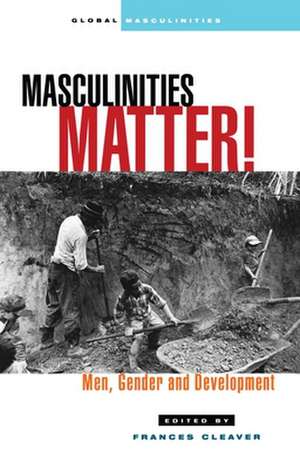
Masculinities Matter!: Men, Gender and Development: Global Masculinities
Autor Frances Cleaveren Limba Engleză Hardback – 31 oct 2002
Din seria Global Masculinities
- 23%
 Preț: 260.08 lei
 - 16%
 Preț: 260.85 lei
 - 14%
 Preț: 268.21 lei
 - 17%
 Preț: 245.44 lei
 - 25%
 Preț: 185.70 lei
 -
 Preț: 387.19 lei
 - 15%
 Preț: 515.17 lei
 -
 Preț: 371.15 lei
 - 15%
 Preț: 662.81 lei
 -
 Preț: 368.58 lei
 -
 Preț: 371.15 lei
 -
 Preț: 368.58 lei
 -
 Preț: 373.16 lei
 -
 Preț: 372.55 lei
 -
 Preț: 371.56 lei
 -
 Preț: 370.57 lei
 -
 Preț: 372.34 lei
 -
 Preț: 372.75 lei
 - 15%
 Preț: 663.97 lei
 - 15%
 Preț: 721.58 lei
 - 15%
 Preț: 668.64 lei
 -
 Preț: 447.32 lei
 - 15%
 Preț: 449.64 lei
 - 15%
 Preț: 669.85 lei
 - 18%
 Preț: 755.31 lei
 -
 Preț: 432.35 lei
Preț: 523.62 lei
Preț vechi: 703.98 lei
-26%
Puncte Express: 785
Carte disponibilă
Livrare economică 09-23 noiembrie
Livrare prin curier în România Termenul estimat este afișat lângă disponibilitate.
Transport gratuit pentru acest produs Plată online sau ramburs, în funcție de opțiunile comenzii.
Retur gratuit în 14 zile Comandă securizată și suport în română.
Specificații
ISBN-13: 9781842770641
ISBN-10: 1842770640
Pagini: 256
Dimensiuni: 138 x 216 x 23 mm
Greutate: 0.43 kg
Editura: ZED BOOKS
Colecția Zed Books
Seria Global Masculinities
Locul publicării:London, United Kingdom
ISBN-10: 1842770640
Pagini: 256
Dimensiuni: 138 x 216 x 23 mm
Greutate: 0.43 kg
Editura: ZED BOOKS
Colecția Zed Books
Seria Global Masculinities
Locul publicării:London, United Kingdom
V-ar putea interesa
-
 -11%Preț: 340.36 lei382.03 lei
 -
 Studying Men and MasculinitiesDavid Buchbinder-15%Preț: 473.17 lei556.67 lei
 -
 Preț: 380.26 lei
 -
 Preț: 486.98 lei
 -
 The Male BrainLouann Brizendine-19%Preț: 64.20 lei79.02 lei
 -
 Difficult MenBrett MartinPreț: 109.26 lei
 -
 Sodomy and the Pirate TraditionB R BurgPreț: 235.39 lei
 -
 What is Masculinity?J. Arnold-18%Preț: 702.66 lei856.91 lei
 -
 Feminism and MenNikki van der Gaag-15%Preț: 132.73 lei156.61 lei
 -
 Islamic MasculinitiesLahoucine Ouzgane-17%Preț: 245.44 lei294.94 lei
 -
 A Man's World?: Changing Men's Practices in a Globalized WorldProfessor Bob Pease-16%Preț: 260.85 lei309.15 lei
Cuprins
Foreword - Michael Kimmel
1. Men and Masculinities: New Directions in Gender and Development - Frances Cleaver
2. Nationalism, Masculinity and the Developmental State: Exploring Hindutva Masculinities - Prem Vijayan
3. Collapsing Masculinities and Weak States - A Case Study of Northern Uganda - Chris Dolan
4. Lenin, the Pinguero and the Cuban Imaginings of Maleness in Times of Scarcity - David Forrest
5. Deconstructing Domination: Gender Disempowerment and the Legacy of Colonialism and Apartheid in Omaheke, Namibia - Niki Kandirikirira
6. Men in Women's Groups: a Gender and Agency Analysis of Local Institutions - Helen Hambly Odame
7. Boys will be Boys: Addressing the Social Construction of Gender - Marilyn Thomson
8. Why Do Dogs Lick their Balls? Gender, Desire and Change - A Case Study from Vietnam - Neil Doyle
9. Targeting Men for a Change: AIDS Discourse and Activism in Africa - Janet Bujra
Index
1. Men and Masculinities: New Directions in Gender and Development - Frances Cleaver
2. Nationalism, Masculinity and the Developmental State: Exploring Hindutva Masculinities - Prem Vijayan
3. Collapsing Masculinities and Weak States - A Case Study of Northern Uganda - Chris Dolan
4. Lenin, the Pinguero and the Cuban Imaginings of Maleness in Times of Scarcity - David Forrest
5. Deconstructing Domination: Gender Disempowerment and the Legacy of Colonialism and Apartheid in Omaheke, Namibia - Niki Kandirikirira
6. Men in Women's Groups: a Gender and Agency Analysis of Local Institutions - Helen Hambly Odame
7. Boys will be Boys: Addressing the Social Construction of Gender - Marilyn Thomson
8. Why Do Dogs Lick their Balls? Gender, Desire and Change - A Case Study from Vietnam - Neil Doyle
9. Targeting Men for a Change: AIDS Discourse and Activism in Africa - Janet Bujra
Index
Recenzii
This book will make an extremely useful contribution to the growing debate on the politics and practice of including a focus on men and masculinities in gender and development policy and planning. With its rich, diverse and empirically grounded contributions, it should be widely read.
A thorough and thoughtful review of the state of affairs in studies of men and masculinities in development and a clear and systematic text every lecturer in gender and development will happily give as required readings to her students.
Cleaver has brought together a compelling set of articles that depict men as at once misunderstood, maligned, and at times resistant, but truly necessary partners in the development process. The more one reads, the more it becomes clear that men represent a critical, but largely untapped resource that must be engaged in partnership to achieve gender equality, reduction in poverty, to slow the spread of HIV/AIDS, and to curb the many forms of gender-based violence.
This much needed book poses serious and timely questions about the scope and purpose of gender and development theory and practice. Its wide range of case studies from different geographical and social contexts illustrates the complexity and urgency of issues around men, gender and development, and demonstrates the strength of an analysis which is both contextually embedded and linked in with global structures and issues.
Composed of a number of essays by academicians and policy workers and designed to stimulate dialogue between these two groups, the book provides for an array of approaches ranging from the densely theoretical to the pragmatic.
A thorough and thoughtful review of the state of affairs in studies of men and masculinities in development and a clear and systematic text every lecturer in gender and development will happily give as required readings to her students.
Cleaver has brought together a compelling set of articles that depict men as at once misunderstood, maligned, and at times resistant, but truly necessary partners in the development process. The more one reads, the more it becomes clear that men represent a critical, but largely untapped resource that must be engaged in partnership to achieve gender equality, reduction in poverty, to slow the spread of HIV/AIDS, and to curb the many forms of gender-based violence.
This much needed book poses serious and timely questions about the scope and purpose of gender and development theory and practice. Its wide range of case studies from different geographical and social contexts illustrates the complexity and urgency of issues around men, gender and development, and demonstrates the strength of an analysis which is both contextually embedded and linked in with global structures and issues.
Composed of a number of essays by academicians and policy workers and designed to stimulate dialogue between these two groups, the book provides for an array of approaches ranging from the densely theoretical to the pragmatic.