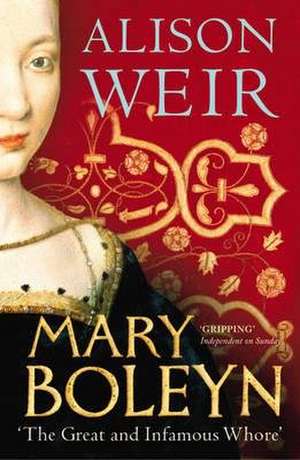
Mary Boleyn
Autor Alison Weiren Limba Engleză Paperback – 20 sep 2012
În secolul al XVI-lea, pe coridoarele umbrite de intrigi ale curții Tudorilor, o femeie pășea tăcută în spatele celei care avea să schimbe istoria Angliei. În timp ce Anne Boleyn își asigura coroana și, ulterior, eșafodul, sora ei, Mary, era deja retrogradată în notele de subsol ale cronicilor vremii drept „marea prostituată”. Ne-a atras atenția modul în care Alison Weir reușește, în acest volum, să curețe straturile de praf și prejudecată de pe imaginea unei femei care a supraviețuit acolo unde alții au pierit. Considerăm că forța acestui volum rezidă în capacitatea autoarei de a transforma o figură marginală într-un protagonist complex, oferind dovezi noi despre paternitatea copiilor săi și despre natura reală a legăturii sale cu Henry al VIII-lea. Subliniem rigoarea analitică prin care Alison Weir deconstruiește miturile create la curtea regelui François I, oferind o perspectivă nuanțată asupra unei supraviețuitoare într-o epocă a bărbaților implacabili. În aceeași familie cu The Other Boleyn Girl de Philippa Gregory, volumul adaugă o bază istorică solidă și factuală acolo unde ficțiunea a preferat speculația romantică. Dacă în The Cardinal sau în Henry VIII: The Heart and the Crown Weir explora mecanismele puterii de la vârful ierarhiei, aici ea alege să privească aceleași evenimente prin ochii unei femei care a cunoscut atât intimitatea regelui, cât și exilul impus de propria familie. Ritmul este cel al unui proces de recuperare istorică, documentat meticulos, dar scris cu o fluență cinematică ce face ca rigoarea academică să devină accesibilă și profund umană.
Preț: 86.99 lei
Preț vechi: 106.78 lei
-19%
Carte disponibilă
Livrare economică 30 octombrie-10 noiembrie
Livrare express 14-20 octombrie pentru 46.30 lei
Specificații
ISBN-10: 0099546485
Pagini: 464
Ilustrații: Illustrations (chiefly col.), ports. (chiefly col.)
Dimensiuni: 131 x 207 x 41 mm
Greutate: 0.36 kg
Editura: Vintage Publishing
V-ar putea interesa
-
 The Other Boleyn GirlPhilippa GregoryPreț: 73.15 lei
 -
 Boleyn TraitorPhilippa GregoryPreț: 118.67 lei
 -
 Elizabeth, the QueenAlison Weir-18%Preț: 89.07 lei108.92 lei
 -
 Anne Boleyn: Fatal AttractionsG. W. BernardPreț: 121.22 lei
 -
 The Lady In The TowerAlison Weir-18%Preț: 87.96 lei107.77 lei
 -
 La Reine BlancheSarah BrysonPreț: 71.58 lei
 -
 Henry VIII's Controversial Aunt, Honor LisleAmy LicencePreț: 188.91 lei
 -
 Murder Most RoyalJean PlaidyPreț: 115.53 lei
 -
 The Life and Death of Anne BoleynEric IvesPreț: 156.14 lei
 -
 The Anne Boleyn PapersElizabeth NortonPreț: 107.10 lei
 -
 In the Footsteps of Anne BoleynNatalie GrueningerPreț: 136.01 lei
 -
 Annne Boleyn A King's ObsessionAlison Weir-25%Preț: 71.32 lei95.03 lei
 -
 Anna of Kleve, Queen of SecretsAlison Weir-24%Preț: 61.35 lei81.00 lei
 -
 Katheryn Howard, The Tainted QueenAlison Weir-25%Preț: 59.46 lei79.46 lei
 -
 Mary I: Queen of SorrowsAlison Weir-24%Preț: 55.57 lei73.17 lei
 -
 Six QueensLydia Monks-31%Preț: 76.47 lei110.40 lei
 -
 Anne Boleyn: 500 Years of LiesHayley NolanPreț: 57.73 lei
 -
 Preț: 144.98 lei
 -
 Anne BoleynElizabeth NortonPreț: 78.59 lei
 -
 Bloody Mary: A Graphic Biography of Mary TudorKristina Gehrmann-15%Preț: 114.57 lei134.67 leiRecomandat
De ce să citești această carte
Recomandăm această biografie cititorilor care doresc să descopere adevărul din spatele ficțiunii istorice. Veți câștiga o înțelegere profundă a dinastiei Tudor prin ochii unei femei care a ales supraviețuirea în detrimentul coroanei. Este o lectură esențială pentru a înțelege cum ambiția unei familii poate sacrifica totul și cum o reputație distrusă de secole poate fi reabilitată prin dovezi istorice concrete.
Despre autor
Alison Weir este unul dintre cei mai respectați istorici britanici contemporani, specializată în biografiile figurilor feminine din dinastiile regale engleze. Cu o carieră începută prin lucrări genealogice precum „Britain's Royal Families”, Weir a devenit celebră pentru capacitatea de a îmbina cercetarea arhivistică riguroasă cu un stil narativ captivant. Opera sa cuprinde atât lucrări de non-ficțiune despre reginele medievale și familia lui Henry al VIII-lea, cât și romane istorice de succes. Prin volumul de față, ea își continuă misiunea de a oferi voce femeilor din umbra istoriei, aplicând aceeași metodă de analiză forensică pe care a folosit-o și în studiile despre Eleanor de Aquitaine sau Elizabeth de York.
Notă biografică
Descriere scurtă
Sister to Anne Boleyn and seduced by two kings, Mary Boleyn has long been the subject of scandal and myth. Her affair with Henry VIII fuelled the shocking annulment of his marriage to Anne, and Mary is rumoured to have borne his child in secret.
In this, the first full-length biography of Mary Boleyn, Alison Weir explodes much of the mythology that surrounds her subject's notoriety. Her extensive research gives us a new and detailed portrayal, revealing Mary as one of hte most misunderstood figures of the Tudor age.
From the internationally bestselling author of Eleanor of Aquitaine.
Extras
The Eldest Daughter
Blickling Hall, one of England's greatest Jacobean showpiece mansions, lies not two miles northwest of Aylsham in Norfolk. It is a beautiful place, surrounded by woods, farms, sweeping parkland and gardens- gardens that were old in the fifteenth century, and which once surrounded the fifteenth century moated manor house of the Boleyn family, the predecessor of the present building. That house is long gone, but it was in its day the cradle of a remarkable dynasty; and here, in those ancient gardens, and within the mellow, red-brick gabled house, in the dawning years of the sixteenth century, the three children who were its brightest scions once played in the spacious and halcyon summers of their early childhood, long before they made their dramatic debut on the stage of history: Anne Boleyn, who would one day become Queen of England; her brother George Boleyn, who would also court fame and glory, but who would ultimately share his sister's tragic and brutal fate; and their sister Mary Boleyn, who would become the mistress of kings, and gain a notoriety that is almost certainly undeserved.
Blickling was where the Boleyn siblings' lives probably began, the protective setting for their infant years, nestling in the broad, rolling landscape of Norfolk, circled by a wilderness of woodland sprinkled with myriad flowers such as bluebells, meadowsweet, loosestrife, and marsh orchids, and swept by the eastern winds. Norfolk was the land that shaped them, that remote corner of England that had grown prosperous through the wool-cloth trade, its chief city, Norwich-which lay just a few miles to the south-being second in size only to London in the Boleyns' time. Norfolk also boasted more churches than any other English shire, miles of beautiful coastline and a countryside and waterways teeming with a wealth of wildlife. Here, at Blickling, nine miles from the sea, the Boleyn children took their first steps, learned early on that they had been born into an important and rising family, and began their first lessons.
Anne and George Boleyn were to take center-stage roles in the play of England's history. By comparison, Mary was left in the wings, with fame and fortune always eluding her. Instead, she is remembered as an infamous whore. And yet, of those three Boleyn siblings, she was ultimately the luckiest, and the most happy.
This is Mary's story.
Mary Boleyn has aptly been described as "a young lady of both breeding and lineage." She was born of a prosperous landed Norfolk family of the knightly class. The Boleyns, whom Anne Boleyn claimed were originally of French extraction, were settled at Salle, near Aylsham, before 1283, when the register of Walsingham Abbey records a John Boleyne living there, but the family can be traced in Norfolk back to the reign of Henry II (1154-89). The earliest Boleyn inscription in the Salle church is to John's great-great-grandson, Thomas Boleyn, who died in 1411; he was the son of another John Boleyn and related to Ralph Boleyn, who was living in 1402. Several other early members of the family, including Mary's great-great-grandparents, Geoffrey and Alice Boleyn, were buried in the Salle church, which is like a small cathedral, rising tall and stately in its perpendicular splendor in the flat Norfolk landscape. The prosperous village it once served, which thrived upon the profitable wool trade with the Low Countries, has mostly disappeared.
The surname Boleyn was spelled in several ways, there being no uniformity in spelling in former times, when it was given as Boleyn, Boleyne, Bolleyne, Bollegne, Boleigne, Bolen, Bullen, Boulen, Boullant, or Boullan, the French form. The bulls' heads on the family coat of arms are a pun on the name. In adult life Anne Boleyn used the modern form adopted in this text. Unfortunately, we don't know how Mary Boleyn spelled her surname, as only two letters of hers survive, both signed with her married name.
The Boleyn family had once been tenant farmers, but the source of their wealth and standing was trade. Thomas's grandson, Sir Geoffrey Boleyn, made his fortune in the City of London as a member and then Master of the Worshipful Company of Mercers (1454); he was Sheriff of London from 1446-47; MP for London in 1449; and an alderman of the City of London from 1452 (an office he held for eleven years). In 1457 he was elected Lord Mayor. By then he had made his fortune; his wealth had enabled him to marry into the nobility, his wife being Anne, daughter and co-heiress of Thomas, Lord Hoo and Hastings, and she brought him great estates. Stow records that Sir Geoffrey "gave liberally to the prisons, hospitals and lazar houses, besides a thousand pounds to poor householders in London, and two hundred pounds to [those] in Norfolk." He was knighted by Henry VI before 1461.
In 1452 (or 1450), Geoffrey had purchased the manor of Blickling in Norfolk from his friend and patron, Sir John Fastolf. The manor had once been the property of the eleventh century Saxon king, Harold Godwineson, and the original manor house on the site had been built in the 1390s by Sir Nicholas Dagworth, but it was evidently outdated or in poor repair, because-as has recently been discovered-it was rebuilt as Blickling Hall, "a fair house" of red brick, by Geoffrey Boleyn. Geoffrey also built the chapel of St. Thomas in Blickling church, and adorned it with beautiful stained glass incorporating the heraldic arms of himself and his wife, which still survives today; in his will, he asked to be buried there if he departed this life at Blickling. In the event, he died in London.
Ten years later, in 1462, Geoffrey bought the manors of Hever Cobham and Hever Brokays in Kent from William Fiennes, Lord Saye and Sele, as well as thirteenth century Hever Castle from Sir Thomas Cobham. Sir Geoffrey now moved in the same social circles as the prosperous Paston family (Norfolk neighbors who knew the Boleyns well, and whose surviving letters tell us so much about fifteenth century life), the Norfolk gentry, and even the exalted Howards, who were descended from King Edward I, and at the head of whose house was John Howard, first Duke of Norfolk; the friendship between the Boleyns and the Howards, which would later be cemented by marriage, dated from at least 1469.
When he died in 1463, Geoffrey was buried in the church of St. Lawrence Jewry by the Guildhall in London. His heir, Thomas Boleyn of Salle, was buried there beside him in 1471, when the family wealth and estates passed to Geoffrey's second son, William Boleyn, Mary's grandfather, who had been born around 1451; he was "aged 36 or more" in the inquisition postmortem on his cousin, Thomas Hoo, taken in October 1487.
The Boleyns had arrived; they were what would soon become known as new men, those who had risen to prominence through wealth, wedlock, and ability. William Boleyn, who-like his father-had supported the House of York during the Wars of the Roses, was dubbed a Knight of the Bath at Richard III's coronation in July 1483, became a Justice of the Peace, and made an even more impressive marriage than his father, to Margaret Butler, who had been born sometime prior to 1465, the younger daughter and co-heiress of Thomas Butler, 7th Earl of Ormond.
The Butlers were an ancient Anglo-Norman family, whose surname derived from the office of butler (an official who was responsible for the provisioning of wine), which their ancestor, Theobald Walter, had borne in the household of the future King John in 1185. They too were descended from Edward I, and had been earls of Ormond since 1329. Thomas Butler was one of the wealthiest peers; he had inherited a fortune of £40,000 (£20 million), and was lord of no fewer than seventy-two manors in England. He sat in Parliament as the premier baron and served as English ambassador to the courts of France and Burgundy. His wife was Anne, daughter and heiress of a rich knight, Sir Richard Hankeford.
Before he had come into his inheritance in 1477, Butler had been chronically short of money, and Sir William Boleyn and his mother had continually come to the rescue; Butler repaid his debts with the hand of his daughter, and a dowry that would handsomely enrich the Boleyn family.
Lady Margaret Butler bore Sir William Boleyn eleven children, of whom there were four surviving sons: Thomas, James, William, and Edward. Thomas was the eldest, being born in 1477, when his mother was probably quite young, although perhaps not as young as twelve, as her mother's inquisition postmortem suggests. After Richard III, the last Plantagenet monarch, was killed at the Battle of Bosworth in 1485, the Boleyns prudently switched their allegiance to the new Tudor dynasty; in 1490, Sir William was appointed Sheriff of Kent, by which time he was probably dividing his time between Blickling and Hever. King Henry VII, the first Tudor sovereign, demonstrated his trust in him by making him responsible for keeping the peace in his locale, delivering prisoners to the assizes, and placing and guarding the beacons that would herald the approach of the King's enemies, giving William a commission of array against an invasion by the French, and appointing him Sheriff of Norfolk in 1501. The next year he was made the third of only four Barons of the Exchequer, who sat as judges in the Court of the Exchequer.
In 1497, Sir William Boleyn and his son Thomas, now twenty, fought for King Henry VII against the rebels of Cornwall, who had risen in protest against excessive taxation. Again and again the Boleyn family would demonstrate its solid loyalty to the Crown, and in so doing would win the notice and favor of the Tudor kings, Henry VII and Henry VIII, who valued "new men" who had risen to prominence through trade and the acquisition of wealth, as opposed to the older nobility, whose power, hitherto boosted by private armies, they strove to keep in check.
The detail in Thomas Boleyn's tomb brass suggests that some attempt was made to reflect his true appearance. It is the image of a dignified man with the long face, high cheekbones, and pointed chin that were inherited by his daughter Anne and his grandson, Lord Hunsdon. He has strong features, wavy hair cut straight at chin level, and the hint of a close-cropped beard. His coat of arms, sporting three bulls' heads, while being a play on his name, also symbolized his valor, bravery, and generosity. In the case of the latter, it was little more than flattery.
Thomas was a gifted linguist, more fluent in French than any other courtier, and proficient at Latin; he was also an expert jouster, and these were talents that would make him admired and useful at court. The celebrated humanist scholar Desiderius Erasmus, thought him "outstandingly learned," and was to dedicate two books to him, one of which was a commentary on the Psalms, in which Thomas Boleyn had shown an interest.
Thomas was to prove a highly able and hardworking statesman and diplomat, and Henry VIII himself would say that there was no skilled negotiator to equal him. He was adept at dealing with his royal master, whose liking for him seems never to have died. Yet although normally affable, even congenial, Thomas Boleyn could also be chillingly dispassionate, brusque, and even insolent, as he showed when on a crucial diplomatic mission to the Holy Roman Emperor in 1530; and when, during an embassy in Rome, the Pope-as was customary- offered his toe to be kissed, and Boleyn's spaniel bit it, Boleyn refused to kiss it because his dog had defiled it, and so compromised his good relations with the Vatican.
Although hardworking and diligent, Thomas Boleyn's besetting vices-by all accounts-were selfishness and avarice; "he could not risk the temptation of money." It was to be said of him that "he would sooner act from interest than from any other motive," and never was that more apparent than when he showed himself willing to participate in the destruction of two of his children in order to protect himself and salvage his own position and career.
Following in the tradition of his father and grandfather, Thomas Boleyn made a great marriage to Lady Elizabeth Howard, the eldest daughter of Thomas Howard, Earl of Surrey. Surrey was the son of John Howard, Duke of Norfolk, who had been killed at the Battle of Bosworth fighting on the wrong side for Richard III. Henry VII had declared the title forfeit and cast the heir into prison, but Thomas Howard gradually recovered royal favor and prospered, with the earldom of Surrey being returned to him just four years later, in 1489, and the dukedom of Norfolk in 1514. Had the Howard fortunes not suffered such a reverse, Master Thomas Boleyn might not have gained such a prize as a Howard bride, even though he was the heir to an impressive landed inheritance and the families were on good terms. Elizabeth was a brilliant match for him, and marriage to her made this ambitious esquire brother-in-law to the sister of the Queen of England, for Elizabeth's brother, another Thomas Howard (who succeeded his father as the third Duke of Norfolk in 1524), had, in 1495, married Edward IV's daughter, Anne Plantagenet; Anne's sister Elizabeth was Henry VII's queen and the mother of the future Henry VIII.
The young Elizabeth Howard was very pretty-in his verses dedicated "To My Lady Elizabeth Howard," the court poet John Skelton compared her to the mythical Trojan beauty Cressida, whose looks far outshone those of the radiant Polyxena, youngest daughter of Priam, King of Troy, and sister of Troilus, whom Cressida was to betray:
To be your remembrancer, Madam, I am bound:
Like unto Irene maidenly of porte [bearing],
Of virtue and cunning the well and perfect ground,
Whom Dame Nature, as well I may report,
Hath freshly enbeautied with many a goodly sort
Of womanly features: whose flourishing tender age
Is lusty to look on, pleasant, demure and sage.
Goodly Cressida, fairer than Polyxena,
For to envy Pandarus' appetite:
Troilus, I vow, if that he had you seen,
In you he would have set his whole delight:
Of all your beauty I suffice not to write,
But, as I said, your flourishing tender age
Is lusty to look on, pleasant, demure and sage.
In comparing Elizabeth with the artist Irene, the gifted daughter and pupil of the Greek painter Cratinus (to whom Boccaccio refers in his book Famous Women), Skelton is perhaps implying that she had some artistic talent herself.
In the poem in which these verses appear, "The Garland of the Laurel" (1523), Skelton describes a visit he made to Sheriff Hutton Castle as the guest of Elizabeth's father, Thomas Howard, Earl of Surrey. In the course of it, the countess, Elizabeth Tylney, was so impressed with Skelton's poetry that, at her behest, her daughters, Lady Elizabeth and Lady Muriel, with some other ladies-Lady Anne Dacre of the South, Mistress Margery Wentworth (who would marry Sir John Seymour and become the mother of Henry VIII's third wife, Jane Seymour), and Margaret Brewes, the wife of Sir Philip Tylney (Surrey's auditor and steward of Framlingham Castle)-made for him a laureate's garland of silk, gold, and pearls in honor of his talent. No one could then have dreamed that two of these young ladies would give birth to future queens of England.
From the Hardcover edition.
Recenzii
“Weir has achieved the enviable skill of blending the necessary forensic and analytical tasks of academia with the passionate engagement that avocational history lovers crave.”—Bookreporter
“Top-notch . . . This book further proves that [Weir] is a historian of the highest caliber.”—Washington Independent Review of Books
“Weir matches her usual professional skills in research and interpretation to her customary, felicitous style.”—Booklist