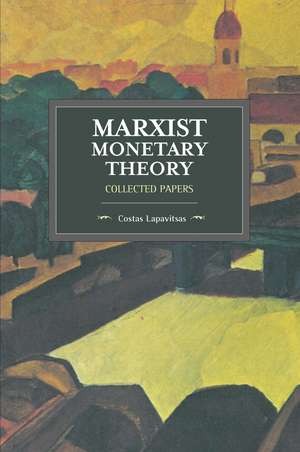
Marxist Monetary Theory
Autor Costas Lapavitsasen Limba Engleză Paperback – 26 dec 2017
Preț: 233.39 lei
Puncte Express: 350
Carte tipărită la comandă
Livrare economică 20 noiembrie-04 decembrie
Livrare prin curier în România Termenul estimat este afișat lângă disponibilitate.
Transport gratuit de la 400.00 lei Plată online sau ramburs, în funcție de opțiunile comenzii.
Retur gratuit în 14 zile Comandă securizată și suport în română.
Specificații
ISBN-13: 9781608468300
ISBN-10: 1608468305
Pagini: 336
Dimensiuni: 153 x 228 x 20 mm
Greutate: 0.47 kg
Editura: Haymarket Books
Locul publicării:United Kingdom
ISBN-10: 1608468305
Pagini: 336
Dimensiuni: 153 x 228 x 20 mm
Greutate: 0.47 kg
Editura: Haymarket Books
Locul publicării:United Kingdom
V-ar putea interesa
-
 Re-Imagining CapitalismDominic Barton-10%Preț: 366.89 lei409.63 lei
 -
 -15%Preț: 433.41 lei509.90 lei
 -
 State and Capital in Independent IndiaChirashree Das Gupta-24%Preț: 493.69 lei646.28 lei
 -
 The Politics of EU-China Economic RelationsJohn Farnell-15%Preț: 661.92 lei778.72 lei
 -
 Transnational Governance and South American PoliticsAlejandro M. Peña-15%Preț: 620.36 lei729.83 lei
 -
 Offshore Finance and Global GovernanceWilliam Vlcek-18%Preț: 891.20 lei1086.82 lei
 -
 The Political Economy of DisneyAlexandre Bohas-15%Preț: 699.39 lei822.81 lei
 -
 Models of Capitalism in the European UnionBeáta Farkas-15%Preț: 632.52 lei744.14 lei
 -
 -18%Preț: 713.80 lei870.48 lei
 -
 Social Foundations of Markets, Money and CreditCostas Lapavitsas-15%Preț: 459.20 lei540.23 lei
 -
 Understanding Small-Island Developing States: Fragility and External ShocksAmelia Santos-PaulinoPreț: 456.35 lei
 -
 Preț: 97.25 lei
 -
 Marx's Economic Manuscript of 1864-1865Fred MoseleyPreț: 514.63 lei
 -
 Money and TotalityFred MoseleyPreț: 311.62 lei
 -
 Finance Capital TodayFrançois ChesnaisPreț: 232.86 lei
 -
 Marx WorldwideCentre for Civil SocietyPreț: 272.48 lei
 -
 Profiting Without ProducingCostas LapavitsasPreț: 286.91 lei
 -
 -17%Preț: 166.00 lei199.57 lei
 -
 Voting ExperimentsAndré Blais-15%Preț: 708.57 lei833.61 lei
 -
 Self-determinable Development of Small IslandsMasahide Ishihara-15%Preț: 650.92 lei765.78 lei
Notă biografică
Costas Lapavitsasis is Professor of Economics at SOAS. He has published widely on money and finance, the Japanese economy, and the Eurozone. He writes often for the international press and his most recent books are Profiting Without Producing (Verso, 2013) and Against the Troika (Verso, 2015, with H. Flassbeck).
Cuprins
Preface
1. Money as Art: The Form, the Material, and Capital
PART I: THE FORMS, THE FUNCTIONS AND THE QUANTITY OF MONEY
2. The Theory of Credit Money: A Structural Analysis
3. The Banking School and the Monetary Thought of Karl Marx
4. The Classical Adjustment Mechanism of International Balances: Marx’s Critique
5. Money and the Analysis of Capitalism: The Significance of Commodity Money
PART II: CREDIT, INTEREST-BEARING CAPITAL, AND THE HOARDING OF MONEY
6. Two Approaches to the Concept of Interest-Bearing Capital
7. On Marx’s Analysis of Money Hoarding in the Turnover of Capital
PART III: THE ORIGIN OF MONEY AND THE NATURE OF COMMODITIES
8. Commodities and Gifts: Why Commodities Represent More than Market Relations
9. The Emergence of Money in Commodity Exchange, or Money as Monopolist of the Ability to Buy
10. The Social Relations of Money as Universal Equivalent: A Response to Ingham
PART IV: THE COMPLEX REALITY OF CONTEMPORARY MONEY
11. Relations of Power and Trust in Contemporary Finance
12. The Monetary Basis of Financialised Capitalism
Bibliography
Index
1. Money as Art: The Form, the Material, and Capital
PART I: THE FORMS, THE FUNCTIONS AND THE QUANTITY OF MONEY
2. The Theory of Credit Money: A Structural Analysis
3. The Banking School and the Monetary Thought of Karl Marx
4. The Classical Adjustment Mechanism of International Balances: Marx’s Critique
5. Money and the Analysis of Capitalism: The Significance of Commodity Money
PART II: CREDIT, INTEREST-BEARING CAPITAL, AND THE HOARDING OF MONEY
6. Two Approaches to the Concept of Interest-Bearing Capital
7. On Marx’s Analysis of Money Hoarding in the Turnover of Capital
PART III: THE ORIGIN OF MONEY AND THE NATURE OF COMMODITIES
8. Commodities and Gifts: Why Commodities Represent More than Market Relations
9. The Emergence of Money in Commodity Exchange, or Money as Monopolist of the Ability to Buy
10. The Social Relations of Money as Universal Equivalent: A Response to Ingham
PART IV: THE COMPLEX REALITY OF CONTEMPORARY MONEY
11. Relations of Power and Trust in Contemporary Finance
12. The Monetary Basis of Financialised Capitalism
Bibliography
Index
Recenzii
"The Wolfson Lecture Theatre (Senate House) was full and lively as Costas led off the afternoon by putting Marx’s analysis of ‘the universal equivalent’ to work in explaining money today in the current conjuncture and its role in overthrowing capitalism. His emphasis was more on the forms than the functions money has taken: commodity money (gold), simple fiat money, credit money, central bank fiat money and electronic monies. Costas foregrounded four ‘stylised facts’ of our current system: first, legal inconvertibility after 1971–1973; second, the quantitative dominance of credit money within the sphere of domestic money; third, the qualitative significance of legal tender as central bank created fiat money; and fourth, the pre-eminence of inconvertible legal tender from a small number of central banks forming international money. Furthermore, Costas made a significant comparison between Bitcoin and gold. [...] As Costas points out in this new book: ‘There is an ideology of money in capitalist society that is similar to religion in both its falseness and necessity.’ I have a firm opinion that everyone on the Left needs to better acknowledge the worth of understanding money as a concept and set of processes, in order to better appreciate money as a weapon of control and to actively resist the power of money to substitute for substantive democracy and genuine governance. Internationally, money is remarkably potent. In his talk, Costas emphasised it as ‘a lever for hierarchy among states’; our global history cannot be told without reference to the British pound, the US dollar and, more recently the €uro — as shown in the sorry story of Syriza’s reign in Greece. So, too, it becomes ‘a mechanism to entrench commercial advantage’ and ‘exercises power over entire societies through fear and identity’." – Anitra Nelson, Progress in Political Economy