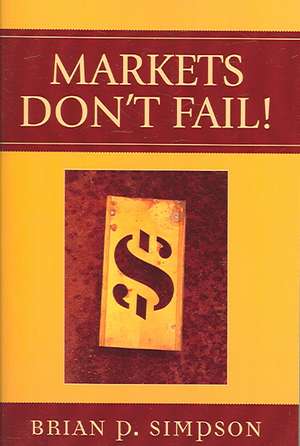
Markets Don't Fail!
Autor Brian P. Simpsonen Limba Engleză Paperback – noi 2005
Preț: 307.35 lei
Preț vechi: 407.44 lei
-25%
Puncte Express: 461
Carte tipărită la comandă
Livrare economică 01-15 decembrie
Livrare prin curier în România Termenul estimat este afișat lângă disponibilitate.
Transport gratuit de la 400.00 lei Plată online sau ramburs, în funcție de opțiunile comenzii.
Retur gratuit în 14 zile Comandă securizată și suport în română.
Specificații
ISBN-13: 9780739113646
ISBN-10: 073911364X
Pagini: 221
Dimensiuni: 152 x 216 x 19 mm
Greutate: 0.36 kg
Editura: Bloomsbury Publishing
Colecția Lexington Books
Locul publicării:New York, United States
ISBN-10: 073911364X
Pagini: 221
Dimensiuni: 152 x 216 x 19 mm
Greutate: 0.36 kg
Editura: Bloomsbury Publishing
Colecția Lexington Books
Locul publicării:New York, United States
V-ar putea interesa
-
 Central Banking in Eastern EuropeBarry HarrisonPreț: 468.40 lei
 -
 Global - Una novela sobre el mundo financieroIsabel AlbaPreț: 217.88 lei
 -
 Preț: 366.91 lei
 -
 Becoming a Professional Human BeingJim BagnolaPreț: 168.49 lei
 -
 The Power of Sales AnalyticsAndris A. Zoltners,Preț: 187.88 lei
 -
 Access to AsiaSharon SchweitzerPreț: 187.86 lei
 -
 One Plus One Equals ThreeDave Trott-34%Preț: 51.48 lei78.57 lei
 -
 On the BrinkHenry M. PaulsonPreț: 144.52 lei
Cuprins
Chapter 1 Capitalism, Socialism, and the Mixed Economy
Chapter 2 Monopoly
Chapter 3 The Antitrust Laws and Predatory Pricing
Chapter 4 Externalities
Chapter 5 Regulation of Safety and Quality
Chapter 6 Environmentalism
Chapter 7 Economic Inequality
Chapter 8 Public Goods
Chapter 9 Asymmetric Information
Chapter 10 Epilogue
Chapter 2 Monopoly
Chapter 3 The Antitrust Laws and Predatory Pricing
Chapter 4 Externalities
Chapter 5 Regulation of Safety and Quality
Chapter 6 Environmentalism
Chapter 7 Economic Inequality
Chapter 8 Public Goods
Chapter 9 Asymmetric Information
Chapter 10 Epilogue
Recenzii
Markets Don't Fail! is akin to works such as Henry Hazlitt's Economics in One Lesson, or Frederic Bastiat's The Law, not only in terms of the free market ideas it espouses, but also given its clear writing style, its reasonable length, and its staunch defense of unregulated economic activity. This book is a significant contribution in economics. It is the first and only such book written from the perspective of Objectivism, the philosophy of Ayn Rand, which has provided a strong impetus for a revival of classical liberalism, based on individual rights and limited government. The writer has remained focused on his defense of markets on the basis of individualism. He has used sound scholarship to advance his case and he clearly knows the material and, thankfully does not burden the text with footnotes for the sake of footnotes. This is the only contemporary text that has taken this approach and is accessible to the beginning student.
Too many economics textbooks allege instances of market failure and call for government intervention while ignoring government failure. Markets Don't Fail! demolishes allegations of market failure and demonstrates that . . . market allocation of resources is the superior alternative.
A skillful blending of economics with its foundations in philosophy....This book defends the market economy against the many attacks made today by contemporary economists. Ranging from the theory of economic monopoly and its basis in the doctrine of pure and perfect competition to the theory of asymmetric information, the author point by point thoroughly demolishes the myriad varieties of alleged market failure.
This is a rare book on economics that grounds its support of a free market in an explicit code of morality--the ethics of rational egoism. The intellectual support of capitalism requires more such books.....
Recommended.
This book is a refreshingly clear text that illustrates the real-world benefits of laissez-faire capitalism. Dr. Simpson uses powerful logical arguments and illustrative examples to make a bulletproof case for the free market. He provides an easily understandable description of competition and monopoly, and shows that monopolies cannot arise in the free market. Dr. Simpson does an excellent job explaining a complex topic that involves so many issues. More importantly, he succeeds in convincing people of the validity of his claims. Everyone should own a copy of Markets Don't Fail! if they want to make sense of the crucial issues concerning the free market.
So expertly written as to be accessible for even the non-specialist general reader with an interest in how free markets work, and concluding with an epilogue, Markets Don't Fail! is enhanced with a substantive bibliography and a comprehensive index.
Simpson's book is a most valuable contribution and I recommend it to all students of economics. Simpson is a gifted student of George Reisman, and he has been much influenced by Reisman's great treatise Capitalism.
Too many economics textbooks allege instances of market failure and call for government intervention while ignoring government failure. Markets Don't Fail! demolishes allegations of market failure and demonstrates that . . . market allocation of resources is the superior alternative.
A skillful blending of economics with its foundations in philosophy....This book defends the market economy against the many attacks made today by contemporary economists. Ranging from the theory of economic monopoly and its basis in the doctrine of pure and perfect competition to the theory of asymmetric information, the author point by point thoroughly demolishes the myriad varieties of alleged market failure.
This is a rare book on economics that grounds its support of a free market in an explicit code of morality--the ethics of rational egoism. The intellectual support of capitalism requires more such books.....
Recommended.
This book is a refreshingly clear text that illustrates the real-world benefits of laissez-faire capitalism. Dr. Simpson uses powerful logical arguments and illustrative examples to make a bulletproof case for the free market. He provides an easily understandable description of competition and monopoly, and shows that monopolies cannot arise in the free market. Dr. Simpson does an excellent job explaining a complex topic that involves so many issues. More importantly, he succeeds in convincing people of the validity of his claims. Everyone should own a copy of Markets Don't Fail! if they want to make sense of the crucial issues concerning the free market.
So expertly written as to be accessible for even the non-specialist general reader with an interest in how free markets work, and concluding with an epilogue, Markets Don't Fail! is enhanced with a substantive bibliography and a comprehensive index.
Simpson's book is a most valuable contribution and I recommend it to all students of economics. Simpson is a gifted student of George Reisman, and he has been much influenced by Reisman's great treatise Capitalism.