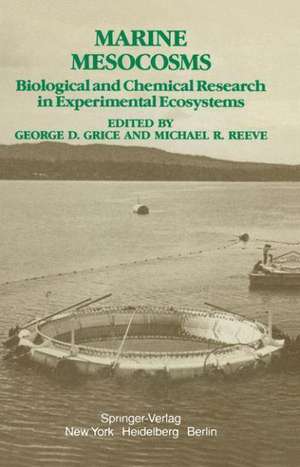
Marine Mesocosms: Biological and Chemical Research in Experimental Ecosystems
Editat de G.D. Grice, M.R. Reeveen Limba Engleză Paperback – 27 dec 2011
Preț: 622.91 lei
Preț vechi: 732.83 lei
-15%
Puncte Express: 934
Carte tipărită la comandă
Livrare economică 24 noiembrie-08 decembrie
Livrare prin curier în România Termenul estimat este afișat lângă disponibilitate.
Transport gratuit pentru acest produs Plată online sau ramburs, în funcție de opțiunile comenzii.
Retur gratuit în 14 zile Comandă securizată și suport în română.
Specificații
ISBN-13: 9781461256472
ISBN-10: 146125647X
Pagini: 448
Ilustrații: 430 p.
Dimensiuni: 155 x 235 x 27 mm
Greutate: 0.63 kg
Ediția:Softcover reprint of the original 1st ed. 1982
Editura: Springer
Colecția Springer
Locul publicării:New York, NY, United States
ISBN-10: 146125647X
Pagini: 448
Ilustrații: 430 p.
Dimensiuni: 155 x 235 x 27 mm
Greutate: 0.63 kg
Ediția:Softcover reprint of the original 1st ed. 1982
Editura: Springer
Colecția Springer
Locul publicării:New York, NY, United States
V-ar putea interesa
-
 -18%Preț: 353.24 lei431.21 lei
 -
 Ecological Networks: Linking Structure to Dynamics in Food WebsMercedes Pascual-31%Preț: 694.78 lei1002.54 lei
 -
 The Estuarine Ecosystem: Ecology, Threats and ManagementDonald S. McLusky-22%Preț: 479.58 lei618.80 lei
 -
 The Biology of Temporary WatersD. Dudley Williams-22%Preț: 528.29 lei679.94 lei
 -
 Fundamental Processes in Ecology: An Earth Systems ApproachDavid M. Wilkinson-21%Preț: 293.37 lei370.30 lei
 -
 Ecology of Aquatic SystemsMichael Dobson-21%Preț: 404.36 lei509.01 lei
 -
 The Biology of Polar RegionsD.N. Thomas-22%Preț: 475.76 lei611.91 lei
 -
 Allee Effects in Ecology and ConservationFranck Courchamp-26%Preț: 426.03 lei575.06 lei
 -
 Aquatic EcosystemsNicholas V. C. Polunin-14%Preț: 1084.83 lei1261.43 lei
 -
 Ecological Developmental BiologyScott F. GilbertPreț: 384.26 lei
 -
 Reintroduction BiologyJohn G Ewen-8%Preț: 465.98 lei506.49 lei
 -
 Preț: 427.21 lei
 -
 Marine Conservation EcologyJohn Roff-15%Preț: 584.04 lei687.10 lei
 -
 The Ecology of Browsing and GrazingIain J. Gordon-18%Preț: 922.01 lei1124.41 lei
 -
 How Likely is Extraterrestrial Life?J. Woods HalleyPreț: 382.81 lei
Public țintă
ResearchCuprins
o.- 1 Introduction and Description of Experimental Ecosystems.- 2 Experimental Marine Ecosystem Enclosures in a Historical Perspective.- 3 Application of Enclosures to the Study of Marine Pelagic Systems.- 4 Application of Enclosures to Studies on the Early Life History of Fishes.- 5 Application of Enclosures to the Study of Ocean Chemistry.- 6 Radiotracers in Studies of Trace Metal Behavior in Mesocosms: Advantages and Limitations.- 7 Natural Radionuclides as Tracers for Geochemical Processes in MERL Mesocosms and Narragansett Bay.- 8 Controlled Marine Ecosystems-A Tool for Studying Stable Trace Metal Cycles: Long-Term Response and Variability.- 9 Fate of Radiolabeled Polycyclic Aromatic Hydrocarbons and Pentachlorophenol in Enclosed Marine Ecosystems.- 10 Biogeochemistry of Volatile Organic Compounds in Marine Experimental Ecosystems and the Estuarine Environment-Initial Results.- 11 The Use of Experimental Ecosystems for Evaluating the Environmental Impact of Pollutants: A Comparison of an Oil Spill in the Baltic Sea and Two Long-Term, Low-Level Oil Addition Experiments in Mesocosms.- 12 Processes Affecting the Movement and Speciation of Mercury in the Marine Environment.- 13 Ecotoxicological Experiments with Marine Plankton Communities in Plastic Bags.- 14 Plankton Spring Development in a South Norwegian Fjord.- 15 The Plankton Tower. IV. Interactions Between Water Column and Sediment in Enclosure Experiments in Kiel Bight Victor Smetacek, Bodo von Bodungen, Bastiaan Knoppers,.- 16 Replication in Controlled Marine Systems: Presenting the Evidence.- 17 Predator Control in Enclosures.- 18 Food and Growth of Juvenile Herring, Clupea harengus pallasi, in CEPEX Enclosures.- 19 Sedimentation of Phytoplankton Cells Within Controlled Experimental Ecosystems Following Launching, and Implications for Further Enclosure Studies.- 20 Phytoplankton Sinking-Rate Dynamics in Enclosed Experimental Ecosystems.- 21 The Manipulation of Physical, Chemical, and Biological Factors to Select Species from Natural Phytoplankton Communities.- 22 The Use of Enclosed Experimental Ecosystems to Study Nitrogen Dynamics in Coastal Waters.- 23 Microbial Contribution to Overall Plankton Community Respiration-Studies in Enclosures.- 24 The Importance of Understanding Phytoplankton Life Strategies in the Design of Enclosure Experiments.- 25 Phytoplankton Species' Responses to Nutrient Changes in Experimental Enclosures and Coastal Waters.- 26 The Population Biology of the Larvacean Oikopleura dioica in Enclosed Water Columns.- 27 Trophic Interactions and Production Processes in Natural Zooplankton Communities in Enclosed Water Columns.- 28 The CEPEX Approach and Its Implications for Future Studies in Plankton Ecology.- 29 How Can Enclosing Seawater Liberate Biological Oceanographers?.- 30 The Future of Controlled Ecosystem Enclosure Experiments.