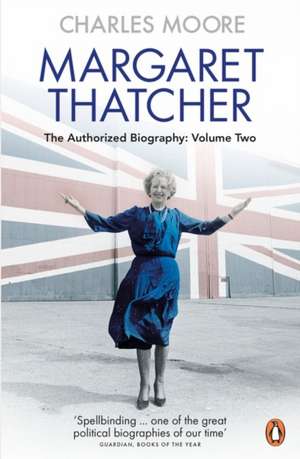
Margaret Thatcher
Autor Charles Mooreen Limba Engleză Paperback – 6 oct 2016
Bazându-ne pe arhivele private și documentele guvernamentale declasificate, subliniem că acest al doilea volum al biografiei autorizate scrise de Charles Moore reprezintă standardul academic pentru analiza perioadei de apogeu a „Doamnei de Fier”. Lucrarea documentează intervalul crucial dintre 1983 și 1987, marcat de cea mai mare majoritate parlamentară din istoria electorală britanică și de transformări structurale profunde, precum privatizarea industriilor strategice și gestionarea grevei minerilor. Credem că valoarea acestui volum rezidă în accesul intim la procesul decizional; cititorul o observă pe Thatcher adnotând documente și navigând crize politice majore, de la afacerea Westland la relația tensionată cu Regina pe tema Commonwealth-ului. Spre deosebire de abordările anterioare ale autorului, care au inclus subiecte diverse precum misticismul în Sadhu Sundar Singh sau arta contemporană în 24-HOUR INTERVIEW, această biografie demonstrează o rigoare istorică excepțională și o capacitate de a sintetiza complexitatea politicii globale. Suntem de părere că portretul oferit este unul de o onestitate brutală, capturând atât geniul politic care a identificat în Mihail Gorbaciov un partener de dialog, cât și defectele care au început să îi erodeze autoritatea internă, precum introducerea taxei locale (poll tax). Ca alternativă la Thatcher de Graham Goodlad pentru cursurile de științe politice sau istorie contemporană, acest volum oferă avantajul unei perspective „din interior”, transformând datele brute din interviuri și corespondență într-o narațiune cu o imensa forță dramatică. În timp ce The Iron Lady de John Campbell oferă o sinteză excelentă a întregii cariere, lucrarea lui Moore excelează prin detaliul microscopic asupra anilor în care Marea Britanie a redevenit un jucător central pe scena mondială.
Preț: 114.20 lei
Preț vechi: 137.66 lei
-17%
Carte disponibilă
Livrare economică 13-24 noiembrie
Livrare express 27-31 octombrie pentru 63.09 lei
Specificații
ISBN-10: 0140279628
Pagini: 880
Ilustrații: 32pp b/w illustrations
Dimensiuni: 126 x 198 x 43 mm
Greutate: 0.64 kg
Editura: Vintage Publishing
Locul publicării:London, United Kingdom
V-ar putea interesa
-
 StatecraftMargaret ThatcherPreț: 143.50 lei
 -
 The Path to PowerMargaret ThatcherPreț: 143.86 lei
 -
 The Downing Street YearsMargaret ThatcherPreț: 145.22 lei
 -
 The ChancellorKati MartonPreț: 79.75 lei
 -
 Margaret ThatcherMargaret ThatcherPreț: 151.98 lei
 -
 Iron LadyJohn Campbell-19%Preț: 100.17 lei122.98 lei
 -
 Maggie - The First Lady: The woman behind the titleBrenda Maddox-27%Preț: 68.21 lei93.03 lei
 -
 Not for TurningRobin Harris-19%Preț: 98.45 lei120.95 lei
 -
 Angela MerkelMatthew Qvortrup-19%Preț: 73.20 lei90.34 lei
 -
 FranklyNicola Sturgeon-30%Preț: 89.39 lei127.46 lei
 -
 A Different Kind of PowerJacinda ArdernPreț: 123.57 lei
 -
 -25%Preț: 92.41 lei122.72 lei
 -
 Thatcher’s Trial: Six Months That Defined a LeaderKwasi Kwarteng-29%Preț: 72.89 lei101.98 lei
 -
 Theresa MayRosa PrincePreț: 77.71 lei
 -
 People Like UsCaroline SlocockPreț: 72.96 lei
 -
 Inside Thatcher's Last ElectionDavid YoungPreț: 143.58 lei
 -
 Margaret ThatcherPeter JustPreț: 187.97 lei
 -
 Memories of Margaret ThatcherIain DalePreț: 107.36 lei
 -
 ThatcherClare Beckett-22%Preț: 74.90 lei96.03 lei
De ce să citești această carte
Recomandăm această carte oricărui cititor interesat de mecanismele puterii și de istoria politică a secolului XX. Veți câștiga o înțelegere profundă a modului în care voința unui singur lider a modelat economia modernă și relațiile internaționale în timpul Războiului Rece. Este o resursă esențială pentru studenții la politologie, oferind detalii inedite despre guvernarea Thatcher pe care nu le veți găsi în manualele standard.
Despre autor
Charles Moore este un jurnalist și biograf britanic de renume, fost editor al publicațiilor „The Daily Telegraph”, „The Spectator” și „The Sunday Telegraph”. Desemnat de Margaret Thatcher ca biograf oficial, Moore a primit acces exclusiv la documentele sale personale și oficiale, condiția fiind ca lucrarea să fie publicată postum. Experiența sa vastă în jurnalismul politic și rigoarea cercetării l-au impus ca o autoritate în documentarea conservatorismului britanic, transformând biografia „Doamnei de Fier” în opera sa capitală, recunoscută la nivel internațional pentru echilibrul dintre detaliul intim și analiza politică macro.
Notă biografică
Recenzii
This is a magnificent piece of work, and when he has completed it with the third volume, Moore will have done the justice she deserves to a great Prime Minister.
Moore's project is a study of detailed depth, and fine and transparent judgements, which rises to the largeness of a figure and a time that were of world significance.
An awesomely thorough and authoritative portrait ... the definitive explanation of the strange person who most shaped modern Britain.
Descriere scurtă
In June 1983 Margaret Thatcher won the biggest increase in a government's Parliamentary majority in British electoral history. Over the next four years, as Charles Moore relates in this central volume of his uniquely authoritative biography, Britain's first woman prime minister changed the course of her country's history and that of the world, often by sheer force of will.
The book reveals as never before how she faced down the Miners' Strike, transformed relations with Europe, privatized the commanding heights of British industry and continued the reinvigoration of the British economy. It describes her role on the world stage with dramatic immediacy, identifying Mikhail Gorbachev as 'a man to do business with' before he became leader of the Soviet Union, and then persistently pushing him and Ronald Reagan, her great ideological soulmate, to order world affairs according to her vision. For the only time since Churchill, she ensured that Britain had a central place in dealings between the superpowers.
But even at her zenith she was beset by difficulties. The beloved Reagan two-timed her during the US invasion of Grenada. She lost the minister to whom she was personally closest to scandal and almost had to resign as a result of the Westland affair. She found herself isolated within her own government over Europe. She was at odds with the Queen over the Commonwealth and South Africa. She bullied senior colleagues and she set in motion the poll tax. Both these last would later return to wound her, fatally.
In all this, Charles Moore has had unprecedented access to all Mrs Thatcher's private and government papers. The participants in the events described have been so frank in interview that we feel we are eavesdropping on their conversations as they pass. We look over Mrs Thatcher's shoulder as she vigorously annotates documents, so seeing her views on many particular issues in detail, and we understand for the first time how closely she relied on a handful of trusted advisors to help shape her views and carry out her will. We see her as a public performer, an often anxious mother, a workaholic and the first woman in western democratic history who truly came to dominate her country in her time.
In the early hours of 12 October 1984, during the Conservative party conference in Brighton, the IRA attempted to assassinate her. She carried on within hours to give her leader's speech at the conference (and later went on to sign the Anglo-Irish agreement). One of her many left-wing critics, watching her that day, said 'I don't approve of her as Prime Minister, but by God she's a great tank commander.' This titanic figure, with all her capacities and all her flaws, storms from these pages as from no other book.