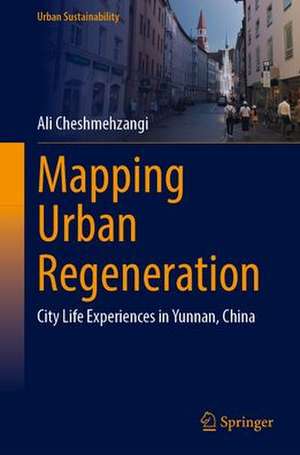
Mapping Urban Regeneration: Urban Sustainability
Autor Ali Cheshmehzangien Limba Engleză Hardback – 30 aug 2023
This book is the first of (hopefully) many more on the way in urban mapping studies with various themes and focus areas. The ultimate goal is to ensure urban mapping is recognized well and practiced extensively in research and education. It is essential to map realities in cities and communities, those that we usually witness but should be experienced, perceived, and touched—not just via desk research. Mapping techniques are more than just common tools in urbanism, urban geography, urban studies, urban planning, etc. They are not just tools but inventive ways of understanding cities, places, communities, experiences, and people. Thus, in this book, we try to understand more about people and places through life experiences and mapping the urban regeneration projects of multiple cities in Yunnan Province.
This collection is based on a very concise context-specific research focused on only one region. The decision to do so is intentional, just because contextual, cultural, and local attributes need to be looked at more accurately, considerably, and dexterously. Hence, this collection delves into case study examples of an inspiring location where traditions remain, resources are plenteous, and cultures are diverse. Yunnan is one of the few provinces left in China that offers a lot for comprehensive research studies at the urban, rural, andtownship levels. The experiences we gained from mapping studies, observations, and multi-stakeholder engagements are exceptionally rich and vibrant, allowing us to think more holistically and find ways and suggestions beyond just the generic globalized models elsewhere. We hope the book will be useful to various stakeholders, particularly urban specialists, researchers, and students. It is also a valuable collection for policymakers, decision-makers, and governmental authorities, who should refrain from top-down processes and bring back people to the heart of urban regeneration processes.
Din seria Urban Sustainability
- 18%
 Preț: 1044.93 lei
 - 18%
 Preț: 906.44 lei
 - 18%
 Preț: 814.67 lei
 - 18%
 Preț: 923.89 lei
 - 18%
 Preț: 1043.34 lei
 - 24%
 Preț: 791.01 lei
 - 24%
 Preț: 655.46 lei
 - 15%
 Preț: 620.29 lei
 - 20%
 Preț: 619.59 lei
 - 18%
 Preț: 950.38 lei
 - 18%
 Preț: 1015.00 lei
 - 18%
 Preț: 1042.80 lei
 - 24%
 Preț: 856.76 lei
 - 18%
 Preț: 1010.67 lei
 -
 Preț: 415.30 lei
 - 24%
 Preț: 790.51 lei
 - 18%
 Preț: 936.22 lei
 - 18%
 Preț: 755.54 lei
 - 5%
 Preț: 1068.85 lei
 - 20%
 Preț: 808.46 lei
 - 18%
 Preț: 1169.40 lei
 - 18%
 Preț: 2003.47 lei
 - 18%
 Preț: 860.42 lei
 - 18%
 Preț: 752.06 lei
 - 18%
 Preț: 750.89 lei
 - 24%
 Preț: 910.76 lei
 - 18%
 Preț: 1036.70 lei
 - 24%
 Preț: 774.25 lei
 - 18%
 Preț: 754.50 lei
 - 18%
 Preț: 1076.94 lei
 - 18%
 Preț: 926.92 lei
 - 24%
 Preț: 826.66 lei
 - 15%
 Preț: 718.92 lei
 - 18%
 Preț: 802.52 lei
 - 15%
 Preț: 727.95 lei
 - 20%
 Preț: 600.98 lei
 - 18%
 Preț: 920.78 lei
 - 18%
 Preț: 811.62 lei
 - 24%
 Preț: 938.70 lei
 - 18%
 Preț: 909.62 lei
 - 20%
 Preț: 1204.93 lei
 - 15%
 Preț: 721.81 lei
 - 18%
 Preț: 1042.83 lei
 - 18%
 Preț: 808.86 lei
Preț: 728.44 lei
Preț vechi: 856.99 lei
-15%
Puncte Express: 1093
Carte disponibilă
Livrare economică 09-23 noiembrie
Livrare prin curier în România Termenul estimat este afișat lângă disponibilitate.
Transport gratuit pentru acest produs Plată online sau ramburs, în funcție de opțiunile comenzii.
Retur gratuit în 14 zile Comandă securizată și suport în română.
Specificații
ISBN-13: 9789819935406
ISBN-10: 9819935407
Pagini: 268
Ilustrații: XXII, 246 p. 259 illus., 257 illus. in color.
Dimensiuni: 160 x 241 x 20 mm
Greutate: 0.57 kg
Ediția:1st ed. 2023
Editura: Springer
Colecția Urban Sustainability
Seria Urban Sustainability
Locul publicării:Singapore, Singapore
ISBN-10: 9819935407
Pagini: 268
Ilustrații: XXII, 246 p. 259 illus., 257 illus. in color.
Dimensiuni: 160 x 241 x 20 mm
Greutate: 0.57 kg
Ediția:1st ed. 2023
Editura: Springer
Colecția Urban Sustainability
Seria Urban Sustainability
Locul publicării:Singapore, Singapore
V-ar putea interesa
-
 -21%Preț: 188.53 lei238.72 lei
 -
 I Deliver Parcels in BeijingHu AnyanPreț: 197.31 lei
 -
 The Image of the CityKevin LynchPreț: 277.67 lei
 -
 Preț: 360.18 lei
 -
 Preț: 383.89 leiRecomandat
 -
 Preț: 264.14 lei
 -
 Requalifying the Built EnvironmentRoderick LawrencePreț: 392.72 lei
 -
 -8%Preț: 450.18 lei489.33 lei
 -
 Preț: 380.83 lei
 -
 Comparative Urbanism - Tactics for Global Urban StudiesJennifer RobinsonPreț: 178.51 lei
 -
 Urban GeographyAndrew E. G. JonasPreț: 260.75 lei
 -
 Welcome to the NeighbourhoodJane FallonPreț: 73.28 lei
 -
 Radical CartographyWilliam Rankin-44%Preț: 133.07 lei237.71 lei
 -
 The Homegrown CityMatias EchanovePreț: 152.61 lei
 -
 The City and the WorldGregor HensPreț: 108.10 lei
 -
 Regeneration SongsAnna MintonPreț: 123.21 lei
 -
 Typological DriftShiqiao LiPreț: 196.93 lei
 -
 Becoming UrbanJoshua BolchoverPreț: 192.68 lei
 -
 New Geographies of Music 2Séverin GuillardPreț: 336.23 lei
 -
 Preț: 390.68 lei
Cuprins
Mapping Urban Regeneration: Introduction to the New, the Old, and the New Old.- Regenerating the Local Industries and Urban Experiences that Matter.- Urban Regeneration and the Inevitable Gentrification: The study of Displaced Communities in the City of Dali.- Urban Regeneration and Building Colours: Mapping Visual and Perceptual Dimensions in Dali’s Old Towns.- Urban Regeneration and Creating Urban Landscapes: Enhancing City Life Experiences in Lijiang.- Urban Regeneration and In-between spaces: Mapping the Social Life of Lijiang’s Old Towns.- Regenerating the Local Characteristics: The Impacts on City Life experience and Identity of Shangri-La’s Old Town.- City Life Experiences: Lessons Learnt for Future Urban Regeneration Strategies.
Notă biografică
Ali Cheshmehzangi is a Full Professor and Head of the School of Architecture, Design and Planning (ADP) at the University of Queensland, where he leads the School and researches across the fields of architecture, design, and planning/urbanism. He has been in the World’s top 2 per cent field leader since 2022, recognised by Stanford University. He is among the top 30 global scholars in the urban sustainability research area. Ali has a wealth of experience, expertise, and a strong commitment to innovation and excellence in the fields of architecture, design, and planning, the three core disciplines of his School at UQ. With a career spanning over two decades, he has made significant contributions to the academic and professional communities, with a focus on sustainable and environmentally conscious design. So far, Ali has published over 500 journal papers, articles, conference papers, book chapters, and reports. He also has 37 other academic books, three of which have received awards at the national, provincial, and municipal levels. He also has received international awards and recognition for his research on urban resilience studies and sustainability research, as well as a Vice-Chancellor’s award for his impactful contribution to higher education.
Nicholas You is a veteran urban specialist and thought leader. Prior to his retirement he was the senior policy and planning advisor to UN-Habitat and the manager of the Habitat II Conference held in Istanbul in 1996. He is the founder and honorary chairman of the UN-Habitat World Urban Campaign Steering Committee, former chairman of the Assurance Group for Urban Infrastructure of the World Business Council for Sustainable Development, former Chairman of the Urban Strategy and Innovation Council for ENGIE and former co-President of the Global Cities Business Alliance.
He is currently the Executive Director of the Guangzhou Institute for Urban Innovation, co-Chair of the Open Green City Lab in Shenzhen and adjunct for the Centre for Liveable Cities, Singapore. He regularly advises central and local governments, technology companies and civil society organisations on urban sustainability, urban governance and urban innovation including the nexus between water, waste, transport and energy. He also works as a strategic planning and governance advisor to many metropolitan authorities worldwide. Since the outbreak of the pandemic, he has been part of a network of professionals facilitating the exchange of positive experiences between civil society and grassroots organisations. In 2020 he co-authored several key reports that were presented to G20.
Zaheer Allam holds a PhD in Humanities, a Master of Arts (Res), an MBA, and a Bachelor of Applied Science in Architectural Science from universities in Australia and the United Kingdom. He is currently an Adjunct Associate Professor at the School of Architecture, Design and Planning at The University of Queensland, Australia. Based in Mauritius, he was the first Chairperson of the National Youth Environment Council (NYEC) and a board member of the Mauritius Renewable Energy Agency (MARENA) and works on a number of projects on the thematic of Smart Cities and on strategies dwelling in the increasing role of technology in Culture and the Society. Zaheer is also the African Representative of the International Society of Biourbanism (ISB), member of the Advisory Circle of the International Federation of Landscape Architects (IFLA), and a member of a number of other international bodies. He is also affiliated with Urban Systems Institute, The University of Hong Kong, Hong Kong SAR, China, and Institute for Sustainabl
Nicholas You is a veteran urban specialist and thought leader. Prior to his retirement he was the senior policy and planning advisor to UN-Habitat and the manager of the Habitat II Conference held in Istanbul in 1996. He is the founder and honorary chairman of the UN-Habitat World Urban Campaign Steering Committee, former chairman of the Assurance Group for Urban Infrastructure of the World Business Council for Sustainable Development, former Chairman of the Urban Strategy and Innovation Council for ENGIE and former co-President of the Global Cities Business Alliance.
He is currently the Executive Director of the Guangzhou Institute for Urban Innovation, co-Chair of the Open Green City Lab in Shenzhen and adjunct for the Centre for Liveable Cities, Singapore. He regularly advises central and local governments, technology companies and civil society organisations on urban sustainability, urban governance and urban innovation including the nexus between water, waste, transport and energy. He also works as a strategic planning and governance advisor to many metropolitan authorities worldwide. Since the outbreak of the pandemic, he has been part of a network of professionals facilitating the exchange of positive experiences between civil society and grassroots organisations. In 2020 he co-authored several key reports that were presented to G20.
Zaheer Allam holds a PhD in Humanities, a Master of Arts (Res), an MBA, and a Bachelor of Applied Science in Architectural Science from universities in Australia and the United Kingdom. He is currently an Adjunct Associate Professor at the School of Architecture, Design and Planning at The University of Queensland, Australia. Based in Mauritius, he was the first Chairperson of the National Youth Environment Council (NYEC) and a board member of the Mauritius Renewable Energy Agency (MARENA) and works on a number of projects on the thematic of Smart Cities and on strategies dwelling in the increasing role of technology in Culture and the Society. Zaheer is also the African Representative of the International Society of Biourbanism (ISB), member of the Advisory Circle of the International Federation of Landscape Architects (IFLA), and a member of a number of other international bodies. He is also affiliated with Urban Systems Institute, The University of Hong Kong, Hong Kong SAR, China, and Institute for Sustainabl
Textul de pe ultima copertă
This book is an unusual attempt to study urban regeneration. First, it is based on mapping the realities of urban regeneration case study examples and their impacts on people, places, and city life experiences. Second, it is context-specific, exploring only a particular region rather than covering one country or multiple locations. Hence, the aim is to avoid generic and global solutions but rather focus on local pathways and directions. Third, it delves into specific case study examples that could share some lessons for research, practice, and academia, particularly in the field of urban regeneration. This book is the first of (hopefully) many more on the way in urban mapping studies with various themes and focus areas. The ultimate goal is to ensure urban mapping is recognized well and practiced extensively in research and education. It is essential to map realities in cities and communities, those that we usually witness but should be experienced, perceived, and touched—not just via desk research. Mapping techniques are more than just common tools in urbanism, urban geography, urban studies, urban planning, etc. They are not just tools but inventive ways of understanding cities, places, communities, experiences, and people. Thus, in this book, we try to understand more about people and places through life experiences and mapping the urban regeneration projects of multiple cities in Yunnan Province.
This collection is based on a very concise context-specific research focused on only one region. The decision to do so is intentional, just because contextual, cultural, and local attributes need to be looked at more accurately, considerably, and dexterously. Hence, this collection delves into case study examples of an inspiring location where traditions remain, resources are plenteous, and cultures are diverse. Yunnan is one of the few provinces left in China that offers a lot for comprehensive research studies at the urban, rural, and township levels. The experiences we gained from mapping studies, observations, and multi-stakeholder engagements are exceptionally rich and vibrant, allowing us to think more holistically and find ways and suggestions beyond just the generic globalized models elsewhere. We hope the book will be useful to various stakeholders, particularly urban specialists, researchers, and students. It is also a valuable collection for policymakers, decision-makers, and governmental authorities, who should refrain from top-down processes and bring back people to the heart of urban regeneration processes.
This collection is based on a very concise context-specific research focused on only one region. The decision to do so is intentional, just because contextual, cultural, and local attributes need to be looked at more accurately, considerably, and dexterously. Hence, this collection delves into case study examples of an inspiring location where traditions remain, resources are plenteous, and cultures are diverse. Yunnan is one of the few provinces left in China that offers a lot for comprehensive research studies at the urban, rural, and township levels. The experiences we gained from mapping studies, observations, and multi-stakeholder engagements are exceptionally rich and vibrant, allowing us to think more holistically and find ways and suggestions beyond just the generic globalized models elsewhere. We hope the book will be useful to various stakeholders, particularly urban specialists, researchers, and students. It is also a valuable collection for policymakers, decision-makers, and governmental authorities, who should refrain from top-down processes and bring back people to the heart of urban regeneration processes.
Caracteristici
Deals with urban regeneration from context-specific attributes in the Yunnan Province, China Explores urban regeneration from the mapping perspective Provides a case study-based approach to look at urban regeneration strategies and their impacts on people and places