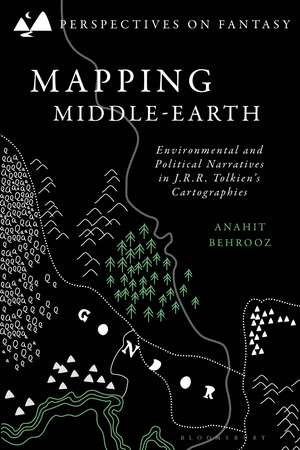
Mapping Middle-earth: Environmental and Political Narratives in J. R. R. Tolkien's Cartographies: Perspectives on Fantasy
Autor Dr Anahit Behroozen Limba Engleză Hardback – 22 feb 2024
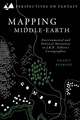
Far more than just illustrations to aid understanding of the story, Tolkien's corpus of maps are crucial to understanding the broader narratives between humans and their political and environmental landscapes within his legendarium. Undertaking a diegetic literary analysis of the maps as examples of Middle-earth's own cultural output, Behrooz reveals a sub-created tradition of cartography that articulates specific power dynamics between mapmaker, map reader, and what is being mapped, as well as the human/nonhuman binary that represents human's control over the natural world.
Mapping Middle-earth surveys how Tolkien frames cartography as an inherently political act that embodies a desire for control of that which it maps. In turn, it analyses harmful contemporary engagements with land that intersect with, but also move beyond, cartography such as environmental damage; human-induced geological change; and the natural and bodily costs of political violence and imperialism. Using historical, eco-critical, and postcolonial frameworks, and such theorists as Michel Foucault, Donna Haraway and Edward Said, this book explores Tolkien's employment of particular generic tropes including medievalism, fantasy, and the interplay between image and text to highlight, and at times correct, his contemporary socio-political epoch and its destructive relationship with the wider world.






Preț: 504.32 lei
Preț vechi: 721.23 lei
-30%
Puncte Express: 756
Carte tipărită la comandă
Livrare economică 20 noiembrie-04 decembrie
Livrare prin curier în România Termenul estimat este afișat lângă disponibilitate.
Transport gratuit pentru acest produs Plată online sau ramburs, în funcție de opțiunile comenzii.
Retur gratuit în 14 zile Comandă securizată și suport în română.
Specificații
ISBN-13: 9781350290761
ISBN-10: 1350290769
Pagini: 200
Dimensiuni: 154 x 236 x 16 mm
Greutate: 0.46 kg
Editura: Bloomsbury Publishing
Colecția Bloomsbury Academic
Seria Perspectives on Fantasy
Locul publicării:London, United Kingdom
ISBN-10: 1350290769
Pagini: 200
Dimensiuni: 154 x 236 x 16 mm
Greutate: 0.46 kg
Editura: Bloomsbury Publishing
Colecția Bloomsbury Academic
Seria Perspectives on Fantasy
Locul publicării:London, United Kingdom
Cuprins
Introduction
- Space, power, and critical cartography
- Literary maps
- Structure and overview
Chapter 1: Political mapmaking
- Medieval cartographic practices
- Modern cartographic practices
- Tolkien's cartography
Map I: I Vene Kemen
Map II: The 'Ambarkanta' diagrams and maps
Map III: Thror's Map
Map IV: The Middle-earth map
Map V: Map of Rohan, Gondor and Mordor
Chapter 2: Environment
- Navigating the human, nonhuman, and posthuman
- Tom Bombadil and the nonhuman
- Mapping the human and nonhuman in Middle-earth
- Stewardship
- Environmental destruction
- Nonhuman agency
Chapter 3: Geology and Time
- Deep time
- Middle-earth's geology
- Mapping geology and geologizing maps
- Fixing experiences of time
- Mapping anthropological change
Chapter 4: Imperialism and Race
- The politics of land and map
- (Dis)possessing Middle-earth's lands
- The threshold space
- Mutual vulnerability and racialization
- Narratives of imperialism
Conclusion
Index
Bibliography
- Space, power, and critical cartography
- Literary maps
- Structure and overview
Chapter 1: Political mapmaking
- Medieval cartographic practices
- Modern cartographic practices
- Tolkien's cartography
Map I: I Vene Kemen
Map II: The 'Ambarkanta' diagrams and maps
Map III: Thror's Map
Map IV: The Middle-earth map
Map V: Map of Rohan, Gondor and Mordor
Chapter 2: Environment
- Navigating the human, nonhuman, and posthuman
- Tom Bombadil and the nonhuman
- Mapping the human and nonhuman in Middle-earth
- Stewardship
- Environmental destruction
- Nonhuman agency
Chapter 3: Geology and Time
- Deep time
- Middle-earth's geology
- Mapping geology and geologizing maps
- Fixing experiences of time
- Mapping anthropological change
Chapter 4: Imperialism and Race
- The politics of land and map
- (Dis)possessing Middle-earth's lands
- The threshold space
- Mutual vulnerability and racialization
- Narratives of imperialism
Conclusion
Index
Bibliography
Recenzii
[An] often illuminating, intentionally provocative study.
A useful counter to the still far too common caricature of Tolkien as a nostalgic, largely apolitical conservative. Behrooz's book is also a helpful guide to the ways in which Tolkien responds to some of the questions posed by what she calls "our own collective mistakemaking."
Mapping Middle-earth revealed challenges in approaching Tolkien in some ways, it also proved how much there is still to learn about the legendarium by employing others. And it did so through insightful readings, well-structured arguments, and with focus on something I cannot pretend to find other than utterly fascinating: maps, mapping, and cartography.
This book is an excellent addition to the already impressive Perspectives on Fantasy series edited by well-known fantasy scholars Brian Attebery, Dimitra Fimi, and Matthew Sangster. As Behrooz points out in her conclusion, this framework could be fruitfully applied to other works of map-reliant fantasy and fiction; even other media, and particularly both tabletop and electronic games, could benefit from similar attention.
A useful counter to the still far too common caricature of Tolkien as a nostalgic, largely apolitical conservative. Behrooz's book is also a helpful guide to the ways in which Tolkien responds to some of the questions posed by what she calls "our own collective mistakemaking."
Mapping Middle-earth revealed challenges in approaching Tolkien in some ways, it also proved how much there is still to learn about the legendarium by employing others. And it did so through insightful readings, well-structured arguments, and with focus on something I cannot pretend to find other than utterly fascinating: maps, mapping, and cartography.
This book is an excellent addition to the already impressive Perspectives on Fantasy series edited by well-known fantasy scholars Brian Attebery, Dimitra Fimi, and Matthew Sangster. As Behrooz points out in her conclusion, this framework could be fruitfully applied to other works of map-reliant fantasy and fiction; even other media, and particularly both tabletop and electronic games, could benefit from similar attention.
Notă biografică
Anahit Behroozis an independent research scholar and arts journalist. She received her PhD from the University of Edinburgh, UK and has taught at Edinburgh and Edinburgh Napier University. Her work has been published in Walking Tree's anthology Sub-creating Arda: World-building in J. R. R. Tolkien's Works, its Precursors, and Legaciesand Fastitocalon, and The University of Edinburgh's The Dangerous Women Project.