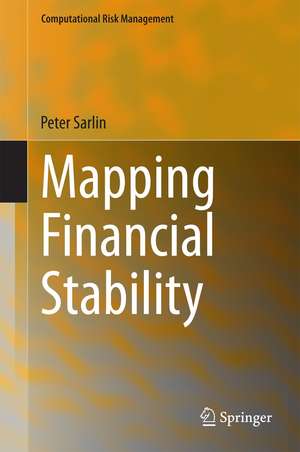
Mapping Financial Stability: Computational Risk Management
Autor Peter Sarlinen Limba Engleză Hardback – 22 mai 2014


Preț: 667.19 lei
Preț vechi: 784.93 lei
-15%
Puncte Express: 1001
Carte tipărită la comandă
Livrare economică 07-21 decembrie
Livrare prin curier în România Termenul estimat este afișat lângă disponibilitate.
Transport gratuit pentru acest produs Plată online sau ramburs, în funcție de opțiunile comenzii.
Retur gratuit în 14 zile Comandă securizată și suport în română.
Specificații
ISBN-13: 9783642549557
ISBN-10: 3642549551
Pagini: 252
Ilustrații: XVI, 233 p. 61 illus., 38 illus. in color.
Dimensiuni: 160 x 241 x 20 mm
Greutate: 0.5 kg
Ediția:2014
Editura: Springer
Colecția Computational Risk Management
Seria Computational Risk Management
Locul publicării:Berlin, Heidelberg, Germany
ISBN-10: 3642549551
Pagini: 252
Ilustrații: XVI, 233 p. 61 illus., 38 illus. in color.
Dimensiuni: 160 x 241 x 20 mm
Greutate: 0.5 kg
Ediția:2014
Editura: Springer
Colecția Computational Risk Management
Seria Computational Risk Management
Locul publicării:Berlin, Heidelberg, Germany
V-ar putea interesa
-
 All About Forex TradingJohn Jagerson-10%Preț: 117.23 lei130.68 lei
 -
 -15%Preț: 619.30 lei728.59 lei
 -
 The Stock-Flow Consistent ApproachMarc Lavoie-15%Preț: 669.02 lei787.08 lei
 -
 Financial CrisisAdrian Buckley-15%Preț: 574.94 lei676.40 lei
 -
 The Philosophy of MoneyGeorg SimmelPreț: 243.40 lei
 -
 Preț: 462.43 lei
 -
 The Future of Global Currency: The Euro Versus the DollarBenjamin J. CohenPreț: 474.91 lei
 -
 The Little Book of Currency TradingKathy LienPreț: 149.21 lei
 -
 World Inflation Since 1950A. J. BrownPreț: 323.95 lei
 -
 A Global History of the Financial Crash of 2007-2010Johan A. LybeckPreț: 307.78 lei
 -
 The New Gold StandardPaul NathanPreț: 230.14 lei
 -
 Tychastic Measure of Viability RiskJean-Pierre AubinPreț: 399.14 lei
 -
 Cost-of-Capital in Managerial FinanceDennis Schlegel-15%Preț: 667.64 lei785.46 lei
Public țintă
ResearchCuprins
Introduction.- Macroprudential Oversight.- Macroprudential Data.- Data and Dimension Reduction.- Data-Dimension Reductions: A Comparison.- Extending the SOM.- Self-Organizing Financial Stability Map (SOFSM).- Exploiting the SOFSM.- Decomposing Financial Crises with SOTMs.- Conclusions, Limitations and the Future.
Textul de pe ultima copertă
This book approaches macroprudential oversight from the viewpoint of three tasks. The focus concerns a tight integration of means for risk communication into analytical tools for risk identification and risk assessment. Generally, this book explores approaches for representing complex data concerning financial entities on low-dimensional displays. Data and dimension reduction methods, and their combinations, hold promise for representing multivariate data structures in easily understandable formats. Accordingly, this book creates a Self-Organizing Financial Stability Map (SOFSM), and lays out a general framework for mapping the state of financial stability. Beyond external risk communication, the aim of the visual means is to support disciplined and structured judgmental analysis based upon policymakers' experience and domain intelligence.