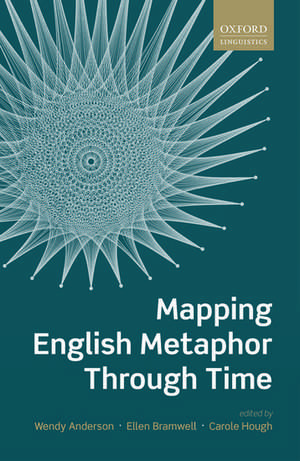
Mapping English Metaphor Through Time
Editat de Wendy Anderson, Ellen Bramwell, Carole Houghen Limba Engleză Hardback – 25 aug 2016
Preț: 810.94 lei
Preț vechi: 1167.79 lei
-31%
Puncte Express: 1216
Carte tipărită la comandă
Livrare economică 04-15 decembrie
Livrare prin curier în România Termenul estimat este afișat lângă disponibilitate.
Transport gratuit pentru acest produs Plată online sau ramburs, în funcție de opțiunile comenzii.
Retur gratuit în 14 zile Comandă securizată și suport în română.
Specificații
ISBN-13: 9780198744573
ISBN-10: 0198744579
Pagini: 344
Dimensiuni: 160 x 234 x 24 mm
Greutate: 0.64 kg
Editura: OUP OXFORD
Colecția OUP Oxford
Locul publicării:Oxford, United Kingdom
ISBN-10: 0198744579
Pagini: 344
Dimensiuni: 160 x 234 x 24 mm
Greutate: 0.64 kg
Editura: OUP OXFORD
Colecția OUP Oxford
Locul publicării:Oxford, United Kingdom
V-ar putea interesa
-
 -32%Preț: 1850.08 lei2714.58 lei
 -
 -30%Preț: 719.16 lei1026.16 lei
 -
 -32%Preț: 1050.98 lei1556.66 lei
 -
 The Oxford Handbook of Names and NamingCarole Hough-17%Preț: 387.55 lei465.71 lei
 -
 The Oxford Guide to Practical LexicographyB. T. Sue Atkins-11%Preț: 367.24 lei413.02 lei
 -
 The Making of the Oxford English DictionaryPeter Gilliver-20%Preț: 508.22 lei635.40 lei
 -
 -33%Preț: 2193.77 lei3250.69 lei
 -
 Practical Lexicography: A ReaderThierry Fontenelle-20%Preț: 512.23 lei639.07 lei
 -
 -33%Preț: 1287.29 lei1911.46 lei
 -
 -20%Preț: 408.78 lei509.36 lei
 -
 The Oxford Handbook of LexicographyPhilip Durkin-34%Preț: 1012.64 lei1540.66 lei
 -
 Beginning Old EnglishCarole HoughPreț: 207.74 lei
 -
 Thought and Language, revised and expanded editionLev S. VygotskyPreț: 372.05 lei
 -
 Women and Dictionary MakingLindsay Rose Russell-14%Preț: 795.56 lei925.06 lei
 -
 Words of the WorldSarah OgilviePreț: 151.10 lei
 -
 Hospital-Based Palliative MedicineSteven Z Pantilat-5%Preț: 667.65 lei702.80 lei
 -
 Understanding Actions, States, and EventsSusan Douglas-23%Preț: 1133.93 lei1472.64 lei
 -
 Lexicography at a CrossroadsHenning Bergenholtz-9%Preț: 768.00 lei843.96 lei
Notă biografică
Wendy Anderson is Senior Lecturer in English Language at the University of Glasgow. Her research and teaching interests include semantics, metaphor, corpus linguistics, collocation and phraseology, and intercultural language education. She was Principal Investigator for the AHRC-funded project 'Mapping Metaphor with the Historical Thesaurus' (2012-2015), which sought to trace metaphor throughout the history of English, and the follow-on project 'Metaphor in the Curriculum' (2015-2016), which created materials on metaphor for use in secondary education. She is the author, with John Corbett, of Exploring English with Online Corpora (Palgrave MacMillan, 2009).Ellen Bramwell is a Research Associate working on metaphor and education at the University of Glasgow. She was Research Associate on the 'Mapping Metaphor with the Historical Thesaurus' project and the follow-on project 'Metaphor in the Curriculum', and previously worked on the Historical Thesaurus of English (published as the Historical Thesaurus of the Oxford English Dictionary) and the 'Scots Words and Place-names' project. In addition to her research interests in digital humanities, semantics, and lexicography, she specializes in onomastics and sociolinguistics, with a particular interest in personal naming systems.Carole Hough is Professor of Onomastics at the University of Glasgow, where she has taught for over 20 years. She is a historical linguist who specializes in name studies, Old English, and historical semantics. She has published widely in these and other fields. Her most recent book is 'An Ald Reht': Essays on Anglo-Saxon Law (2014), and her most recent edited volume is The Oxford Handbook of Names and Naming (2016). She has served as President of the International Council of Onomastic Sciences and President of the International Society of Anglo-Saxonists, and is currently Vice-President of the Society for Name Studies in Britain and Ireland.