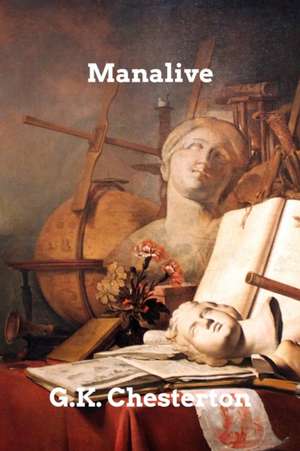
Manalive
Autor G. K. Chestertonen Limba Engleză Paperback – 9 ian 2022
Preț: 93.65 lei
Puncte Express: 140
Carte disponibilă
Livrare economică 12-26 noiembrie
Livrare prin curier în România Termenul estimat este afișat lângă disponibilitate.
Transport gratuit de la 400.00 lei Plată online sau ramburs, în funcție de opțiunile comenzii.
Retur gratuit în 14 zile Comandă securizată și suport în română.
Specificații
ISBN-13: 9781006008337
ISBN-10: 1006008330
Pagini: 138
Dimensiuni: 152 x 229 x 8 mm
Greutate: 0.21 kg
Editura: BLURB INC
ISBN-10: 1006008330
Pagini: 138
Dimensiuni: 152 x 229 x 8 mm
Greutate: 0.21 kg
Editura: BLURB INC
V-ar putea interesa
-
 Father Brown Selected StoriesG. K. Chesterton-18%Preț: 53.92 lei65.49 lei
 -
 OrthodoxyG. K. Chesterton-17%Preț: 30.05 lei36.40 lei
 -
 As a Man ThinkethJames Allen-45%Preț: 22.52 lei41.20 lei
 -
 Collected Works of G.K. ChestertonG. K. ChestertonPreț: 128.50 lei
 -
 What's Wrong with the WorldG. K. ChestertonPreț: 44.19 lei
 -
 George Bernard ShawG. K. ChestertonPreț: 40.86 lei
 -
 The Club of Queer TradesG. K. ChestertonPreț: 42.04 lei
 -
 A Miscellany of MenG. K. ChestertonPreț: 40.46 lei
 -
 The Trees of PrideG. K. ChestertonPreț: 38.89 lei
 -
 The Wild Knight and Other PoemsG. K. ChestertonPreț: 40.86 lei
 -
 The Wisdom of Father BrownG. K. ChestertonPreț: 41.86 lei
 -
 The Complete ThinkerDale AhlquistPreț: 113.99 lei
 -
 The Everlasting ManG. K. ChestertonPreț: 55.93 lei
 -
 HereticsG. K. ChestertonPreț: 46.29 lei
 -
 The Everyman ChestertonG. K. Chesterton-16%Preț: 125.06 lei149.03 lei
 -
 The Complete Father Brown StoriesG. K. ChestertonPreț: 41.36 lei
 -
 The Man Who Was ThursdayG. K. ChestertonPreț: 38.95 lei
 -
 The Ball and the CrossG. K. ChestertonPreț: 44.87 lei
 -
 The New JerusalemG. K. ChestertonPreț: 44.37 lei
Descriere
Descriere de la o altă ediție sau format:
This classic novel by the brilliant Chesterton tells the rollicking tale of Innocent Smith, a man who may be crazy--or possibly the most sane man of all. In this delightfully strange mystery, Chesterton demonstrates why life is worth living, and that sometimes we need a little madness just to know we are alive.
This classic novel by the brilliant Chesterton tells the rollicking tale of Innocent Smith, a man who may be crazy--or possibly the most sane man of all. In this delightfully strange mystery, Chesterton demonstrates why life is worth living, and that sometimes we need a little madness just to know we are alive.
Notă biografică
Gilbert Keith Chesterton (1874 - 1936), better known as G. K. Chesterton, was an English writer, poet, philosopher, dramatist, journalist, orator, lay theologian, biographer and literary and art critic. Chesterton is often referred to as the "prince of paradox". Time magazine has observed of his writing style: "Whenever possible Chesterton made his points with popular sayings, proverbs, allegories-first carefully turning them inside out." Chesterton is well known for his fictional priest-detective Father Brown and for his reasoned apologetics. Even some of those who disagree with him have recognized the wide appeal of such works as Orthodoxy and The Everlasting Man. Chesterton, as a political thinker, cast aspersions on both Progressivism and Conservatism, saying, "The whole modern world has divided itself into Conservatives and Progressives. The business of Progressives is to go on making mistakes. The business of the Conservatives is to prevent the mistakes from being corrected." Chesterton routinely referred to himself as an "orthodox" Christian and came to identify this position more and more with Catholicism, eventually converting to Catholicism from High Church Anglicanism. George Bernard Shaw, Chesterton's "friendly enemy" according to Time, said of him, "He was a man of colossal genius."