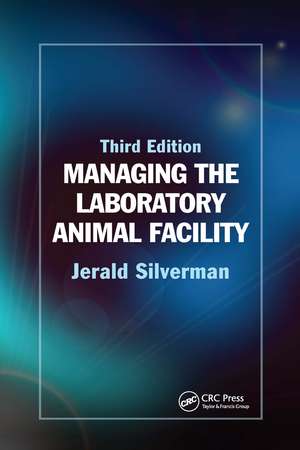
Managing the Laboratory Animal Facility
Autor Jerald Silvermanen Limba Engleză Paperback – 12 iul 2022
"The author brings in management wisdom from the world outside laboratory animal medicine and veterinary medicine. As a result, there is a rich mixture of the experience of a seasoned professional and the theoretical framework used by schools of management …. I recommend this book to managers and laboratory animal specialists at any stage of their careers."
—Franklin M. Loew, DVM, PhD, DACLAM, JAVMA, Vol. 222, No. 6, 2003
"… This book is a good informational resource for any new manager to the field of laboratory management. The information is presented in a way that will keep your interest and stimulate you to think how it can benefit you and the facility in which you work."
—Susan K. Cutter, BS, RVT, RLATG, Purdue University, West Lafayette, Indiana, USA, LAMA Review
Written in Jerry Silverman’s trademark style, Managing the Laboratory Animal Facility, Third Edition provides the reader with sound management theory and associated management practices that are easy to read, easy to understand, easy to implement, and pertinent to the daily management and leadership of laboratory animal facilities. Maintaining the practical focus of previous editions, this greatly expanded volume presents the critical knowledge needed to help you make efficient and effective use of the key resources that are used every day by vivarium managers – people, time, money, and information.
New to the Third Edition
Incorporating the latest developments in management theory and application, the edition contains approximately 100 pages of new and expanded material. This more detailed coverage:
- Discusses lean management concepts and practices and their application to laboratory animal science
- Adds information on many essential topics, especially in human resources management in its treatment of negotiations, influence, and performance reviews
- Provides a large number of revisions and updates to Appendix 2 in its presentation of Per diem calculations
- Includes an extensive list of references for further study of specialized topics
| Toate formatele și edițiile | Preț | Express |
|---|---|---|
| Paperback (1) | 420.82 lei 6-8 săpt. | |
| CRC Press – 12 iul 2022 | 420.82 lei 6-8 săpt. | |
| Hardback (1) | 970.54 lei 6-8 săpt. | |
| CRC Press – 21 oct 2016 | 970.54 lei 6-8 săpt. |
Preț: 420.82 lei
Preț vechi: 495.08 lei
-15%
Puncte Express: 631
Preț estimativ în valută:
74.42€ • 85.90$ • 64.32£
74.42€ • 85.90$ • 64.32£
Carte tipărită la comandă
Livrare economică 01-15 mai
Specificații
ISBN-13: 9781032339849
ISBN-10: 1032339845
Pagini: 420
Ilustrații: 6
Dimensiuni: 156 x 234 x 25 mm
Greutate: 0.59 kg
Ediția:3
Editura: CRC Press
Colecția CRC Press
Locul publicării:Boca Raton, United States
ISBN-10: 1032339845
Pagini: 420
Ilustrații: 6
Dimensiuni: 156 x 234 x 25 mm
Greutate: 0.59 kg
Ediția:3
Editura: CRC Press
Colecția CRC Press
Locul publicării:Boca Raton, United States
V-ar putea interesa
-
 -5%Preț: 335.65 lei353.31 lei
 -
 Preț: 424.09 lei
 -
 Preț: 338.19 lei
 -
 -18%Preț: 1362.16 lei1661.17 lei
 -
 Experimental Design and Reproducibility in Preclinical Animal StudiesJosé M. Sánchez Morgado-5%Preț: 1194.93 lei1257.82 lei
 -
 -23%Preț: 827.52 lei1074.69 lei
Public țintă
Professional ReferenceCuprins
The basics of managing a laboratory animal facility. The organizational environment, The management of human resources. Managing financial resources. . Management of information resources. Time management. Leadership. Appendix 1 - Productivity goals and measurements. Appendix 2 - Setting per diem rates. Appendix 3 - Hiring the right person. Appendix 4 - Training.
Notă biografică
Jerald Silverman, DVM, is director of the Department of Animal Medicine and professor of pathology at the University of Massachusetts Medical School. He is also an adjunct professor at the Cummings School of Veterinary Medicine at Tufts University. He received his degrees in vertebrate zoology and veterinary medicine from Cornell University and has a master’s degree in nonprofit organization management from the New School for Social Research. Dr. Silverman is a Diplomate of the American College of Laboratory Animal Medicine and past president of the American Society of Laboratory Animal Practitioners.
Descriere
The thrust of Managing the Laboratory Animal Facilities, beginning with the first edition, has been a focus on basic management skills (planning, directing, decision making, organizing, controlling), how they integrate, and how they are used to effect a positive and productive work environment. This philosophy continues into the third edi