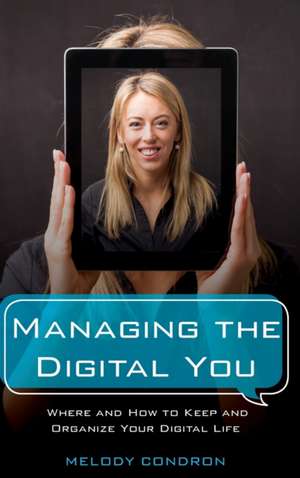
Managing the Digital You: Where and How to Keep and Organize Your Digital Life: LITA Guides
Autor Melody Karleen Limba Engleză Hardback – 24 feb 2017
Features include:
Value assessment exercises to help readers identify what is a preservation priority to them personallyBest practices for managing digital financial and legal documentsHow to save things from multiple devices, as well as social media sitesRecommendations for scheduling maintenance activities and automating backupGuidelines for creating a personal management plan so that users are prepared to handle new and existing documents, photos, and other digital material for ongoing access
After reading this short primer, readers will be ready to:
better organize and identify what they already have in a digital form, have a personal plan for knowing what to discard and what to retain, know how to digitize papers, photographs, voicemail,preserve email and social media postings, andset up a workable long-term file naming and organizational structure.
| Toate formatele și edițiile | Preț | Express |
|---|---|---|
| Paperback (1) | 123.00 lei 6-8 săpt. | |
| Bloomsbury Publishing – 8 feb 2019 | 123.00 lei 6-8 săpt. | |
| Hardback (1) | 244.89 lei 6-8 săpt. | |
| Bloomsbury Publishing – 24 feb 2017 | 244.89 lei 6-8 săpt. |
Din seria LITA Guides
- 23%
 Preț: 248.10 lei
 -
 Preț: 440.14 lei
 - 22%
 Preț: 314.67 lei
 - 23%
 Preț: 240.84 lei
 - 22%
 Preț: 259.20 lei
 - 22%
 Preț: 313.40 lei
 - 21%
 Preț: 208.77 lei
 - 19%
 Preț: 296.68 lei
 - 23%
 Preț: 240.84 lei
 - 28%
 Preț: 373.17 lei
 -
 Preț: 482.55 lei
 - 18%
 Preț: 123.00 lei
 - 23%
 Preț: 240.94 lei
 - 20%
 Preț: 215.40 lei
 - 31%
 Preț: 496.99 lei
 - 23%
 Preț: 269.90 lei
 - 23%
 Preț: 270.95 lei
 - 23%
 Preț: 241.54 lei
 - 19%
 Preț: 325.22 lei
 - 23%
 Preț: 270.86 lei
 - 23%
 Preț: 241.50 lei
 - 31%
 Preț: 372.22 lei
 - 23%
 Preț: 248.28 lei
 - 19%
 Preț: 296.39 lei
 - 34%
 Preț: 582.48 lei
 - 19%
 Preț: 346.86 lei
 - 15%
 Preț: 213.80 lei
 - 19%
 Preț: 346.60 lei
 - 28%
 Preț: 371.43 lei
 - 33%
 Preț: 179.01 lei
Preț: 244.89 lei
Preț vechi: 316.17 lei
-23%
Puncte Express: 367
Preț estimativ în valută:
43.35€ • 50.44$ • 37.59£
43.35€ • 50.44$ • 37.59£
Carte tipărită la comandă
Livrare economică 28 februarie-14 martie
Preluare comenzi: 021 569.72.76
Specificații
ISBN-13: 9781442278875
ISBN-10: 1442278870
Pagini: 178
Dimensiuni: 158 x 239 x 17 mm
Greutate: 0.38 kg
Editura: Bloomsbury Publishing
Colecția Rowman & Littlefield Publishers
Seria LITA Guides
Locul publicării:New York, United States
ISBN-10: 1442278870
Pagini: 178
Dimensiuni: 158 x 239 x 17 mm
Greutate: 0.38 kg
Editura: Bloomsbury Publishing
Colecția Rowman & Littlefield Publishers
Seria LITA Guides
Locul publicării:New York, United States
V-ar putea interesa
-
 -12%Preț: 342.40 lei388.61 lei
 -
 Doubles and Hybrids in Latin American GothicAntonio Alcalá González-18%Preț: 1013.74 lei1236.26 lei
 -
 Preț: 385.78 lei
 -
 -23%Preț: 303.66 lei393.11 lei
 -
 Media and Maltese SocietyCarmen Sammut-22%Preț: 330.21 lei423.59 lei
 -
 -22%Preț: 337.76 lei433.04 lei
 -
 Fighting the Forces: What's at Stake in Buffy the Vampire SlayerRhonda V. Wilcox-18%Preț: 309.38 lei378.60 lei
 -
 War, Media, and PropagandaYahya R Kamalipour-18%Preț: 322.87 lei395.76 lei
 -
 Persuasion: Messages, Receivers, and ContextsWilliam Rogers-27%Preț: 417.94 lei574.65 lei
 -
 -19%Preț: 350.48 lei430.47 lei
 -
 Media in an American Crisis: Studies of September 11, 2001Elinor Kelley Grusin-31%Preț: 337.07 lei487.55 lei
 -
 -15%Preț: 625.32 lei735.66 lei
 -
 The Soundtrack Album: Listening to MediaPaul N. ReinschPreț: 336.31 lei
 -
 -18%Preț: 1013.74 lei1236.26 lei
 -
 -18%Preț: 1012.23 lei1234.43 lei
 -
 An Introduction to GameGuruMichael Matthew Messina-18%Preț: 804.45 lei981.04 lei
 -
 Media, Myth, and Millennials: Critical Perspectives on Race and CultureLoren Saxton Coleman-23%Preț: 660.07 lei857.23 lei
 -
 Understanding Esports: An Introduction to the Global PhenomenonDr. Ryan Rogers-34%Preț: 554.94 lei836.53 lei
 -
 The Dialectic of Digital CultureDavid Arditi-34%Preț: 555.78 lei837.02 lei
 -
 Media EthicsFestus Eribo-23%Preț: 750.67 lei974.89 lei
 -
 -19%Preț: 313.40 lei385.50 lei
 -
 Preț: 507.89 lei
 -
 -34%Preț: 556.95 lei837.75 lei
 -
 DOKUMENTARFILM ALS MEDIUM DER ERINNERUHJohanna Pumb-23%Preț: 440.18 lei571.66 lei
Recenzii
This compact primer by librarian Condron outlines both the why and the how of approaching the mammoth task of organizing one's digital life. In the preface, Cordon presents four simple, compelling reasons for taking on the project: loss avoidance, ease of sharing and collaboration, personal digital archiving, and ease of access during an emergency. The succeeding eight chapters systematically walk the reader through how to approach and execute the project. Chapters 1 and 2 are mandatory reading as they outline the guided assessment, or determining what you own and its value, and best practice for filenaming conventions and organizational structure. Readers may dip into the remaining chapters for tips specific to areas of interest, including legacy planning (your digital will), digital correspondence, photos, social-media accounts, legal documents, and other media. The short, straightforward chapters are broken up by useful illustrations, screenshots, and tips (Google Docs and backup files are not synonymous) and conclude with learning objectives or summary. Appendixes of blank forms and digital-archiving resources follow.
Gone are the piles of boxes in the attic. Nowadays, our life is stored in multiple digital formats in dozens of different places-email, voicemail, music, photos, Facebook, LinkedIn, Twitter, Flickr, Instagram, phones, tablets, CDs, and more. Do you know where your data is stored and do you care what happens to it all? That 's what this book is all about.... Thoughout the book the author reminds you to think about what you are keeping and wy. She makes suggestions, but leaves you to determine exactly what you want to do. If you have any interest in keeping your digital 'stuff,' this book will get you on the right path. The actual work is up to you.
Managing the Digital You is an excellent tool for coping with the volume of incoming data that we all deal with on a daily basis. Encompassing subjects of correspondence, financial and legal documents, legacy planning, multimedia, nondigital documents, password protection, photos, and social media archiving, this resource provides a clear path to avoiding electronic mayhem. Creating a system for digital management means simplification of life; files are organized for finding, photos will be in order, useless information deleted. After the preface, eight chapters categorize topics on how to succeed in cleaning up and sorting your digital chaos. Chapters 1 and 2 provide readers with a logical place to begin and an assessment of individual needs. Beyond introductory information, later chapters are unambiguous with titles such as 'Legal, Financial, and Medical Documents' (chapter 3) or 'Digital Photographs' (chapter 5). Text is supported with figures and tables throughout, all black and white. Visuals are not eye-catching but provide the visual documentation necessary. Summaries and bibliographic notes conclude each chapter. Two appendixes provide additional resources and a brief index offers entry to subjects such as backup, disaster preparedness, and file formats. Google, Microsoft Office, Photoshop, and Twitter are just some of the platforms discussed in relation to organization. This title is one that most anyone should have on the shelf (or, yes, downloaded on your digital device!). Better yet, open it up, read a chapter, and get digitally organized! Highly recommended.
Managing the Digital You is targeted at individuals, but institutions and organizations will also find its practical advice to be very useful. One of the best features of the book is that while all the chapters fit together to create a comprehensive plan, each chapter is very useful on an individual level. Where was this book when I was first used a computer?
Folders, floppy disks, flash drives - managing information has been a nuisance for decades. The 21st century added new challenges: texts on one device, emails on another, photos in the cloud. Managing the Digital You shows a practical way to rein in your data while keeping your sanity.
By cleverly weaving professional best practices, and acknowledging that the digital you undoubtedly has personal habits for handling your stuff that are flexible, but not likely completely reversible, Melody Condron has created a valuable, contemporary guide for a more efficient, effective and vital digital life.
Managing the Digital You is an excellent guide on digital asset management. A great resource for the general public and professionals alike, anyone from genealogists to librarians to nostalgic family members can benefit from Condron's advice. This is a well-organized, simple to read how-to manual for managing existing and future digital items. While providing a general approach to personal digital archiving, this book also includes specifics, from password protection to multimedia conversion and even management of social media sites among other interesting tricks of the trade.
Gone are the piles of boxes in the attic. Nowadays, our life is stored in multiple digital formats in dozens of different places-email, voicemail, music, photos, Facebook, LinkedIn, Twitter, Flickr, Instagram, phones, tablets, CDs, and more. Do you know where your data is stored and do you care what happens to it all? That 's what this book is all about.... Thoughout the book the author reminds you to think about what you are keeping and wy. She makes suggestions, but leaves you to determine exactly what you want to do. If you have any interest in keeping your digital 'stuff,' this book will get you on the right path. The actual work is up to you.
Managing the Digital You is an excellent tool for coping with the volume of incoming data that we all deal with on a daily basis. Encompassing subjects of correspondence, financial and legal documents, legacy planning, multimedia, nondigital documents, password protection, photos, and social media archiving, this resource provides a clear path to avoiding electronic mayhem. Creating a system for digital management means simplification of life; files are organized for finding, photos will be in order, useless information deleted. After the preface, eight chapters categorize topics on how to succeed in cleaning up and sorting your digital chaos. Chapters 1 and 2 provide readers with a logical place to begin and an assessment of individual needs. Beyond introductory information, later chapters are unambiguous with titles such as 'Legal, Financial, and Medical Documents' (chapter 3) or 'Digital Photographs' (chapter 5). Text is supported with figures and tables throughout, all black and white. Visuals are not eye-catching but provide the visual documentation necessary. Summaries and bibliographic notes conclude each chapter. Two appendixes provide additional resources and a brief index offers entry to subjects such as backup, disaster preparedness, and file formats. Google, Microsoft Office, Photoshop, and Twitter are just some of the platforms discussed in relation to organization. This title is one that most anyone should have on the shelf (or, yes, downloaded on your digital device!). Better yet, open it up, read a chapter, and get digitally organized! Highly recommended.
Managing the Digital You is targeted at individuals, but institutions and organizations will also find its practical advice to be very useful. One of the best features of the book is that while all the chapters fit together to create a comprehensive plan, each chapter is very useful on an individual level. Where was this book when I was first used a computer?
Folders, floppy disks, flash drives - managing information has been a nuisance for decades. The 21st century added new challenges: texts on one device, emails on another, photos in the cloud. Managing the Digital You shows a practical way to rein in your data while keeping your sanity.
By cleverly weaving professional best practices, and acknowledging that the digital you undoubtedly has personal habits for handling your stuff that are flexible, but not likely completely reversible, Melody Condron has created a valuable, contemporary guide for a more efficient, effective and vital digital life.
Managing the Digital You is an excellent guide on digital asset management. A great resource for the general public and professionals alike, anyone from genealogists to librarians to nostalgic family members can benefit from Condron's advice. This is a well-organized, simple to read how-to manual for managing existing and future digital items. While providing a general approach to personal digital archiving, this book also includes specifics, from password protection to multimedia conversion and even management of social media sites among other interesting tricks of the trade.