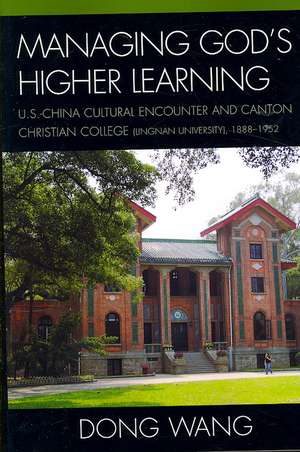
Managing God's Higher Learning: U.S.-China Cultural Encounter and Canton Christian College (Lingnan University), 1888-1952
Autor Dong Wangen Limba Engleză Paperback – 30 mai 2007
Preț: 351.61 lei
Preț vechi: 483.31 lei
-27%
Puncte Express: 527
Carte tipărită la comandă
Livrare economică 08-22 decembrie
Livrare prin curier în România Termenul estimat este afișat lângă disponibilitate.
Transport gratuit de la 400.00 lei Plată online sau ramburs, în funcție de opțiunile comenzii.
Retur gratuit în 14 zile Comandă securizată și suport în română.
Specificații
ISBN-13: 9780739119365
ISBN-10: 0739119362
Pagini: 226
Dimensiuni: 153 x 230 x 15 mm
Greutate: 0.37 kg
Ediția:New.
Editura: Bloomsbury Publishing
Colecția Lexington Books
Locul publicării:New York, United States
ISBN-10: 0739119362
Pagini: 226
Dimensiuni: 153 x 230 x 15 mm
Greutate: 0.37 kg
Ediția:New.
Editura: Bloomsbury Publishing
Colecția Lexington Books
Locul publicării:New York, United States
V-ar putea interesa
-
 Mao: A Very Short IntroductionDelia Davin-19%Preț: 57.46 lei71.12 lei
 -
 The Silk Road: A Very Short IntroductionJames A. Millward-19%Preț: 57.72 lei71.12 lei
 -
 Early Medieval China – A SourcebookWendy SwartzPreț: 421.47 lei
 -
 Letters and Epistolary Culture in Early Medieval ChinaAntje RichterPreț: 256.31 lei
 -
 NinjaJohn Man-18%Preț: 76.58 lei93.83 lei
 -
 Hiroshima NagasakiPaul Ham-17%Preț: 121.80 lei145.97 lei
 -
 Zen at WarBrian Daizen Victoria-20%Preț: 319.18 lei396.68 lei
 -
 Out of Mao's ShadowPhilip P. PanPreț: 128.11 lei
 -
 Wave: A Memoir of Life After the TsunamiSonali Deraniyagala-26%Preț: 79.01 lei107.06 lei
Cuprins
Chapter 1 The Setting: Honglok, Guangzhou, and Canton Christian College (Lingnan University)
Chapter 2 Cultural Migration: Lingnan as a Foreign and Local Institution
Chapter 3 Financing God's Higher Education: Management and Governance
Chapter 4 The Advance to Higher Education: Women's Education, Power and Modernization
Chapter 5 From Lingnan to Pomona: Charles K. Edmunds and His Chinese-American Career
Chapter 6 Conclusion: Memories and Legacies of Lingnan
Chapter 2 Cultural Migration: Lingnan as a Foreign and Local Institution
Chapter 3 Financing God's Higher Education: Management and Governance
Chapter 4 The Advance to Higher Education: Women's Education, Power and Modernization
Chapter 5 From Lingnan to Pomona: Charles K. Edmunds and His Chinese-American Career
Chapter 6 Conclusion: Memories and Legacies of Lingnan
Recenzii
Professor Wang's rich study is not an institutional history of the old style but a theoretically informed reassessment. Canton Christian College, originally an example of that uniquely American institution, the liberal arts college, in a generation became Lingnan University, a multifaceted research institution embedded in the emerging Chinese nation. Wang concludes that this was not 'cultural imperialism' but a multi-cultural and Trans-Pacific enterprise which sets an example for NGOs in China today.
Whereas previous studies of Christian colleges in China have stressed the confrontational aspects of this Sino-foreign encounter, Professor Dong Wang's monograph highlights transnational collaboration and mutual cultural understanding at Canton Christian College (later called Lingnan University). The author demonstrates effectively that Lingnan, with its distinctive interdenominational Christian atmosphere, encouraged Chinese involvement in shaping a complex educational enterprise. As an important contribution to the history of Sino-American interaction, Wang pays particular attention to the business management of the college. In contrast to previous research concerning Christian colleges in China, she argues that southern Chinese entrepreneurial expertise played a significant role in the management and governance of the college. Moreover, this important work argues convincingly that a substantial proportion of the funding of the institutional structures of this joint Sino-American venture came from Chinese donors.
[Wang's] work is based on extensive research in libraries and archives on both sides of the Pacific Ocean, utilizing Chinese and English language sources. . . . She is to be commended for this publication, and it is to be hoped that not only will this work receive a wide readership but the issues presented by it will also encourage other scholars to pursue similar understudied themes.
Wang's attention to the mutual interactions between nations and local places is to be applauded, as is her attention to the exceptional nature of Canton Christian College among the Christian colleges as a truly Sino-American venture in funding, staffing and student body, from the beginning.
Dong Wang takes a new look at Canton Christian College (Lingnan) and finds that it was a Sino-American venture from its inception. The institution was deeply rooted in the community and simultaneously international in its outreach. As a leader in women's higher education, Canton Christian College took pride in graduating the first Chinese woman to receive a B.A. degree from a coeducational college in China. A welcome addition to the continuing story of the Chinese Christian colleges.
Managing God's Higher Learning has filled a gap in the study of Christian institutions of higher education in China by providing new archival evidence and offering a different perspective. The author's arguments regarding cultural encounters may lead to thoughtful discussions on how a receiving culture can benefit from this encounter.
Whereas previous studies of Christian colleges in China have stressed the confrontational aspects of this Sino-foreign encounter, Professor Dong Wang's monograph highlights transnational collaboration and mutual cultural understanding at Canton Christian College (later called Lingnan University). The author demonstrates effectively that Lingnan, with its distinctive interdenominational Christian atmosphere, encouraged Chinese involvement in shaping a complex educational enterprise. As an important contribution to the history of Sino-American interaction, Wang pays particular attention to the business management of the college. In contrast to previous research concerning Christian colleges in China, she argues that southern Chinese entrepreneurial expertise played a significant role in the management and governance of the college. Moreover, this important work argues convincingly that a substantial proportion of the funding of the institutional structures of this joint Sino-American venture came from Chinese donors.
[Wang's] work is based on extensive research in libraries and archives on both sides of the Pacific Ocean, utilizing Chinese and English language sources. . . . She is to be commended for this publication, and it is to be hoped that not only will this work receive a wide readership but the issues presented by it will also encourage other scholars to pursue similar understudied themes.
Wang's attention to the mutual interactions between nations and local places is to be applauded, as is her attention to the exceptional nature of Canton Christian College among the Christian colleges as a truly Sino-American venture in funding, staffing and student body, from the beginning.
Dong Wang takes a new look at Canton Christian College (Lingnan) and finds that it was a Sino-American venture from its inception. The institution was deeply rooted in the community and simultaneously international in its outreach. As a leader in women's higher education, Canton Christian College took pride in graduating the first Chinese woman to receive a B.A. degree from a coeducational college in China. A welcome addition to the continuing story of the Chinese Christian colleges.
Managing God's Higher Learning has filled a gap in the study of Christian institutions of higher education in China by providing new archival evidence and offering a different perspective. The author's arguments regarding cultural encounters may lead to thoughtful discussions on how a receiving culture can benefit from this encounter.