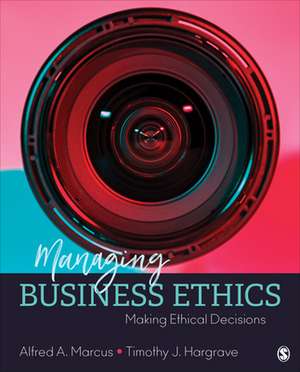
Managing Business Ethics: Making Ethical Decisions
Autor Alfred A. Marcus, Timothy J. Hargraveen Limba Engleză Electronic book text – 20 ian 2020
This practical, down-to-earth text also delves into topics not covered extensively by other books such as slow and fast thinking, the inherent conflict between the individual and organization, conformity, and the difficulties of speaking truth to power. Students are offered ample opportunity to engage in thoughtful reflection, discussion, and application as they grapple with ethical issues big and small.
Preț: 524.50 lei
Preț vechi: 570.10 lei
-8% Precomandă
Puncte Express: 787
Nepublicat încă
Livrare prin curier în România Precomanda se expediază când titlul devine disponibil.
Transport gratuit pentru acest produs Plată online sau ramburs, în funcție de opțiunile comenzii.
Retur gratuit în 14 zile Comandă securizată și suport în română.
Doresc să fiu notificat când acest titlu va fi disponibil:
Se trimite...
Specificații
ISBN-13: 9781506388601
ISBN-10: 1506388604
Pagini: 448
Dimensiuni: 187 x 232 mm
Ediția:1
Editura: SAGE Publications
Colecția Sage Publications, Inc
Locul publicării:Thousand Oaks, United States
ISBN-10: 1506388604
Pagini: 448
Dimensiuni: 187 x 232 mm
Ediția:1
Editura: SAGE Publications
Colecția Sage Publications, Inc
Locul publicării:Thousand Oaks, United States
V-ar putea interesa
-
 -9%Preț: 937.43 lei1030.15 lei
 -
 The Necessary Nature of Future FirmsGeorge P. Huber-18%Preț: 819.59 lei999.50 lei
 -
 Applying E-Commerce in BusinessRana Tassabehji-15%Preț: 602.41 lei708.71 lei
 -
 Beyond ManagementIan Lennie-18%Preț: 725.53 lei884.79 lei
 -
 Controversial Issues in Energy PolicyAlfred A. Marcus-15%Preț: 624.87 lei735.14 lei
 -
 'Managing' StressTim Newton-18%Preț: 723.12 lei881.85 lei
 -
 The Adversary Economy: Business Responses to Changing Government RequirementsAlfred Allen Marcus-40%Preț: 474.27 lei791.09 lei
 -
 -41%Preț: 454.59 lei768.49 lei
 -
 Strategies for Managing UncertaintyAlfred A. Marcus-26%Preț: 527.18 lei716.85 lei
 -
 Innovations in SustainabilityAlfred A. MarcusPreț: 318.04 lei
 -
 Strategies for Managing UncertaintyAlfred A. MarcusPreț: 402.74 lei
 -
 Preț: 144.27 lei
 -
 Preț: 274.00 lei
 -
 Preț: 174.91 lei
 -
 Der Weg zu Burnout-freien ArbeitsweltenRuth TrösterPreț: 309.76 lei
 -
 Jahresabschluss nach HGBTorsten MindermannPreț: 179.95 lei
Cuprins
Preface
Acknowledgments
About the Authors
PART I: INTRODUCTION TO ETHICAL DECISION-MAKING—THE INDIVIDUAL
Chapter 1. A Commonsense Approach to Business Ethics
Introduction: Ethics Is Tough!
What Ethics Is About
Ethical Decisions and Ethical Dilemmas
Someone May Be Hurt
Intuition Versus Reasoning
A Commonsense Method of Making Ethical Choices: The Weight-of-Reasons Framework
Understanding the Framework
Medical Products: The Complicated Business of Addressing Risks
Applying the Framework
Some Pointers in Using the Framework
Use the Framework Organically
Summary and Conclusion
Key Terms and Concepts
Case Applications
Notes
Chapter 2. Using Ethical Reasoning
Introduction: Approaches to Ethics
Utilitarianism
Deontology: Rights and Duties
Combining Utilitarianism and Deontology
Virtue Theory
Other Ethical Perspectives
Summary and Conclusion
Key Terms and Concepts
Case Applications
Notes
Chapter 3. Thinking, Fast and Slow: Ethical Intuitions and Reasoning
Introduction
Fast Versus Slow Thinking in Ethics
Self-Interest
Ethical Intuitions
Combining Fast and Slow Thinking: The Weight-of-Reasons Framework
Summary and Conclusion
Key Terms and Concepts
Cases Related to the Reading
Case Applications
Notes
PART II: THE ORGANIZATIONAL CONTEXT FOR ETHICAL DECISION-MAKING
Chapter 4. Managing Social Influences on Ethical Decision-Making
Introduction
The Problem of Conformity
Obedience to Authority
Conformity Due to Groupthink
Challenging Unethical Behavior in Organizations: Voice, Whistle-Blowing, and Exiting
Applying the Weight-of-Reasons Framework to Close the Circle
Summary and Conclusion
Key Terms and Concepts
Cases Related to the Reading
Case Applications
Notes
Chapter 5. From Short-Term Fixes to Long-Term Solutions
Introduction
Building Learning Into Decision Processes
Systems Thinking
Both/And Thinking
Moral Imagination
Team Decision-Making
Ethical Decision-Making and Uncertainty: The Incremental Approach
Ethical Learning Spirals
Summary and Conclusion
Key Terms and Concepts
Cases Related to the Reading
Case Applications
Notes
Chapter 6. Building Ethical Organizations
Introduction
Ethics Programs
Compliance-Based and Values-Based Ethics Programs
Diversity Programs
Ethics Programs and the Weight of Reasons
Ethical Organizations
Summary and Conclusion
Key Terms and Concepts
Cases Related to the Reading
Case Applications
Notes
PART III: THE SOCIETAL CONTEXT FOR ETHICAL DECISION-MAKING
Chapter 7. Legal Compliance and Beyond
Introduction
Legal Considerations and the Interests of Stakeholders
Existing Laws That Protect the Rights and Interests of Stakeholders
Ethics Means Going Beyond Compliance
Approaches to Going Beyond Compliance
Summary and Conclusion
Key Terms and Concepts
Cases Related to the Reading
Case Applications
Notes
Chapter 8. The Role of Stakeholders in Ethical Decision-Making
Introduction
Stakeholders, Ethics, and Priorities
Shareholder Theory
Stakeholder Theory
Does It Pay to Be “Good”?
Managing Stakeholder Relationships
Stakeholders and the Weight-of-Reasons Framework
Summary and Conclusion
Key Terms and Concepts
Cases Related to the Reading
Case Applications
Notes
Chapter 9. Ethics, Strategy, and Grand Challenges
Introduction
Addressing Grand Challenges Through Ethical Decision-Making
Ethical Innovations to Address Grand Challenges: Three Approaches
Summary and Conclusion
Key Terms and Concepts
Cases Related to the Reading
Case Applications
Notes
PART IV: CASES
Chapter 10. Cases
Introduction
Bayer: The Acquisition of Monsanto
BP: The Big Oil Spill: What Went Wrong
Dow–DuPont: The Bhopal Disaster
Facebook: Privacy and the Public Interest
Ford: Safety Recalls
General Mills: Nutrition
Google: Doing No Harm
Google: Problems With Sexual Harassment
Intel: Mobileye
Mallinckrodt: The Opioid Crisis
Merck and J&J: Problems With Consumer Safety
Microsoft: Addressing Bribery
VW: Dieselgate
Walmart: Sustainability
Wells Fargo: Can It Come Back?
Whole Foods: Conscious Capitalism
Further Readings
Notes
Glossary
Index
Acknowledgments
About the Authors
PART I: INTRODUCTION TO ETHICAL DECISION-MAKING—THE INDIVIDUAL
Chapter 1. A Commonsense Approach to Business Ethics
Introduction: Ethics Is Tough!
What Ethics Is About
Ethical Decisions and Ethical Dilemmas
Someone May Be Hurt
Intuition Versus Reasoning
A Commonsense Method of Making Ethical Choices: The Weight-of-Reasons Framework
Understanding the Framework
Medical Products: The Complicated Business of Addressing Risks
Applying the Framework
Some Pointers in Using the Framework
Use the Framework Organically
Summary and Conclusion
Key Terms and Concepts
Case Applications
Notes
Chapter 2. Using Ethical Reasoning
Introduction: Approaches to Ethics
Utilitarianism
Deontology: Rights and Duties
Combining Utilitarianism and Deontology
Virtue Theory
Other Ethical Perspectives
Summary and Conclusion
Key Terms and Concepts
Case Applications
Notes
Chapter 3. Thinking, Fast and Slow: Ethical Intuitions and Reasoning
Introduction
Fast Versus Slow Thinking in Ethics
Self-Interest
Ethical Intuitions
Combining Fast and Slow Thinking: The Weight-of-Reasons Framework
Summary and Conclusion
Key Terms and Concepts
Cases Related to the Reading
Case Applications
Notes
PART II: THE ORGANIZATIONAL CONTEXT FOR ETHICAL DECISION-MAKING
Chapter 4. Managing Social Influences on Ethical Decision-Making
Introduction
The Problem of Conformity
Obedience to Authority
Conformity Due to Groupthink
Challenging Unethical Behavior in Organizations: Voice, Whistle-Blowing, and Exiting
Applying the Weight-of-Reasons Framework to Close the Circle
Summary and Conclusion
Key Terms and Concepts
Cases Related to the Reading
Case Applications
Notes
Chapter 5. From Short-Term Fixes to Long-Term Solutions
Introduction
Building Learning Into Decision Processes
Systems Thinking
Both/And Thinking
Moral Imagination
Team Decision-Making
Ethical Decision-Making and Uncertainty: The Incremental Approach
Ethical Learning Spirals
Summary and Conclusion
Key Terms and Concepts
Cases Related to the Reading
Case Applications
Notes
Chapter 6. Building Ethical Organizations
Introduction
Ethics Programs
Compliance-Based and Values-Based Ethics Programs
Diversity Programs
Ethics Programs and the Weight of Reasons
Ethical Organizations
Summary and Conclusion
Key Terms and Concepts
Cases Related to the Reading
Case Applications
Notes
PART III: THE SOCIETAL CONTEXT FOR ETHICAL DECISION-MAKING
Chapter 7. Legal Compliance and Beyond
Introduction
Legal Considerations and the Interests of Stakeholders
Existing Laws That Protect the Rights and Interests of Stakeholders
Ethics Means Going Beyond Compliance
Approaches to Going Beyond Compliance
Summary and Conclusion
Key Terms and Concepts
Cases Related to the Reading
Case Applications
Notes
Chapter 8. The Role of Stakeholders in Ethical Decision-Making
Introduction
Stakeholders, Ethics, and Priorities
Shareholder Theory
Stakeholder Theory
Does It Pay to Be “Good”?
Managing Stakeholder Relationships
Stakeholders and the Weight-of-Reasons Framework
Summary and Conclusion
Key Terms and Concepts
Cases Related to the Reading
Case Applications
Notes
Chapter 9. Ethics, Strategy, and Grand Challenges
Introduction
Addressing Grand Challenges Through Ethical Decision-Making
Ethical Innovations to Address Grand Challenges: Three Approaches
Summary and Conclusion
Key Terms and Concepts
Cases Related to the Reading
Case Applications
Notes
PART IV: CASES
Chapter 10. Cases
Introduction
Bayer: The Acquisition of Monsanto
BP: The Big Oil Spill: What Went Wrong
Dow–DuPont: The Bhopal Disaster
Facebook: Privacy and the Public Interest
Ford: Safety Recalls
General Mills: Nutrition
Google: Doing No Harm
Google: Problems With Sexual Harassment
Intel: Mobileye
Mallinckrodt: The Opioid Crisis
Merck and J&J: Problems With Consumer Safety
Microsoft: Addressing Bribery
VW: Dieselgate
Walmart: Sustainability
Wells Fargo: Can It Come Back?
Whole Foods: Conscious Capitalism
Further Readings
Notes
Glossary
Index
Descriere
Managing
Business
Ethics:
Making
Ethical
Decisionsteaches
students
how
to
navigate
ethical
issues
they
will
encounter
using
the
weight-of-reasons
approach
applied
throughout
the
book.
Notă biografică
Alfred A. Marcus is the Edson Spencer Endowed Professor in strategy and
technological leadership in the Strategic Management and Entrepreneurship
Department at the Carlson School of Management, the University of Minnesota,
and the Technological Leadership Institute in the University of Minnesota's
Institute of Technology. He is the author of Innovations in Sustainability: Fuel
and Food, published by Cambridge University Press in 2015 and the author of
Strategies for Managing Uncertainty: Booms and Busts in the Energy Industry,
published by Cambridge University Press in 2019. Innovations in Sustainability
won the "Outstanding Book" award in 2016 for the ONE division at the Academy
of Management. He was coeditor of a special 2011 fall issue of the California
Management Review on regulatory uncertainty and the natural environment.
From 1995 to 2001, he was chair of the Strategic Management and Organization
Department at the Carlson School. He has consulted with numerous major corporations
and has received grants from government agencies. Since 2006, he also
has taught in the MBA program of the Technion Israel Institute of Technology. He
received his bachelor's and master's degrees from the University of Chicago and his
PhD from Harvard University. In 2005 and 2015, he won the outstanding teacher
of the year award in the Carlson School MBA programs, and he has won a similar
award at the Technion.
technological leadership in the Strategic Management and Entrepreneurship
Department at the Carlson School of Management, the University of Minnesota,
and the Technological Leadership Institute in the University of Minnesota's
Institute of Technology. He is the author of Innovations in Sustainability: Fuel
and Food, published by Cambridge University Press in 2015 and the author of
Strategies for Managing Uncertainty: Booms and Busts in the Energy Industry,
published by Cambridge University Press in 2019. Innovations in Sustainability
won the "Outstanding Book" award in 2016 for the ONE division at the Academy
of Management. He was coeditor of a special 2011 fall issue of the California
Management Review on regulatory uncertainty and the natural environment.
From 1995 to 2001, he was chair of the Strategic Management and Organization
Department at the Carlson School. He has consulted with numerous major corporations
and has received grants from government agencies. Since 2006, he also
has taught in the MBA program of the Technion Israel Institute of Technology. He
received his bachelor's and master's degrees from the University of Chicago and his
PhD from Harvard University. In 2005 and 2015, he won the outstanding teacher
of the year award in the Carlson School MBA programs, and he has won a similar
award at the Technion.