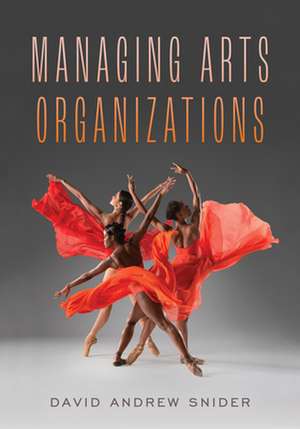
Managing Arts Organizations
Autor David Andrew Snideren Limba Engleză Paperback – 15 ian 2022
In Managing Arts Organizations, David Andrew Snider provides a playbook for navigating arts management in this new era and seeks to inspire a new generation of arts managers. Each chapter is focused on a specific topic, with principles, stories, exercises, advice, and best practices related to that topic. The appendix includes eight case studies, each illuminating issues in arts management via a real world scenario or organization. These narratives will enhance the reader's understanding of topics including financial management, marketing, programming, Diversity, Equity, and Inclusion efforts, and accessibility across multiple disciplines.
An instructor's manual is available for professors who adopt the book as a required textbook.
Preț: 314.22 lei
Preț vechi: 393.21 lei
-20%
Puncte Express: 471
Carte tipărită la comandă
Livrare economică 30 noiembrie-14 decembrie
Livrare prin curier în România Termenul estimat este afișat lângă disponibilitate.
Transport gratuit de la 400.00 lei Plată online sau ramburs, în funcție de opțiunile comenzii.
Retur gratuit în 14 zile Comandă securizată și suport în română.
Specificații
ISBN-13: 9781538160640
ISBN-10: 1538160641
Pagini: 328
Ilustrații: 24 b/w photos; 15 tables; 13 textboxes
Dimensiuni: 172 x 252 x 22 mm
Greutate: 0.66 kg
Editura: Bloomsbury Publishing
Colecția Rowman & Littlefield
Locul publicării:New York, United States
ISBN-10: 1538160641
Pagini: 328
Ilustrații: 24 b/w photos; 15 tables; 13 textboxes
Dimensiuni: 172 x 252 x 22 mm
Greutate: 0.66 kg
Editura: Bloomsbury Publishing
Colecția Rowman & Littlefield
Locul publicării:New York, United States
Cuprins
Title Page
Dedication
Table of Contents
A Note to Instructors
Preface
Acknowledgements
Finding Our PurposeFocusing On Our PrinciplesDefining Mission, Vision, and ValuesBuilding Programming Growing an OrganizationPursuing Diversity, Equity and InclusionRaising MoneyManaging MoneyBudgeting StrategicallyManaging PeopleEngaging AudiencesInspiring StudentsActivating Communities Adapting from City Mouse to Country Mouse Rebuilding an Organization Following a FounderListening to the FieldLooking ForwardAppendix: Case Studies
The Case of the Indianapolis Museum of ArtThe Case of Beeple and Breonna TaylorThe Case of Scaffold at the Walker Arts CenterThe Case of Rita CrundwellThe Case of Theatre de la Jeune LuneThe Case of Healing Arts InitiativeThe Case of Young Playwrights' TheaterThe Case of Hubbard Hall About the Author
Index
Dedication
Table of Contents
A Note to Instructors
Preface
Acknowledgements
Finding Our PurposeFocusing On Our PrinciplesDefining Mission, Vision, and ValuesBuilding Programming Growing an OrganizationPursuing Diversity, Equity and InclusionRaising MoneyManaging MoneyBudgeting StrategicallyManaging PeopleEngaging AudiencesInspiring StudentsActivating Communities Adapting from City Mouse to Country Mouse Rebuilding an Organization Following a FounderListening to the FieldLooking ForwardAppendix: Case Studies
The Case of the Indianapolis Museum of ArtThe Case of Beeple and Breonna TaylorThe Case of Scaffold at the Walker Arts CenterThe Case of Rita CrundwellThe Case of Theatre de la Jeune LuneThe Case of Healing Arts InitiativeThe Case of Young Playwrights' TheaterThe Case of Hubbard Hall About the Author
Index
Recenzii
David Snider's Managing Arts Organizations is a timely and relevant resource for both aspiring and emerging arts leaders. Framed in the real-world, David shares with the reader his zeal for tackling tough issues facing arts organizations in the 21st Century, and he does so with keen insight and compassion. David's common-sense approach to problem-solving is woven throughout the text and his case studies are as intuitive as they are thought-provoking. Managing Arts Organizations is the culmination of years of experience and lessons learned by a dynamic and inspiring arts leader who I am honored to consider a trusted colleague and friend.
Managing Arts Organizations is a must-read for artists who want to create, manage, and produce the arts.
Managing Arts Organizations is a must have for students, educators, professionals, and artists alike. With case studies and interviews, David Snider's astute book is practical and insightful about building programs, creating partnerships, deepening funding relationships and managing arts organizations in big cities and small towns. Most importantly of all, it offers better-practice arts management principles to develop sustainable adaptive strategies for new and challenging contexts.
'Big city or tiny town, rural or urban,' Snider acknowledges that the status quo arts and cultural world continues to undergo tectonic shifts. Not only does Snider provide visibility in this new world but he creates much-needed stratification to the old host of terms allowing for more space to understand distinct challenges for individual organizations. Snider confirms that there is not a one size fits all solution for governance, relationship-building, and management.
Drawing on decades of personal experience as a successful arts manager, as well as several years supporting the development and learning of those aspiring to be arts administrators, David Snider has written a guidebook covering the fundamentals of arts management. With each chapter serving as a valuable primer to a single topic, this resource is well-suited to less experienced staffers and board members, those pursuing a post-secondary degree, aspiring professionals, and others who are unfamiliar with the key features of the arts management terrain and seeking an overview of the typical structures, practices, and processes of the field.
His readable and engaging text should prove invaluable to students and professionals alike, but also for artists looking to better understand the field and board members faced with the countless challenges of guiding a nonprofit
Managing Arts Organizations is a must-read for artists who want to create, manage, and produce the arts.
Managing Arts Organizations is a must have for students, educators, professionals, and artists alike. With case studies and interviews, David Snider's astute book is practical and insightful about building programs, creating partnerships, deepening funding relationships and managing arts organizations in big cities and small towns. Most importantly of all, it offers better-practice arts management principles to develop sustainable adaptive strategies for new and challenging contexts.
'Big city or tiny town, rural or urban,' Snider acknowledges that the status quo arts and cultural world continues to undergo tectonic shifts. Not only does Snider provide visibility in this new world but he creates much-needed stratification to the old host of terms allowing for more space to understand distinct challenges for individual organizations. Snider confirms that there is not a one size fits all solution for governance, relationship-building, and management.
Drawing on decades of personal experience as a successful arts manager, as well as several years supporting the development and learning of those aspiring to be arts administrators, David Snider has written a guidebook covering the fundamentals of arts management. With each chapter serving as a valuable primer to a single topic, this resource is well-suited to less experienced staffers and board members, those pursuing a post-secondary degree, aspiring professionals, and others who are unfamiliar with the key features of the arts management terrain and seeking an overview of the typical structures, practices, and processes of the field.
His readable and engaging text should prove invaluable to students and professionals alike, but also for artists looking to better understand the field and board members faced with the countless challenges of guiding a nonprofit