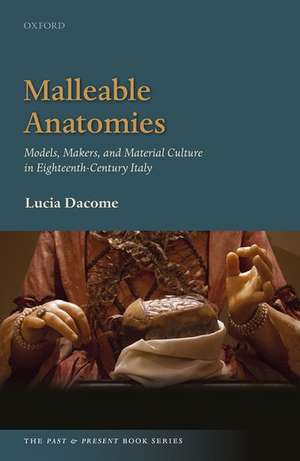
Malleable Anatomies: Models, Makers, and Material Culture in Eighteenth-Century Italy: The Past and Present Book Series
Autor Lucia Dacomeen Limba Engleză Hardback – iun 2017
Din seria The Past and Present Book Series
- 21%
 Preț: 202.41 lei
 - 15%
 Preț: 249.44 lei
 - 21%
 Preț: 218.60 lei
 - 16%
 Preț: 244.07 lei
 - 17%
 Preț: 240.93 lei
 - 32%
 Preț: 641.49 lei
 - 33%
 Preț: 627.92 lei
 - 15%
 Preț: 250.46 lei
 - 16%
 Preț: 244.52 lei
 - 21%
 Preț: 244.63 lei
 - 31%
 Preț: 531.27 lei
 - 33%
 Preț: 642.67 lei
 - 33%
 Preț: 543.96 lei
 - 32%
 Preț: 692.43 lei
 - 32%
 Preț: 585.61 lei
 - 17%
 Preț: 334.31 lei
 - 16%
 Preț: 337.16 lei
 - 16%
 Preț: 243.71 lei
 - 23%
 Preț: 148.67 lei
 - 21%
 Preț: 193.54 lei
 - 31%
 Preț: 679.32 lei
 - 9%
 Preț: 662.96 lei
 - 18%
 Preț: 273.24 lei
 - 16%
 Preț: 368.20 lei
 - 31%
 Preț: 588.76 lei
 - 21%
 Preț: 203.23 lei
Preț: 730.77 lei
Preț vechi: 1050.84 lei
-30%
Puncte Express: 1096
Carte tipărită la comandă
Livrare economică 03-08 decembrie
Livrare prin curier în România Termenul estimat este afișat lângă disponibilitate.
Transport gratuit pentru acest produs Plată online sau ramburs, în funcție de opțiunile comenzii.
Retur gratuit în 14 zile Comandă securizată și suport în română.
Specificații
ISBN-13: 9780198736189
ISBN-10: 0198736185
Pagini: 336
Ilustrații: black and white images, colour plate section
Dimensiuni: 161 x 240 x 27 mm
Greutate: 0.72 kg
Editura: OUP OXFORD
Colecția OUP Oxford
Seria The Past and Present Book Series
Locul publicării:Oxford, United Kingdom
ISBN-10: 0198736185
Pagini: 336
Ilustrații: black and white images, colour plate section
Dimensiuni: 161 x 240 x 27 mm
Greutate: 0.72 kg
Editura: OUP OXFORD
Colecția OUP Oxford
Seria The Past and Present Book Series
Locul publicării:Oxford, United Kingdom
V-ar putea interesa
-
 An Atlas of Animal Anatomy for ArtistsW. Ellenberger-18%Preț: 102.04 lei123.79 lei
 -
 An Atlas of Anatomy for ArtistsFritz Schider-33%Preț: 110.92 lei166.13 lei
 -
 -18%Preț: 114.75 lei140.61 lei
 -
 The Anatomical VenusJoanna Ebenstein-26%Preț: 146.48 lei196.89 lei
 -
 Slashed BeautiesA. Rushby-19%Preț: 112.10 lei137.56 lei
 -
 Preț: 425.22 lei
 -
 -18%Preț: 168.46 lei205.77 lei
 -
 Modelwork: The Material Culture of Making and KnowingMartin BrücknerPreț: 242.86 lei
 -
 Flesh and Bones: The Art of AnatomyMonique KornellPreț: 406.06 lei
 -
 Putting Plastic Surgery on PaperChristine SloboginPreț: 245.12 lei
 -
 AnatomyChristopher Joseph-20%Preț: 94.09 lei118.33 lei
 -
 Anatomica: The Exquisite and Unsettling Art of Human AnatomyJoanna Ebenstein-22%Preț: 189.73 lei242.04 lei
 -
 The Art of Anatomy in Medieval EuropeTaylor McCall-13%Preț: 119.13 lei136.81 lei
 -
 Andreas Vesalius: Anatomy and the World of BooksSachiko Kusukawa-11%Preț: 123.64 lei139.43 lei
 -
 The Surgeon, The Midwife, The QuackAlanna SkusePreț: 138.14 lei
 -
 The Beating Heart: The Art and Science of Our Most Vital OrganRobin Choudhury-32%Preț: 184.62 lei270.97 lei
 -
 Human AnatomyJane De Burgh-5%Preț: 312.35 lei328.79 lei
 -
 Anatomical WaxesMarta PoggesiPreț: 206.84 lei
 -
 Anatomical WaxesDavid Cronenberg-15%Preț: 515.06 lei605.96 lei
Recenzii
[A] superb work... Highly recommended.
...the volume is rich and important. Focusing more on the lives of wax modellers than on that of the anatomical waxes (which could be a choice), it broadens the horizon on the relationships between art, science, gender and patronage in the eighteenth century.
This is an important book, dealing with eighteenth-century Italian anatomical models and displays, especially those made in wax, in Bologna, with a coda on Southern Italy, on Naples and Palermo ... This is a timely and useful book, offering a nuanced assessment of anatomy and surgery, medicine and science, while also providing an enlightening and at times unexpected perspective on Italian history in the Settecento.
demonstrates the continuing power of richly contextualized local case studies. Dacome's analysis brings together a wide range of approaches: by tracing the models and their materiality she finds new ways of understanding contemporary epistemological debates ... Dacome's book presents a rich and complex image of the world of anatomical models and their makers that will be of interest to a wide range of historians.
Dacome has produced a timely and beautiful work that substantively adds to our understanding of anatomical collections and Grand Tour literature, gender, and material culture in eighteenth-century Italy.
This book is one of the most carefully crafted and wide-ranging studies on early modern anatomical collections to date.
Malleable Anatomies provides an intricate history of the 'diversified' world of mid-18th century Italian anatomy. In many ways the book is a thing of great beauty. It is rich in details that can only be the product of years of meticulous archival research, and it is wonderfully illustrated. The analysis in the individual chapters is also woven together with great skill ... this book is full of interesting insights and perspectives.
...the volume is rich and important. Focusing more on the lives of wax modellers than on that of the anatomical waxes (which could be a choice), it broadens the horizon on the relationships between art, science, gender and patronage in the eighteenth century.
This is an important book, dealing with eighteenth-century Italian anatomical models and displays, especially those made in wax, in Bologna, with a coda on Southern Italy, on Naples and Palermo ... This is a timely and useful book, offering a nuanced assessment of anatomy and surgery, medicine and science, while also providing an enlightening and at times unexpected perspective on Italian history in the Settecento.
demonstrates the continuing power of richly contextualized local case studies. Dacome's analysis brings together a wide range of approaches: by tracing the models and their materiality she finds new ways of understanding contemporary epistemological debates ... Dacome's book presents a rich and complex image of the world of anatomical models and their makers that will be of interest to a wide range of historians.
Dacome has produced a timely and beautiful work that substantively adds to our understanding of anatomical collections and Grand Tour literature, gender, and material culture in eighteenth-century Italy.
This book is one of the most carefully crafted and wide-ranging studies on early modern anatomical collections to date.
Malleable Anatomies provides an intricate history of the 'diversified' world of mid-18th century Italian anatomy. In many ways the book is a thing of great beauty. It is rich in details that can only be the product of years of meticulous archival research, and it is wonderfully illustrated. The analysis in the individual chapters is also woven together with great skill ... this book is full of interesting insights and perspectives.
Notă biografică
Lucia Dacome is an associate professor and Pauline M.H. Mazumdar Chair in the History of Medicine at the IHPST, University of Toronto. She received her PhD from the University of Cambridge and held postdoctoral fellowships at the Max Planck Institute for the History of Science in Berlin, the Wellcome Trust Centre for the History of Medicine at UCL, the UCLA Centre for seventeenth- and eighteenth-century studies in Los Angeles, and a Marie Curie Intra-European Fellowship supported by the European Commission at the Centre Alexandre Koyré/CNRS in Paris. Her research focuses on themes at the intersection of the history of medicine, the history of the body, the history of visual and material cultures of medicine, gender history, the history of the self, and that of medical practices and exchanges in the Mediterranean world.
Cuprins
- Acknowledgments
- List of Plates
- List of Figures
- List of Abbreviation
- Introduction
- 1: Prospero's Tools
- 2: Artificer and Connoisseur
- 3: Anatomy, Embroidery, and the Fabric of Celebrity
- 4: Women, Wax, and Anatomy
- 5: Blindfolding the Midwives
- 6: Transferring Values
- 7: Injecting Knowledge
- Epilogue: Becoming Obsolete
- Selected Bibliography
- Index