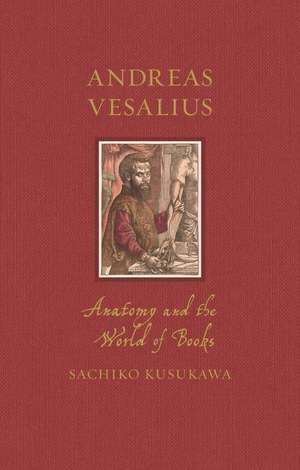
Andreas Vesalius: Anatomy and the World of Books: Renaissance Lives
Autor Sachiko Kusukawaen Limba Engleză Hardback – 30 iul 2024
In 1543 the young and ambitious physician Andreas Vesalius published one of the most famous books in the history of medicine, On the Fabric of the Human Body. While we often think of dissection as destroying the body, Vesalius believed that it helped him understand how to construct the human body. In this book, Sachiko Kusukawa shows how Vesalius’s publication emerged from the interplay of Renaissance art, printing technology, and classical tradition. She challenges the conventional view of Vesalius as a proto-modern, anti-authoritarian father of anatomy through a more nuanced account of how Vesalius exploited cultural and technological developments to create a big and beautiful book that propelled him into imperial circles and secured his enduring fame.
Din seria Renaissance Lives
- 12%
 Preț: 127.31 lei
 - 11%
 Preț: 128.46 lei
 - 13%
 Preț: 125.50 lei
 - 11%
 Preț: 129.06 lei
 - 13%
 Preț: 124.93 lei
 - 12%
 Preț: 127.83 lei
 - 7%
 Preț: 129.98 lei
 - 10%
 Preț: 133.61 lei
 - 12%
 Preț: 129.39 lei
 - 12%
 Preț: 126.02 lei
 - 11%
 Preț: 130.56 lei
 - 7%
 Preț: 129.39 lei
 -
 Preț: 128.57 lei
 - 11%
 Preț: 129.06 lei
 -
 Preț: 144.12 lei
 - 12%
 Preț: 127.31 lei
 - 12%
 Preț: 127.31 lei
 - 14%
 Preț: 105.18 lei
 - 13%
 Preț: 106.44 lei
 - 11%
 Preț: 129.84 lei
 - 12%
 Preț: 126.06 lei
 - 13%
 Preț: 124.39 lei
 - 8%
 Preț: 126.06 lei
 - 8%
 Preț: 127.31 lei
 - 13%
 Preț: 108.55 lei
 -
 Preț: 135.72 lei
 - 14%
 Preț: 103.45 lei
 -
 Preț: 138.64 lei
 - 8%
 Preț: 125.27 lei
 -
 Preț: 107.71 lei
 -
 Preț: 104.02 lei
 -
 Preț: 107.50 lei
 -
 Preț: 133.08 lei
 -
 Preț: 132.11 lei
 -
 Preț: 135.85 lei
 -
 Preț: 132.32 lei
 -
 Preț: 132.02 lei
 -
 Preț: 132.68 lei
 -
 Preț: 137.20 lei
 -
 Preț: 138.51 lei
 -
 Preț: 137.20 lei
 -
 Preț: 131.71 lei
Preț: 122.64 lei
Preț vechi: 139.23 lei
-12%
Puncte Express: 184
Carte disponibilă
Livrare economică 28 octombrie-04 noiembrie
Livrare express 14-20 octombrie pentru 46.79 lei
Livrare prin curier în România Termenul estimat este afișat lângă disponibilitate.
Transport gratuit de la 400.00 lei Plată online sau ramburs, în funcție de opțiunile comenzii.
Retur gratuit în 14 zile Comandă securizată și suport în română.
Specificații
ISBN-13: 9781789148527
ISBN-10: 1789148529
Pagini: 224
Ilustrații: 45 color plates, 30 halftones
Dimensiuni: 138 x 216 x 25 mm
Greutate: 0.61 kg
Editura: REAKTION BOOKS
Colecția Reaktion Books
Seria Renaissance Lives
ISBN-10: 1789148529
Pagini: 224
Ilustrații: 45 color plates, 30 halftones
Dimensiuni: 138 x 216 x 25 mm
Greutate: 0.61 kg
Editura: REAKTION BOOKS
Colecția Reaktion Books
Seria Renaissance Lives
V-ar putea interesa
-
 Preț: 207.61 lei
 -
 Gray's Anatomy: The Anatomical Basis of Clinical PracticeSusan Standring-28%Preț: 1303.21 lei1812.11 lei
 -
 An Atlas of Anatomy for ArtistsFritz Schider-34%Preț: 110.03 lei165.90 lei
 -
 The Ten Books on ArchitectureVitruviusPreț: 136.13 lei
 -
 The Illustrations from the Works of Andreas Vesalius of BrusselsAndreas Vesalius-48%Preț: 118.67 lei228.24 lei
 -
 -20%Preț: 279.25 lei351.05 lei
 -
 -30%Preț: 536.76 lei768.41 lei
 -
 The Book-MakersAdam SmythPreț: 94.28 lei
 -
 Flesh and Bones: The Art of AnatomyMonique KornellPreț: 399.05 lei
 -
 AnatomyChristopher Joseph-21%Preț: 91.85 lei116.68 lei
 -
 The Art of Anatomy in Medieval EuropeTaylor McCall-13%Preț: 116.34 lei134.41 lei
 -
 -5%Preț: 80.48 lei84.72 lei
 -
 Johannes Gutenberg: A Biography in BooksEric Marshall WhitePreț: 122.50 lei
 -
 The Surgeon, The Midwife, The QuackAlanna SkusePreț: 137.94 lei
 -
 Human AnatomyJane De Burgh-5%Preț: 311.70 lei328.10 lei
 -
 Remarkable Renaissance BooksJohn BoardleyPreț: 453.01 lei
 -
 Anatomical WaxesMarta PoggesiPreț: 206.53 lei
 -
 The Fabrica of Andreas VesaliusDániel Margócsy-5%Preț: 1580.54 lei1663.72 lei
Notă biografică
Sachiko Kusukawa is professor of the history of science at the University of Cambridge. Her books include Picturing the Book of Nature: Image, Text, and Argument in Sixteenth-Century Human Anatomy and Medical Botany, which won the Pfizer Award from the History of Science Society.
Cuprins
Introduction
1 Learned Medicine and Its Books
2 Books and Careers
3 Vesalius and the World of Books
4 The Making of the Book: The Printer and the Author
5 The Human Figure: Art and Anatomy
6 Theatre
7 The Bodies in the Book
8 Vesalius: Surgeon, Anatomist, Physician?
9 Making and Unmaking
10 After Fabrica
Chronology
References
Select Bibliography
Acknowledgements
Photo Acknowledgements
Index
1 Learned Medicine and Its Books
2 Books and Careers
3 Vesalius and the World of Books
4 The Making of the Book: The Printer and the Author
5 The Human Figure: Art and Anatomy
6 Theatre
7 The Bodies in the Book
8 Vesalius: Surgeon, Anatomist, Physician?
9 Making and Unmaking
10 After Fabrica
Chronology
References
Select Bibliography
Acknowledgements
Photo Acknowledgements
Index
Recenzii
"[A] rich, pluralistic intellectual world is exquisitely evoked by Sachiko Kusukawa in her marvellous new book on Vesalius and the Fabrica. Before turning to the man himself, she guides us through the practices of his immediate predecessors . . . The greatest strength of Kusukawa’s book is its meticulous description of the design, composition and preparation of the Fabrica . . . Reaktion has done a wonderful job here, as with other works in its Renaissance Lives series. The illustrations (many in colour) are crisp, and the book is bound with thread rather than glue. Many larger publishers could learn from them."
"It is published as part of Reaktion’s excellent Renaissance Lives series, and offers an elegant and knowledgeable entry point to the subject in question - even if in this instance, it is as much about the life of Vesalius’s book as about the man himself. Kusukawa’s account of De Fabrica’s famous images of the human body is particularly skilled . . . Elegant and authoritative, Kusukawa’s book is a perfect introduction both to Vesalius and to the world in which he was able to socially climb - and transform - through his glorious yet somewhat gory medical masterpiece."
“Kusukawa’s monograph is affordable and beautifully produced. . . It is a learned introduction to the man and his celebrated masterpiece that specialists too will find useful and thought-provoking, a powerful reminder that top scholarship can be beautifully written in a didactic fashion.”
"Kusukawa’s vivid reconstruction of the making of Vesalius's Fabrica takes us deep inside the world of anatomical demonstrations, hospital postmortems, criminal executions, university lecture halls, humanist libraries and artistic and printing workshops. She explains how Vesalius thought about books, images and bodies, and his skill at instructing Renaissance readers how to look, touch, dissect and model the human body in order to learn from it. There is no better introduction to Vesalius."
"In this brilliant digestion of her earlier work, Kusukawa not only reconstructs ‘the making’ of Andreas Vesalius’s masterpiece, Fabrica (and the book’s reception and afterlife), but the making of the man himself. The ‘founder’ of modern anatomy we see in full context, reliant on his peers, his readers and his students in the production of his masterpiece. He is also shown to be a canny negotiator with artists and printers in the making of the book’s famous images. Ultimately Andreas Vesalius: Anatomy and the World of Books compels engagement with the construction of the ‘truthfulness’ of all scientific images, then and now. This is historical anatomy and provocation at its arresting best."