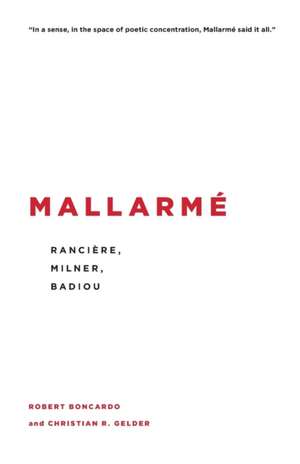
Mallarmé: Rancière, Milner, Badiou: Insolubilia: New Work in Contemporary Philosophy
Autor Robert Boncardo, Christian R. Gelderen Limba Engleză Paperback – 16 mar 2017
Preț: 257.89 lei
Preț vechi: 351.20 lei
-27%
Puncte Express: 387
Carte tipărită la comandă
Livrare economică 26 noiembrie-10 decembrie
Livrare prin curier în România Termenul estimat este afișat lângă disponibilitate.
Transport gratuit de la 400.00 lei Plată online sau ramburs, în funcție de opțiunile comenzii.
Retur gratuit în 14 zile Comandă securizată și suport în română.
Specificații
ISBN-13: 9781786603111
ISBN-10: 178660311X
Pagini: 144
Dimensiuni: 139 x 216 x 8 mm
Greutate: 0.41 kg
Editura: Bloomsbury Publishing
Colecția Rowman & Littlefield
Seria Insolubilia: New Work in Contemporary Philosophy
Locul publicării:New York, United States
ISBN-10: 178660311X
Pagini: 144
Dimensiuni: 139 x 216 x 8 mm
Greutate: 0.41 kg
Editura: Bloomsbury Publishing
Colecția Rowman & Littlefield
Seria Insolubilia: New Work in Contemporary Philosophy
Locul publicării:New York, United States
Descriere
From the post-War writings of Sartre and Blanchot to the post-structuralism of Jacques Derrida and Julia Kristeva, French philosophers have consistently debated the poetry of Stéphane Mallarmé, almost as a rite of passage. Alain Badiou, Jean-Claude Milner and Jacques Rancière - three of the most important philosophers alive today - are no exception, having written extensively about the poet since the 1960's and 70's up until today. This book contains a series of interviews with these three figures on Mallarmé, as well as an extended introduction that places their thought on literature into dialogue. Speaking about their personal and philosophical relationships with each other, on methods of reading, on poetry and politics, and poetry and mathematics, each philosopher reflects on their life-long engagement with Mallarmé, as well as on the different, often incommensurable, images of the poet their philosophies have generated. As Rancière, Milner and Badiou point to the past importance and future directions Mallarmé gives to thought, these interviews lend credence to Barthes' remark that "all we can do is repeat Mallarmé - and it is good that we do so".
Cuprins
Introduction: The subject to which everything is attached / 1. "A singular invention of language and thought": Jacques Rancière / 2. "I believed I owed Mallarmé the truth": Jean-Claude Milner / 3. "Mallarmé said it all": Alain Badiou / Further Reading / Index
Recenzii
"Mallarmé said it all": these conversations with three of France's leading philosophers explore the complexity of the poet's thought, moving from the broadly humanistic to the more overtly political. By tying each interpretation to the personal evolution of each thinker, the two editors enhance our understanding both of these readings of Mallarmé and of the philosophers themselves. ?
The interviews conducted by Robert Boncardo and Christian Gelder with Alain Badiou, Jean-Claude Milner and Jacques Rancière are invaluable, and for more than one reason. They confirm that Stéphane Mallarmé is an unsurpassable figure in the French literary and intellectual field for whoever reflects with even the slightest seriousness on the relations between literature, philosophy, science and politics. They provide a very illuminating overview of the mental universes of some of the greatest contemporary French intellectuals, and prove in passing that, no, they have not yet completely disappeared. And finally, they suffice to show that, in a period of academic regression in literary studies, it is possible to assign this discipline tasks far more exhilarating than what today's reigning neo-philology can imagine.
When properly conscious of Mallarmé at all, the Anglophone world has rarely if ever registered the astonishing variety of the thought he has provoked in modern France, and his crucial importance for a range of philosophical, linguistic, political, aesthetic and mathematical debates. With a long and well-informed introduction, these searching and absorbing interviews tell us much, not only about how Mallarmé has mattered and continued to matter to his compatriots, but about why he should matter to ourselves.
The interviews with Badiou, Rancière and Milner, as occasioned and recorded in this important new book restore Stéphane Mallarmé to the world of real artistic, political and scientific events and actions, and hopefully contribute towards further emancipating the great poet's work from perceptions of inaccessibility and obscurity.
[Le livre] a le grand mérite, d'abord, de rappeler que le poète est encore à l'origine de pensées abstraites, malgré la domination depuis une bonne dizaine d'années, dans un champ toujours en expansion, de l'approche socio-historique.
The interviews conducted by Robert Boncardo and Christian Gelder with Alain Badiou, Jean-Claude Milner and Jacques Rancière are invaluable, and for more than one reason. They confirm that Stéphane Mallarmé is an unsurpassable figure in the French literary and intellectual field for whoever reflects with even the slightest seriousness on the relations between literature, philosophy, science and politics. They provide a very illuminating overview of the mental universes of some of the greatest contemporary French intellectuals, and prove in passing that, no, they have not yet completely disappeared. And finally, they suffice to show that, in a period of academic regression in literary studies, it is possible to assign this discipline tasks far more exhilarating than what today's reigning neo-philology can imagine.
When properly conscious of Mallarmé at all, the Anglophone world has rarely if ever registered the astonishing variety of the thought he has provoked in modern France, and his crucial importance for a range of philosophical, linguistic, political, aesthetic and mathematical debates. With a long and well-informed introduction, these searching and absorbing interviews tell us much, not only about how Mallarmé has mattered and continued to matter to his compatriots, but about why he should matter to ourselves.
The interviews with Badiou, Rancière and Milner, as occasioned and recorded in this important new book restore Stéphane Mallarmé to the world of real artistic, political and scientific events and actions, and hopefully contribute towards further emancipating the great poet's work from perceptions of inaccessibility and obscurity.
[Le livre] a le grand mérite, d'abord, de rappeler que le poète est encore à l'origine de pensées abstraites, malgré la domination depuis une bonne dizaine d'années, dans un champ toujours en expansion, de l'approche socio-historique.
Notă biografică
Robert Boncardo has completed a doctorate in French Studies at The University of Sydney and Aix-Marseille Université.