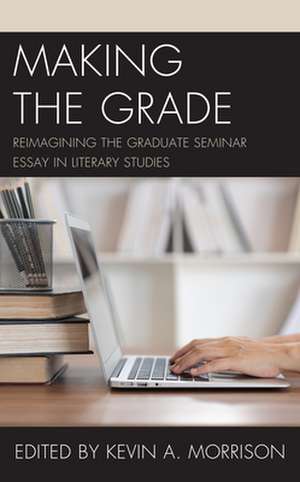
Making the Grade: Reimagining the Graduate Seminar Essay in Literary Studies
Editat de Kevin A. Morrisonen Limba Engleză Paperback – iul 2021
Preț: 219.66 lei
Preț vechi: 292.40 lei
-25%
Puncte Express: 329
Carte tipărită la comandă
Livrare economică 30 noiembrie-14 decembrie
Livrare prin curier în România Termenul estimat este afișat lângă disponibilitate.
Transport gratuit de la 400.00 lei Plată online sau ramburs, în funcție de opțiunile comenzii.
Retur gratuit în 14 zile Comandă securizată și suport în română.
Specificații
ISBN-13: 9781475856385
ISBN-10: 1475856385
Pagini: 140
Ilustrații: 9 b/w illustrations
Dimensiuni: 148 x 226 x 14 mm
Greutate: 0.29 kg
Editura: Bloomsbury Publishing
Colecția Rowman & Littlefield
Locul publicării:New York, United States
ISBN-10: 1475856385
Pagini: 140
Ilustrații: 9 b/w illustrations
Dimensiuni: 148 x 226 x 14 mm
Greutate: 0.29 kg
Editura: Bloomsbury Publishing
Colecția Rowman & Littlefield
Locul publicării:New York, United States
Cuprins
Introduction: The Graduate Classroom Staple
Kevin A. Morrison
Part One: The Seminar Paper: History, Conception, Experience
1. Essaying Assessment and Assessing the Essay: The Graduate Seminar Paper as Disciplinary Performance
Phil Robinson-Self
2. The Cost of Ambiguity: How Students Experience the Graduate Seminar Paper Genre
Gabriel Morrison and Thomas Deans
Part Two: Argument, Ethos, Intervention
3. The Seminar Essay as Academic Literary Criticism: Strategies for Entering the Scholarly Conversation
Almas Khan
4. Writing with Authority: Ethos and the Seminar Essay in English Studies
Elizabeth Vogel
5. A Scaffold for Scholarship: Re-vising the Seminar Writing Assignment
Janet G. Auten
Part Three: Reading, Writing, Revision, and Presentation
6. Setting Up for Success: Strategies for Managing Research and Writing
Marilyn Gray
7. Time Management is Everything: Useful Tips for Graduate Students
Natalie M. Dorfeld
8. Peer Review, Revisited: Graduate Writing Groups
Mark Celeste
9. Presenting Research Ideas in a Seminar Setting
Lucinda Becker
Part Four: New Directions, Expanding Possibilities
10. Digital Methods and Visual Essays in the Classroom
Lisann Anders
11. Structural Shifts and the Graduate Literary Essay: Examples for the Twenty-First Century Classroom
Shanthini Pillai
12. Not for Everyone: Experiments in Assessment
Kevin A. Morrison
Coda: Demystifying the Seminar Paper
Jessie Reeder
Kevin A. Morrison
Part One: The Seminar Paper: History, Conception, Experience
1. Essaying Assessment and Assessing the Essay: The Graduate Seminar Paper as Disciplinary Performance
Phil Robinson-Self
2. The Cost of Ambiguity: How Students Experience the Graduate Seminar Paper Genre
Gabriel Morrison and Thomas Deans
Part Two: Argument, Ethos, Intervention
3. The Seminar Essay as Academic Literary Criticism: Strategies for Entering the Scholarly Conversation
Almas Khan
4. Writing with Authority: Ethos and the Seminar Essay in English Studies
Elizabeth Vogel
5. A Scaffold for Scholarship: Re-vising the Seminar Writing Assignment
Janet G. Auten
Part Three: Reading, Writing, Revision, and Presentation
6. Setting Up for Success: Strategies for Managing Research and Writing
Marilyn Gray
7. Time Management is Everything: Useful Tips for Graduate Students
Natalie M. Dorfeld
8. Peer Review, Revisited: Graduate Writing Groups
Mark Celeste
9. Presenting Research Ideas in a Seminar Setting
Lucinda Becker
Part Four: New Directions, Expanding Possibilities
10. Digital Methods and Visual Essays in the Classroom
Lisann Anders
11. Structural Shifts and the Graduate Literary Essay: Examples for the Twenty-First Century Classroom
Shanthini Pillai
12. Not for Everyone: Experiments in Assessment
Kevin A. Morrison
Coda: Demystifying the Seminar Paper
Jessie Reeder
Recenzii
Concrete, rhetorically rich, impactful, and engaging in multimodal literacy, this timely volume is an essential contribution to writing scholarship on demystifying the role of seminar essay writing in graduate-level and professional literary studies. Each essay in the volume speaks to distinct and multiple audiences-professors, students, junior scholars, and writing center directors and consultants. As a result, it creates a dialogic and engaging space to (re)frame the seminar essay as groundwork, or apprentice-level work, that allows new scholars and junior faculty to develop their literature-based research and writing skills and leverage these skills in broader ways. The volume will help faculty scaffold the graduate seminar essay assignment and evaluation with intentionality and to stage the graduate seminar essay as a meaningful and rewarding process for both the facilitator and the emerging scholar.
For a field that prides itself on rethinking its theoretical grounds, literary studies often takes for granted the pragmatic mechanics of scholarship. Making the Grade fills that gap. From a cultural history of the essay to incisive contemporary rethinking of its usefulness in the classroom, from guides on how to write a seminar paper to guides on how to assess them, Making the Grade offers desperately needed clarity on a complex genre. The contributions in this book should be standard for every first-semester graduate student and every first-semester professor who wants to prepare undergraduates for graduate-level writing or who wants to prepare graduate students for professional publication.
This book is a great resource for new graduate students interested in knowing how to navigate their studies more effectively and creatively. It draws from a wide variety of perspectives and insights. There is not only a recognition of institutional efforts, such as Graduate Writing Centers, to improve international students' writing skills, but also a consideration of how colonialism has affected literacy studies over time. Many important ethical elements are emphasized, including reflection and trustworthiness. I highly recommend this book for those embarking on their scholarly journey.
Throughout my four years in a doctoral program, I have been recommended at least a dozen writing handbooks. But as Morrison notes no book thus far has been solely dedicated to the seminar paper. . . . An innovative feature of the book is its foregrounding of the multimodal essay, which broadens how research in the humanities can be conducted and presented, and its advocacy for training in digital methods and the inclusion of visual essay formats in the graduate classroom. For instructors who are suspicious of the efficacy of these newer, relatively untested forms, this book provides a digestible introduction, among many other useful ideas and recommendations.
For a field that prides itself on rethinking its theoretical grounds, literary studies often takes for granted the pragmatic mechanics of scholarship. Making the Grade fills that gap. From a cultural history of the essay to incisive contemporary rethinking of its usefulness in the classroom, from guides on how to write a seminar paper to guides on how to assess them, Making the Grade offers desperately needed clarity on a complex genre. The contributions in this book should be standard for every first-semester graduate student and every first-semester professor who wants to prepare undergraduates for graduate-level writing or who wants to prepare graduate students for professional publication.
This book is a great resource for new graduate students interested in knowing how to navigate their studies more effectively and creatively. It draws from a wide variety of perspectives and insights. There is not only a recognition of institutional efforts, such as Graduate Writing Centers, to improve international students' writing skills, but also a consideration of how colonialism has affected literacy studies over time. Many important ethical elements are emphasized, including reflection and trustworthiness. I highly recommend this book for those embarking on their scholarly journey.
Throughout my four years in a doctoral program, I have been recommended at least a dozen writing handbooks. But as Morrison notes no book thus far has been solely dedicated to the seminar paper. . . . An innovative feature of the book is its foregrounding of the multimodal essay, which broadens how research in the humanities can be conducted and presented, and its advocacy for training in digital methods and the inclusion of visual essay formats in the graduate classroom. For instructors who are suspicious of the efficacy of these newer, relatively untested forms, this book provides a digestible introduction, among many other useful ideas and recommendations.