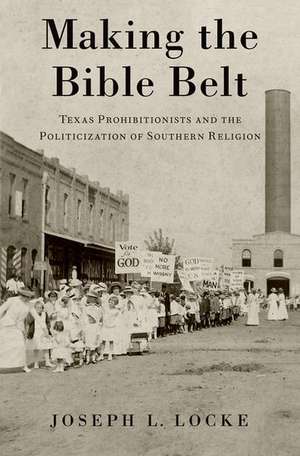
Making the Bible Belt: Texas Prohibitionists and the Politicization of Southern Religion
Autor Joseph Lockeen Limba Engleză Hardback – 27 iul 2017
Recomandăm Making the Bible Belt ca o resursă academică esențială pentru înțelegerea mecanismelor prin care religia a devenit un pilon de putere în viața publică americană, o temă de maximă relevanță pentru examenele de istorie politică și sociologia religiei. Joseph Locke demontează ideea preconcepută conform căreia „Centura Biblică” a fost o entitate statică, demonstrând că această alianță a fost rezultatul unei campanii deliberate și conflictuale desfășurate pe parcursul mai multor decenii. Premisa centrală se concentrează pe statul Texas, unde eforturile de a interzice consumul de alcool au forțat bisericile evanghelice să își abandoneze reținerile teologice tradiționale față de viața seculară.
Considerăm că forța acestui volum rezidă în documentarea tranziției de la o teologie introspectivă la un activism politic fără scuze, totul pe fondul unei rezistențe anticlericale acerbe care invoca amintirea vânătorilor de vrăjitoare puritane. Locke analizează cum lideri precum J. Frank Norris au utilizat concepte de rasă, gen și istorie pentru a construi o mișcare politică formidabilă. Cititorii familiarizați cu Southern Cross de Christine Leigh Heyrman vor aprecia modul în care volumul de față completează tabloul evoluției protestantismului sudic, oferind o perspectivă mai aplicată asupra momentului în care moralitatea religioasă a fost codificată în legislație statală și națională. Spre deosebire de lucrările care tratează religia sudică drept un bloc monolitic, Making the Bible Belt evidențiază fracturile și înfrângerile timpurii care au rafinat strategiile politice ale clerului, oferind totodată indicii prețioase despre originile istorice ale dreptei religioase moderne.
Preț: 308.45 lei
Preț vechi: 344.59 lei
-10%
Carte tipărită la comandă
Livrare economică 05-16 iunie
Specificații
ISBN-10: 019021628X
Pagini: 296
Ilustrații: 13 hts
Dimensiuni: 157 x 236 x 28 mm
Greutate: 0.52 kg
Editura: Oxford University Press
Colecția OUP USA
Locul publicării:New York, United States
V-ar putea interesa
-
 John Calvin as Sixteenth-Century ProphetJon Balserak-34%Preț: 733.47 lei1110.50 lei
 -
 -34%Preț: 1761.96 lei2676.03 lei
 -
 -14%Preț: 872.95 lei1015.05 lei
 -
 -34%Preț: 842.79 lei1273.57 lei
 -
 -34%Preț: 1646.83 lei2509.83 lei
 -
 -28%Preț: 736.24 lei1019.49 lei
 -
 -14%Preț: 630.91 lei733.62 lei
 -
 Jesus Swagger: Break Free from Poser ChristianityJarrid WilsonPreț: 115.90 lei
 -
 Preț: 132.53 lei
 -
 Seven Men: And the Secret of Their GreatnessEric MetaxasPreț: 102.06 lei
 -
 Preț: 95.65 lei
De ce să citești această carte
Reținem această lucrare pentru rigoarea cu care explică rădăcinile activismului politic religios. Este o lectură fundamentală pentru studenții la științe politice și istorie care doresc să înțeleagă cum o mișcare de reformă morală, precum prohibiția, a fost vehiculul prin care valorile conservatoare au cucerit sfera publică. Cititorul câștigă o înțelegere nuanțată a modului în care identitatea regională americană a fost modelată prin conflict ideologic și mobilizare religioasă.
Despre autor
Joseph Locke este un istoric specializat în intersecția dintre religie și politica americană, aducând o perspectivă critică asupra structurilor de putere din sudul Statelor Unite. În Making the Bible Belt, publicat de Oxford University Press, el își valorifică expertiza pentru a arhiva un moment transformator în istoria Texasului. Abordarea sa monografică a fost lăudată de critici pentru modul în care reușește să spulbere supozițiile eronate despre rolul religiei în istoria politică, fiind considerat un cercetător atent la nuanțele sociologice și istorice ale regiunii.
Descriere
Recenzii
Only a few monographs force historians to reconsider something we all 'know.' Making the Bible Belt is one of those books. Joseph Locke argues convincingly that the critical role played by clericalism in the political life of Texas, rather than having always been present, actually dates only from the era of prohibition. Texas did not join the Bible Belt until the battle against alcohol allowed clericalism to overcome a long-standing tradition of anticlericalism and give religion its currently pervasive role in the state's public life.
In this bold and informative book Locke poses a vital question: How did the religious world of late-nineteenth century Texas--freewheeling, iconoclastic, and skeptical of preachers in politics--become in the twentieth century a hub of the Bible Belt, with its conformist 'Texas Theology' and politically aggressive church establishment? His answers will be of value to anyone interested in the history and current role of religion in American politics.
Many talk of the Bible Belt, but few understand its origins. Joseph Locke's book describes a forgotten anti-clerical culture in Texas, then explains the emergence of political preachers, provides an insightful account of the fight over prohibition there, and demonstrates the importance of a neglected historical figure-Senator Morris Sheppard. Locke's fascinating book reveals how conservative evangelicals came to exercise such influence in America. It tells a compelling story that explains the past and speaks to the present.
With rigor and flair, Joseph Locke shatters the presumption, passed down by generations of pundits and scholars, that the South has always been the Bible Belt, a natural hothouse of fundamentalist zeal. It was only through the relentless crusading of a rising clerical class, capped off by the political triumph over rum, that the region we now recognize as evangelical orthodoxy's dominant hub assumed its reigning religiosity. This is a beautifully crafted book by a talented historian.
By highlighting the important role of clericalism in the Texas prohibition campaigns, Joseph L. Locke has given us a new and useful way to think about the relationship between religious and political institutions in Texas, in the Bible Belt, and in the nation as a whole. That is no small accomplishment.
Crisply written and studiously documentedMaking the Bible Beltpresents a compelling argument[about] late nineteenth-and early-twentieth-century Texas, revealing a contentious, competitive religious milieu.
Many people mistakenly believe the American South was always a hotbed of religious fervor. In his meticulously researched andartfully written Making the Bible Belt, Joseph L. Locke demonstrates how recent a development the Bible belt phenomenon is and tracesit to determined opposition of church people to anticlericalism in the late nineteenth and early twentieth centuries.
This book should be required reading for anyone wishing to assess patterns enacted by elements of the Christian church that engage themselves in political rhetoric and the lust for power that comes from wishing to dictate cultural morality. Locke does a fantastic job ordering historical material in a way that the reader feels as if they are reading a book about a contemporary social concern, all the while explaining the foundation of the "Bible Belt" in the late nineteenth and early twentieth century.
Joseph L. Locke's eye-opening monograph shatters erroneous and too-long-held assumptions regarding the role of religion in Texas political history...This nuanced volume should be read closely not just by historians of American religion, but political scientists and sociologists as well.