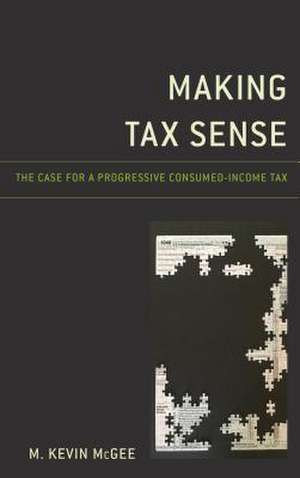
Making Tax Sense: The Case for a Progressive Consumed-Income Tax
Autor M. Kevin McGeeen Limba Engleză Hardback – 15 mar 2019
We need a tax system that make sense. As this book shows however, making a traditional income tax coherent is an impossible goal. But coherence is achievable if we adjust our target, and complete the switch to a consumed-income tax -- a system that taxes all income, not when it is earned, but when that income is consumed. The move towards a consumed-income tax was begun decades ago, when we first adopted IRAs and other tax-deferred savings accounts. We just needed to complete the evolution.
The book explores a variety of tax issues -- among them savings, small businesses, owner-occupied houses, and corporations -- and develops seven groups of recommended changes. These changes would result in a tax system that would be pro-growth, by eliminating the existing disincentives to saving and investment. But the tax system would also remain progressive, with the wealthy taxed as much as and perhaps even more than currently. That combination could make the recommended changes attractive to members of both parties, and might bring to a close the political seesaw in tax policy that we've experienced over that last several decades.
| Toate formatele și edițiile | Preț | Express |
|---|---|---|
| Paperback (1) | 242.57 lei 6-8 săpt. | |
| Bloomsbury Publishing – 6 iul 2021 | 242.57 lei 6-8 săpt. | |
| Hardback (1) | 622.25 lei 3-5 săpt. | |
| Bloomsbury Publishing – 15 mar 2019 | 622.25 lei 3-5 săpt. |
Preț: 622.25 lei
Preț vechi: 732.07 lei
-15%
Puncte Express: 933
Preț estimativ în valută:
110.01€ • 127.99$ • 95.69£
110.01€ • 127.99$ • 95.69£
Carte disponibilă
Livrare economică 27 martie-10 aprilie
Specificații
ISBN-13: 9781498587174
ISBN-10: 1498587178
Pagini: 180
Ilustrații: 14 tables;
Dimensiuni: 161 x 229 x 20 mm
Greutate: 0.45 kg
Editura: Bloomsbury Publishing
Colecția Lexington Books
Locul publicării:New York, United States
ISBN-10: 1498587178
Pagini: 180
Ilustrații: 14 tables;
Dimensiuni: 161 x 229 x 20 mm
Greutate: 0.45 kg
Editura: Bloomsbury Publishing
Colecția Lexington Books
Locul publicării:New York, United States
V-ar putea interesa
-
 The New Business of FootballS. Morrow-15%Preț: 614.05 lei722.41 lei
 -
 Banking in the New EuropeEdward P M Gardener-15%Preț: 619.66 lei729.01 lei
 -
 Preț: 333.72 lei
 -
 Preț: 157.20 lei
 -
 Value Creation and Opportunity Management in Africa's Leather SectorMwinyikione Mwinyihija-24%Preț: 464.88 lei614.53 lei
 -
 Preț: 157.82 lei
 -
 Offshore CompaniesMichael MagnussonPreț: 120.19 lei
 -
 Quality Management in the Nonprofit WorldLarry W KennedyPreț: 68.45 lei
 -
 Preț: 193.51 lei
 -
 Preț: 80.59 lei
 -
 The Profit MachineLarry EarnhartPreț: 113.35 lei
 -
 Balance Sheet ManagementMorris A. NunesPreț: 238.88 lei
 -
 Chapter 11 Business Reorganizations: For Business Leaders, Accountants and LawyersMyles H. Jr. AldermanPreț: 248.34 lei
 -
 The Tax Aspects of Acquiring a BusinessGene SeagoPreț: 106.76 lei
 -
 State and Local TaxationCharles W SwensonPreț: 447.95 lei
Cuprins
1 The Problem
2 The Impossibility of a Coherent Traditional Income Tax
3 The Logic of Consumption-timed Taxes
4 The VAT, Flat, and all That
5 Savings & Borrowing Under a Consumed-Income Tax
6 The Tax Treatment of Owner Occupied Housing
7 Transition Issues
8 The Tax Treatment of Small Businesses
9 Inheritances, Bequests, and the Estate Tax
10 Insurance
11 The Corporate Income Tax
12 Tax Expenditures
13 The Trump Tax Cut
14 Summary: The Needed Tax Changes
15 Is Reform Attainable?
16 Conclusion
2 The Impossibility of a Coherent Traditional Income Tax
3 The Logic of Consumption-timed Taxes
4 The VAT, Flat, and all That
5 Savings & Borrowing Under a Consumed-Income Tax
6 The Tax Treatment of Owner Occupied Housing
7 Transition Issues
8 The Tax Treatment of Small Businesses
9 Inheritances, Bequests, and the Estate Tax
10 Insurance
11 The Corporate Income Tax
12 Tax Expenditures
13 The Trump Tax Cut
14 Summary: The Needed Tax Changes
15 Is Reform Attainable?
16 Conclusion
Recenzii
Kevin McGee's book is a lucid guide to a big idea in the debate over fundamental tax reform, one that is aimed at achieving the hitherto elusive goal of a tax code that is fairer, simpler, and more efficient.
The recent tax bill did not constitute a full-blown reform of what and how we tax. Thankfully, Kevin McGee reminds us of what a real pro-growth reform might be. The individual and corporate Income taxes fall more heavily on income used for saving and investment than on income used for consumption; they retard capital formation and wage growth, and they cost the country about a tenth of its potential annual output and income each year. McGee resurrects the concept of a progressive tax on income used for consumption - a "consumed-income tax" - that avoids these biases. It would allow more deferral of saving and full deductions for the cost of capital outlays. He has carefully explained how it would be applied to all manner of income and assets. Importantly, he addresses the transition to the new tax system, knocking down long-standing objections that it is too hard to get from here to there. This is a must read for young people new to the tax debates, and a good refresher for those who cut their teeth on the Flat Tax, the X Tax, and the national retail sales tax ideas of the post-Kennedy tax cuts era.
Taking off from the inconsistencies, imperfections, and idiocies inherent in the current tax system, Dr. McGee lays out the most thorough-and certainly best explained-case for a consumed income tax that I have seen. Along the way, he tackles the many difficult issues in such a reform, including debt, depreciation, old and new wealth, inheritance, timing, progressivity, and difficult transition issues. A true tour de force.
The recent tax bill did not constitute a full-blown reform of what and how we tax. Thankfully, Kevin McGee reminds us of what a real pro-growth reform might be. The individual and corporate Income taxes fall more heavily on income used for saving and investment than on income used for consumption; they retard capital formation and wage growth, and they cost the country about a tenth of its potential annual output and income each year. McGee resurrects the concept of a progressive tax on income used for consumption - a "consumed-income tax" - that avoids these biases. It would allow more deferral of saving and full deductions for the cost of capital outlays. He has carefully explained how it would be applied to all manner of income and assets. Importantly, he addresses the transition to the new tax system, knocking down long-standing objections that it is too hard to get from here to there. This is a must read for young people new to the tax debates, and a good refresher for those who cut their teeth on the Flat Tax, the X Tax, and the national retail sales tax ideas of the post-Kennedy tax cuts era.
Taking off from the inconsistencies, imperfections, and idiocies inherent in the current tax system, Dr. McGee lays out the most thorough-and certainly best explained-case for a consumed income tax that I have seen. Along the way, he tackles the many difficult issues in such a reform, including debt, depreciation, old and new wealth, inheritance, timing, progressivity, and difficult transition issues. A true tour de force.