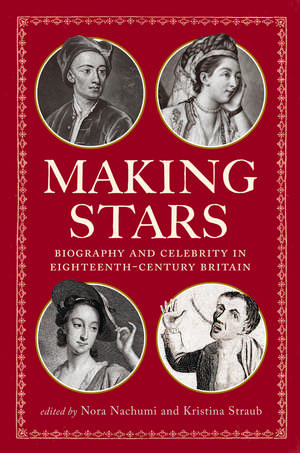
Making Stars
Editat de Nora Nachumi, Kristina Strauben Limba Engleză Hardback – 15 iul 2022
Preț: 938.84 lei
Preț vechi: 1095.68 lei
-14% Nou
Puncte Express: 1408
Preț estimativ în valută:
166.13€ • 194.81$ • 145.90£
166.13€ • 194.81$ • 145.90£
Carte indisponibilă temporar
Doresc să fiu notificat când acest titlu va fi disponibil:
Se trimite...
Preluare comenzi: 021 569.72.76
Specificații
ISBN-13: 9781644532652
ISBN-10: 1644532654
Pagini: 396
Ilustrații: 54 b&w, 10 color images
Dimensiuni: 156 x 235 x 28 mm
Greutate: 0.49 kg
Editura: University of Delaware Press
ISBN-10: 1644532654
Pagini: 396
Ilustrații: 54 b&w, 10 color images
Dimensiuni: 156 x 235 x 28 mm
Greutate: 0.49 kg
Editura: University of Delaware Press
Notă biografică
NORA NACHUMI is an Associate Professor in the Department of English and coordinator of the minor in Women’s Studies at Stern College for Women, Yeshiva University in New York, NY. She is the author of Acting Like a Lady: British Women Novelists and the Eighteenth-Century Stage and has published essays and book chapters on female novelists, playwrights, pedagogy and film adaptation.
KRISTINA STRAUB is a Professor of Literary and Cultural Studies at Carnegie Mellon University in Pittsburgh, Pennsylvania. She is the author of Sexual Suspects: Eighteenth-Century Players and Sexual Ideology and Domestic Affairs: Intimacy, Eroticism, and Violence Between Servants and Masters in Eighteenth Century Britain, as well as numerous articles on eighteenth-century theatre, sexuality, and gender. She co-curated “Will & Jane: Shakespeare, Austen, and Literary Celebrity” at the Folger Shakespeare Library with Janine Barchas.
KRISTINA STRAUB is a Professor of Literary and Cultural Studies at Carnegie Mellon University in Pittsburgh, Pennsylvania. She is the author of Sexual Suspects: Eighteenth-Century Players and Sexual Ideology and Domestic Affairs: Intimacy, Eroticism, and Violence Between Servants and Masters in Eighteenth Century Britain, as well as numerous articles on eighteenth-century theatre, sexuality, and gender. She co-curated “Will & Jane: Shakespeare, Austen, and Literary Celebrity” at the Folger Shakespeare Library with Janine Barchas.
Cuprins
List of Illustrations
Acknowledgments
Introduction
Nora Nachumi and Kristina Straub
PART I
REPRESENTING CELEBRITY ON THE STAGE AND THE PAGE
1 The Periodical and the Prism: Two Ways of Working at Celebrity in the Careers of Catherine Clive, Eliza Haywood, and Charlotte Charke
Stuart Sherman
2 Embodied Stage Biography and Celebrity in the Eighteenth Century
Semane Parsons
3 Image/Counterimage: Contesting Celebrity in Graphic Satire
Heather McPherson
PART II
MARKETING CELEBRITY IN THE MATERIAL WORLD
4 Modular Pope: Letters, Portraits, and the Collectible Celebrity
Sören Hammerschmidt
5 Biographical Fictions: Improvisation, Temporality, and the Celebrated Gunning Sisters, 1750 to Today
Kevin Bourque
6 Art and Merchandise, Followers and Fragility: Creating the Blueprint for Animal Celebrity
Glynis Ridley
PART III
LIFE WRITING AS SELF-DEFENSE
7 Neglected Genius: William Henry Ireland’s Quest for Anonymous Celebrity
Jack Lynch
8 Interpreting a Life: Theophilus Cibber, Celebrity Biography, and Public Adjudication
Elaine McGirr
9 Legal Stardom: Law, Life Writing, and Celebrity in the Case of Mary Bowes, Countess of Strathmore
Sarah Ailwood
PART IV
THE BODY AND THE BODY POLITIC
10 Creating Celebratory Memory: The Tombeaux des Princes
Anne Betty Weinshenker
11 Embodied Politics: Marlborough, Celebrity, and Secret History
Rebecca Tierney-Hynes
12 The Everyday Celebrity of “Sir” Jeffrey Dunstan, Mayor of Garrat
Miriam Wallace
PART V
WHOSE LIFE IS IT ANYWAY?
13 A “Universally Sorrowful Sensation”: National Mourning, Narrative, and Celebrity in the Posthumous Biographies of Princess Charlotte Augusta
Teri Doerksen
14 Spectacular Materials: The Afterlives of Murderess Mary Blandy
Kirsten T. Saxton
15 Extra-illustration, Participatory Biography, and the Construction of Celebrity
Jane Wessel
Notes on Contributors
Index
Acknowledgments
Introduction
Nora Nachumi and Kristina Straub
PART I
REPRESENTING CELEBRITY ON THE STAGE AND THE PAGE
1 The Periodical and the Prism: Two Ways of Working at Celebrity in the Careers of Catherine Clive, Eliza Haywood, and Charlotte Charke
Stuart Sherman
2 Embodied Stage Biography and Celebrity in the Eighteenth Century
Semane Parsons
3 Image/Counterimage: Contesting Celebrity in Graphic Satire
Heather McPherson
PART II
MARKETING CELEBRITY IN THE MATERIAL WORLD
4 Modular Pope: Letters, Portraits, and the Collectible Celebrity
Sören Hammerschmidt
5 Biographical Fictions: Improvisation, Temporality, and the Celebrated Gunning Sisters, 1750 to Today
Kevin Bourque
6 Art and Merchandise, Followers and Fragility: Creating the Blueprint for Animal Celebrity
Glynis Ridley
PART III
LIFE WRITING AS SELF-DEFENSE
7 Neglected Genius: William Henry Ireland’s Quest for Anonymous Celebrity
Jack Lynch
8 Interpreting a Life: Theophilus Cibber, Celebrity Biography, and Public Adjudication
Elaine McGirr
9 Legal Stardom: Law, Life Writing, and Celebrity in the Case of Mary Bowes, Countess of Strathmore
Sarah Ailwood
PART IV
THE BODY AND THE BODY POLITIC
10 Creating Celebratory Memory: The Tombeaux des Princes
Anne Betty Weinshenker
11 Embodied Politics: Marlborough, Celebrity, and Secret History
Rebecca Tierney-Hynes
12 The Everyday Celebrity of “Sir” Jeffrey Dunstan, Mayor of Garrat
Miriam Wallace
PART V
WHOSE LIFE IS IT ANYWAY?
13 A “Universally Sorrowful Sensation”: National Mourning, Narrative, and Celebrity in the Posthumous Biographies of Princess Charlotte Augusta
Teri Doerksen
14 Spectacular Materials: The Afterlives of Murderess Mary Blandy
Kirsten T. Saxton
15 Extra-illustration, Participatory Biography, and the Construction of Celebrity
Jane Wessel
Notes on Contributors
Index
Descriere
Making Stars provides multiple perspectives on the simultaneous emergence of modern forms of life writing and celebrity culture in eighteenth-century Britain. Crossing multiple genres and media, contributors reveal the complex and varied ways in which these modern ways of thinking about individual identity mutually conditioned their emergence during this formative period.