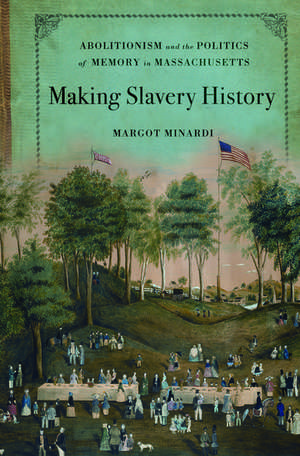
Making Slavery History: Abolitionism and the Politics of Memory in Massachusetts
Autor Margot Minardien Limba Engleză Hardback – 28 oct 2010
Preț: 601.69 lei
Preț vechi: 872.55 lei
-31%
Puncte Express: 903
Carte tipărită la comandă
Livrare economică 16-27 octombrie
Livrare prin curier în România Termenul estimat este afișat lângă disponibilitate.
Transport gratuit pentru acest produs Plată online sau ramburs, în funcție de opțiunile comenzii.
Retur gratuit în 14 zile Comandă securizată și suport în română.
Specificații
ISBN-13: 9780195379372
ISBN-10: 0195379373
Pagini: 240
Ilustrații: 10 illustrations
Dimensiuni: 239 x 163 x 23 mm
Greutate: 0.5 kg
Editura: Oxford University Press
Colecția OUP USA
Locul publicării:New York, United States
ISBN-10: 0195379373
Pagini: 240
Ilustrații: 10 illustrations
Dimensiuni: 239 x 163 x 23 mm
Greutate: 0.5 kg
Editura: Oxford University Press
Colecția OUP USA
Locul publicării:New York, United States
V-ar putea interesa
-
 WILLIAM WILBERFORCE PBWilliam HaguePreț: 121.76 lei
 -
 Twelve Years a SlaveSolomon NorthupPreț: 28.01 lei
 -
 -31%Preț: 957.70 lei1384.44 lei
 -
 Human Trafficking in EuropeGillian WyliePreț: 392.21 lei
 -
 Chernobyl PrayerSvetlana Alexiévich-26%Preț: 57.71 lei77.84 lei
 -
 Preț: 91.70 lei
 -
 Narrative of the Life of Frederick Douglass, an American SlaveFrederick Douglass-19%Preț: 22.85 lei28.26 lei
 -
 Liverpool Docks: A Short HistoryDavid Paul-12%Preț: 104.72 lei118.60 lei
 -
 -27%Preț: 66.81 lei91.54 lei
 -
 A Brief History of Slavery: A New Global HistoryJeremy Black-27%Preț: 66.71 lei91.48 lei
Recenzii
In Making Slavery History, Margot Minardi analyzes how perceptions of events, and those who participate in them, change and how such changes reflect and affect action. She is the first to center on this phenomenon as a means of understanding how, between the American Revolution and the Civil War, people in Massachusetts understood slavery and abolition, African American character, and the antislavery struggle.
A smart, creative, and provocative account...Making Slavery History represents one of those rare books that can be savored in part and devoured in whole...Minardi's narrative masters the art of using small stories to tell large tales. She not only reveals who makes history and how history gets made, she reminds readers why the stories the living choose to tell about the dead really matter at all.
Minardi s book is a passionate and much-needed reminder both of 'the power of memory to move us, hopefully and purposefully, through a broken and tumultuous world,' as well as the power of memory to sharpen resistance to change and hinder some futures.
Excellent monograph...Making Slavery History is elegantly written, thought provoking, and deserves to be widely read.
This is a graceful, elegant book that is also very, very smart. Minardi's subject is history itself and its uses in constructing identity-the chronicling, justifying, memorializing, and explaining of slavery and the Revolutionary-era ending of slavery in Massachusetts. She elaborates, fine-tunes, and textures the 'constructed amnesia' argument about the history of slavery in New England in important ways, demonstrating just how this was in fact a history constructed of both presence and absence. In style and imagination, this manuscript powerfully evokes Jill Lepore's The Name of War, and in skillful reading of material objects as well as texts, Laurel Thatcher Ulrich's The Age of Homespun.
A smart, creative, and provocative account...Making Slavery History represents one of those rare books that can be savored in part and devoured in whole...Minardi's narrative masters the art of using small stories to tell large tales. She not only reveals who makes history and how history gets made, she reminds readers why the stories the living choose to tell about the dead really matter at all.
Minardi s book is a passionate and much-needed reminder both of 'the power of memory to move us, hopefully and purposefully, through a broken and tumultuous world,' as well as the power of memory to sharpen resistance to change and hinder some futures.
Excellent monograph...Making Slavery History is elegantly written, thought provoking, and deserves to be widely read.
This is a graceful, elegant book that is also very, very smart. Minardi's subject is history itself and its uses in constructing identity-the chronicling, justifying, memorializing, and explaining of slavery and the Revolutionary-era ending of slavery in Massachusetts. She elaborates, fine-tunes, and textures the 'constructed amnesia' argument about the history of slavery in New England in important ways, demonstrating just how this was in fact a history constructed of both presence and absence. In style and imagination, this manuscript powerfully evokes Jill Lepore's The Name of War, and in skillful reading of material objects as well as texts, Laurel Thatcher Ulrich's The Age of Homespun.
Notă biografică
Margot Minardi is Assistant professor of History and Humanities, Reed College