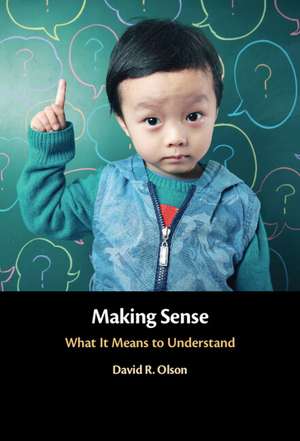
Making Sense: What It Means to Understand
Autor David R. Olsonen Limba Engleză Hardback – 4 mai 2022
Preț: 651.19 lei
Preț vechi: 731.68 lei
-11%
Puncte Express: 977
Carte tipărită la comandă
Livrare economică 02-16 iulie
Specificații
ISBN-13: 9781316513330
ISBN-10: 1316513335
Pagini: 200
Dimensiuni: 157 x 235 x 14 mm
Greutate: 0.45 kg
Ediția:Nouă
Editura: Cambridge University Press
Colecția Cambridge University Press
Locul publicării:Cambridge, United Kingdom
ISBN-10: 1316513335
Pagini: 200
Dimensiuni: 157 x 235 x 14 mm
Greutate: 0.45 kg
Ediția:Nouă
Editura: Cambridge University Press
Colecția Cambridge University Press
Locul publicării:Cambridge, United Kingdom
Cuprins
Preface; 1. Introduction; 2. Understanding as feeling and understanding as concept; 3. The linguistic basis of mind- linguistic concepts; 4. Subjective mental states: the feeling of understanding; 5. Objective mental states: the truth of understanding; 6. Intersubjectivity of mental states; 7. Identity conditions for feelings and concepts; 8. What 'understanding' means: ascribing understanding; 9. The referential scope of understanding; 10. Understanding in the theory of mind; 11. Understanding and making sense; 12. Understanding as a learnable skill; 13. Understanding in everyday life; 14. Ascriptivism and cognitive development; References.
Recenzii
'When David R. Olson asked his apparently pre-verbal 1-year-old to get her shoes, she promptly complied - much to his surprise. That incident planted the seed for a deep enquiry. Had she truly understood him? What does it mean to ascribe understanding to such a young child? We also need to consider who is doing the ascribing. Are young children able to ascribe understanding to themselves? And what about animals and computers? Drawing on the contributions of philosophers, linguists, and psychologists, David R. Olson proposes that understanding is a uniquely human capacity, slowly acquired as part of a web of language practices. His book is a provocative and original contribution to the study of children's theory of mind.' Paul Lansley Harris, Harvard Graduate School of Education, USA
Descriere
This account of children's learning to ascribe understanding to themselves and others may help to explain children's theory of mind.