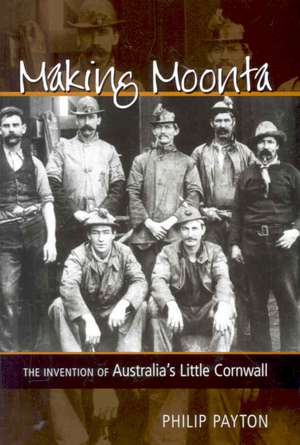
Making Moonta: The Invention of Australia's Little Cornwall
Autor Philip Paytonen Limba Engleză Hardback – 9 noi 2007
Winner of the 2008 Holyer An Gof Award for non-fiction. An investigation of the popular tradition of ‘Australia’s Little Cornwall’: how one town in South Australia gained and perpetuated this identity into the twenty-first century. This book is about Moonta and its special place in the Cornish transnational identity. Today Moonta is a small town on South Australia’s northern Yorke Peninsula; along with the neighbouring townships of of Wallaroo and Kadina, it is an agricultural and heritage tourism centre. In the second half of the nineteenth century, however, Moonta was the focus of a major copper mining industry.
This book is about Moonta and its special place in the Cornish transnational identity. Today Moonta is a small town on South Australia’s northern Yorke Peninsula; along with the neighbouring townships of of Wallaroo and Kadina, it is an agricultural and heritage tourism centre. In the second half of the nineteenth century, however, Moonta was the focus of a major copper mining industry.
From the beginning, Moonta cast itself as unique among Cornish immigrant communities, becoming ‘the hub of the universe’ according to its inhabitants, forging the myth of ‘Australia’s Little Cornwall’: a myth perpetuated by Oswald Pryor and others that survived the collapse of the copper mines in 1923—and remains vibrant and intact today.
This book is about Moonta and its special place in the Cornish transnational identity. Today Moonta is a small town on South Australia’s northern Yorke Peninsula; along with the neighbouring townships of of Wallaroo and Kadina, it is an agricultural and heritage tourism centre. In the second half of the nineteenth century, however, Moonta was the focus of a major copper mining industry.
From the beginning, Moonta cast itself as unique among Cornish immigrant communities, becoming ‘the hub of the universe’ according to its inhabitants, forging the myth of ‘Australia’s Little Cornwall’: a myth perpetuated by Oswald Pryor and others that survived the collapse of the copper mines in 1923—and remains vibrant and intact today.
Preț: 504.89 lei
Preț vechi: 668.50 lei
-24% Nou
Puncte Express: 757
Preț estimativ în valută:
89.34€ • 104.76$ • 78.46£
89.34€ • 104.76$ • 78.46£
Carte indisponibilă temporar
Doresc să fiu notificat când acest titlu va fi disponibil:
Se trimite...
Preluare comenzi: 021 569.72.76
Specificații
ISBN-13: 9780859897952
ISBN-10: 0859897958
Pagini: 269
Dimensiuni: 236 x 157 x 25 mm
Editura: UNIVERSITY OF EXETER PRESS
Colecția University of Exeter Press
ISBN-10: 0859897958
Pagini: 269
Dimensiuni: 236 x 157 x 25 mm
Editura: UNIVERSITY OF EXETER PRESS
Colecția University of Exeter Press
V-ar putea interesa
-
 Kelly, C: Flamboya TreeClara Olink KellyPreț: 109.06 lei
 -
 In TasmaniaNicholas ShakespearePreț: 109.35 lei
 -
 Empire and Environmental AnxietyJ. Beattie-15%Preț: 626.36 lei736.90 lei
 -
 Hill, D: The Great RaceDavid HillPreț: 198.39 lei
 -
 -55%Preț: 99.39 lei221.51 lei
 -
 Preț: 228.78 lei
 -
 Preț: 209.73 lei
 -
 Searching For The Secret RiverKate GrenvillePreț: 88.07 lei
 -
 Hocken: Prince of CollectorsDonald Kerr-15%Preț: 240.33 lei281.25 lei
 -
 -16%Preț: 193.97 lei231.15 lei
 -
 -10%Preț: 162.24 lei180.99 lei
Notă biografică
Philip Payton is Professor of Cornish & Australian Studies, University of Exeter, and is Director of the Institute of Cornish Studies at the University’s Cornwall campus. He has written widely on Cornwall and the Cornish; he is the author of A.L. Rowse and Cornwall: A Paradoxical Patriot (UEP, 2005, paperback 2007) and The Cornish Overseas: A History of Cornwall’s Great Emigration. He is a frequent visitor to Australia, where he has conducted extensive research and addressed numerous conferences.
Descriere
Descriere de la o altă ediție sau format:
An investigation of the popular tradition of `Australia's Little Cornwall': how one town in South Australia gained and perpetuated this identity into the twenty-first century. This book is about Moonta and its special place in the Cornish transnational identity.
An investigation of the popular tradition of `Australia's Little Cornwall': how one town in South Australia gained and perpetuated this identity into the twenty-first century. This book is about Moonta and its special place in the Cornish transnational identity.