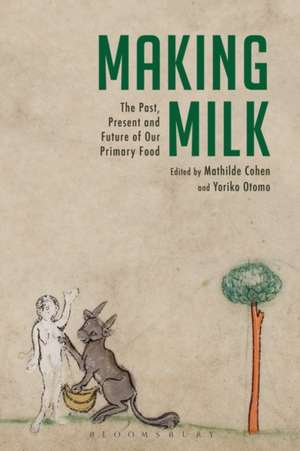
Making Milk: The Past, Present and Future of Our Primary Food
Editat de Mathilde Cohen, Yoriko Otomoen Limba Engleză Hardback – 2 noi 2017
This brand new research from scholars includes writing from an array of perspectives, including jurisprudence, food law, history, geography, art theory, and gender studies. It will be of use to professionals and researchers in such disciplines as anthropology, visual culture, cultural studies, development studies, food studies, environment studies, critical animal studies, and gender studies.
Preț: 837.59 lei
Preț vechi: 1243.89 lei
-33%
Puncte Express: 1256
Carte tipărită la comandă
Livrare economică 23 noiembrie-07 decembrie
Livrare prin curier în România Termenul estimat este afișat lângă disponibilitate.
Transport gratuit pentru acest produs Plată online sau ramburs, în funcție de opțiunile comenzii.
Retur gratuit în 14 zile Comandă securizată și suport în română.
Specificații
ISBN-13: 9781350029965
ISBN-10: 1350029963
Pagini: 320
Ilustrații: 60 b&w illus
Dimensiuni: 162 x 238 x 24 mm
Greutate: 0.61 kg
Editura: Bloomsbury Publishing
Colecția Bloomsbury Academic
Locul publicării:London, United Kingdom
ISBN-10: 1350029963
Pagini: 320
Ilustrații: 60 b&w illus
Dimensiuni: 162 x 238 x 24 mm
Greutate: 0.61 kg
Editura: Bloomsbury Publishing
Colecția Bloomsbury Academic
Locul publicării:London, United Kingdom
Cuprins
List of Tables
List of Contributors
Foreword
Acknowledgments
Introduction
Part One: Drinking Milk: Histories and Representations
1. More than Food: Animals, Men, and Supernatural Lactation
in Occidental Late Middle Ages, Chloé Maillet (Musée du quai de Branly, France)
2. Feminized Protein: Meaning, Representations, and
Implications, Carol J. Adams (independent scholar, USA)
3. Growing a Nation: Milk Consumption in India since
the Raj, Andrea S. Wiley (Indiana University, USA)
Part Two: Making Milk: Technologies and Economies
4. Unreliable Matriarchs, Melanie Jackson (UCL, University of London, UK) and Esther Leslie (Birkbeck, University of London, UK)
5. The Mechanical Calf: On the Making of a Multispecies Machine, Richie Nimmo (University of Manchester, UK)
6. Milk, Adulteration, Disgust: Making Legal Meaning, Yofi Tirosh (Tel Aviv University, Israel) and Yair Eldan (Ono Academic College, Israel)
7. Markets in Mothers' Milk: Virtue, Vice, Promise, or
Problem?Julie P. Smith (Australian National University, Australia)
Part Three: Queering Milk: Male Feeding and Plant Milk
8. The Lactating Man, Mathilde Cohen (University of Connecticut, USA)
9. "Cow's Milk is for Calves, Breastmilk is for Babies." Alfred
Bosworth's Reconstituted Milk and the Women who Innovated
Infant Feeding Amid an American Health Crisis, Hannah Ryan (Cornell University, USA)
10. Plant Milk: From Obscurity to Visions of a Post-Dairy
Society, Tobias Linné (Lund University, Sweden) and Ally McCrow-Young (University of Copenhagen, Denmark)
11. Critical Ecofeminism: Milk Fauna and Flora, Greta Gaard (University of Wisconsin-River Falls, USA)
Part Four: Thinking about Plant Milk
12. Milk and Meaning: Puzzles in Posthumanist Method, Jessica Eisen (Harvard Law School, USA)
13. DIY Plant Milk: A Recipe-Manifesto and Method of
Ethical Relations, Care, and Resistance, Matilda Arvidsson (Lund University, Sweden)
Notes
Bibliography
Index
List of Contributors
Foreword
Acknowledgments
Introduction
Part One: Drinking Milk: Histories and Representations
1. More than Food: Animals, Men, and Supernatural Lactation
in Occidental Late Middle Ages, Chloé Maillet (Musée du quai de Branly, France)
2. Feminized Protein: Meaning, Representations, and
Implications, Carol J. Adams (independent scholar, USA)
3. Growing a Nation: Milk Consumption in India since
the Raj, Andrea S. Wiley (Indiana University, USA)
Part Two: Making Milk: Technologies and Economies
4. Unreliable Matriarchs, Melanie Jackson (UCL, University of London, UK) and Esther Leslie (Birkbeck, University of London, UK)
5. The Mechanical Calf: On the Making of a Multispecies Machine, Richie Nimmo (University of Manchester, UK)
6. Milk, Adulteration, Disgust: Making Legal Meaning, Yofi Tirosh (Tel Aviv University, Israel) and Yair Eldan (Ono Academic College, Israel)
7. Markets in Mothers' Milk: Virtue, Vice, Promise, or
Problem?Julie P. Smith (Australian National University, Australia)
Part Three: Queering Milk: Male Feeding and Plant Milk
8. The Lactating Man, Mathilde Cohen (University of Connecticut, USA)
9. "Cow's Milk is for Calves, Breastmilk is for Babies." Alfred
Bosworth's Reconstituted Milk and the Women who Innovated
Infant Feeding Amid an American Health Crisis, Hannah Ryan (Cornell University, USA)
10. Plant Milk: From Obscurity to Visions of a Post-Dairy
Society, Tobias Linné (Lund University, Sweden) and Ally McCrow-Young (University of Copenhagen, Denmark)
11. Critical Ecofeminism: Milk Fauna and Flora, Greta Gaard (University of Wisconsin-River Falls, USA)
Part Four: Thinking about Plant Milk
12. Milk and Meaning: Puzzles in Posthumanist Method, Jessica Eisen (Harvard Law School, USA)
13. DIY Plant Milk: A Recipe-Manifesto and Method of
Ethical Relations, Care, and Resistance, Matilda Arvidsson (Lund University, Sweden)
Notes
Bibliography
Index
Recenzii
Making Milk proves through its carefully researched and detail-oriented descriptions to be a helpful resource to those wanting an understanding of what milk has been over time and place, for whom it is intended, the problematic issues behind how it functions symbolically in modern societies, and finally, suggestions on how to view milk going forward.
Making Milk is an ambitious, fascinating, and often disturbing read . It is also a hopeful read, one that offers readers a glimpse beyond the world we currently live in, beyond the Gilead of our past and of our present, and into a future beyond patriarchy, exploitation, and oppression, a future where new ways of relating with each other--men and women, humans and other animals--are possible, if we only dare to create them.
Editors Mathilde Cohen and Yoriko Otomo assemble a provocative collection of strong interdisciplinary scholarship to explore milk's material, affective, historical, semantic, symbolic and economic relations.
This book will introduce you to some of today's most exciting and creative food studies scholars as they take on the topic of milk. Each chapter approaches the topic from a different theoretical lens. The results are a series of deep and multifaceted looks at this endlessly fascinating and complex food.
Milk is a political issue. These eloquent essays reveal the contentious cultural, economic, and symbolic meanings of milk from the middle ages to the posthuman world. They are a riveting account of a fluid that many of us take for granted. I was enchanted, shocked, and intrigued.
Of the many foods ingested by humans, milk is the most laden with significance, as well as the most biochemically complex. This collection explores these layers of meaning from political, economic, environmental, symbolic and spiritual perspectives - encompassing the milk of humans, other animals, and plants. Each essay is a thoughtful provocation which reframes our understanding of this profoundly relational substance and increases our respect for those who produce it.
A welcome addition to strong cultural scholarship of milk. Summing Up: Recommended. Upper-division undergraduates through faculty and professionals.
Making Milk is an ambitious, fascinating, and often disturbing read . It is also a hopeful read, one that offers readers a glimpse beyond the world we currently live in, beyond the Gilead of our past and of our present, and into a future beyond patriarchy, exploitation, and oppression, a future where new ways of relating with each other--men and women, humans and other animals--are possible, if we only dare to create them.
Editors Mathilde Cohen and Yoriko Otomo assemble a provocative collection of strong interdisciplinary scholarship to explore milk's material, affective, historical, semantic, symbolic and economic relations.
This book will introduce you to some of today's most exciting and creative food studies scholars as they take on the topic of milk. Each chapter approaches the topic from a different theoretical lens. The results are a series of deep and multifaceted looks at this endlessly fascinating and complex food.
Milk is a political issue. These eloquent essays reveal the contentious cultural, economic, and symbolic meanings of milk from the middle ages to the posthuman world. They are a riveting account of a fluid that many of us take for granted. I was enchanted, shocked, and intrigued.
Of the many foods ingested by humans, milk is the most laden with significance, as well as the most biochemically complex. This collection explores these layers of meaning from political, economic, environmental, symbolic and spiritual perspectives - encompassing the milk of humans, other animals, and plants. Each essay is a thoughtful provocation which reframes our understanding of this profoundly relational substance and increases our respect for those who produce it.
A welcome addition to strong cultural scholarship of milk. Summing Up: Recommended. Upper-division undergraduates through faculty and professionals.