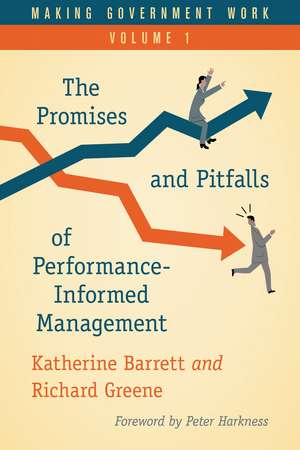
Making Government Work: The Promises and Pitfalls of Performance-Informed Management, Volume 1: Making Government Work
Autor Katherine Barrett, Richard Greeneen Limba Engleză Paperback – 24 dec 2019
As performance management has evolved, it has encompassed many different tools and approaches including measurement, data analysis, evidence-based management, process improvement, research and evaluation. In the past, many of the efforts to improve performance in government have been fragmented, separated into silos and labeled with a variety of different names including performance-based budgeting, performance-informed management, managing for results and so on.
Making Government Work: The Promises and Pitfalls of Performance-Informed Management by Katherine Barrett and Rich Greene is loaded with dozens of stories of what practitioners are currently working on-what's working and what's not. The benefits are ample, so are the challenges. This book describes both, along with practical steps taken by practitioners to make government work better. Readers will discover that while the authors strive to meet the documentation standards of carefully vetted academic papers, the approach they take is journalistic. Over the last year, Barrett and Greene talked to scores of state and local officials, as well as academics and other national experts to find out how performance management tools and approaches have changed, and what is coming in the near-term future.
Performance management has been in a state of evolution for decades now, and so Barrett and Greene have endeavored to capture the state of the world as it is today. By detailing both the challenges and conquests of performance management in Making Government Work: The Promises and Pitfalls of Performance-Informed Management, Barrett and Greene ensure readers will find the kind of balanced information that is helpful to both academics and practitioners-and that can move the field forward.
Preț: 177.68 lei
Preț vechi: 237.96 lei
-25%
Puncte Express: 267
Carte tipărită la comandă
Livrare economică 28 noiembrie-12 decembrie
Livrare prin curier în România Termenul estimat este afișat lângă disponibilitate.
Transport gratuit de la 400.00 lei Plată online sau ramburs, în funcție de opțiunile comenzii.
Retur gratuit în 14 zile Comandă securizată și suport în română.
Specificații
ISBN-13: 9781538125687
ISBN-10: 1538125684
Pagini: 152
Ilustrații: 14 b/w illustrations; 10 b/w photos; 9 textboxes
Dimensiuni: 147 x 227 x 11 mm
Greutate: 0.26 kg
Editura: Bloomsbury Publishing
Colecția Rowman & Littlefield
Seria Making Government Work
Locul publicării:New York, United States
ISBN-10: 1538125684
Pagini: 152
Ilustrații: 14 b/w illustrations; 10 b/w photos; 9 textboxes
Dimensiuni: 147 x 227 x 11 mm
Greutate: 0.26 kg
Editura: Bloomsbury Publishing
Colecția Rowman & Littlefield
Seria Making Government Work
Locul publicării:New York, United States
Cuprins
Acknowledgements
Preface
About the Authors
1. Overview
2. Challenges
Sustainability
The human element
Differing perspectives
3. Benefits
Exhibit A: Montgomery County
A catalogue of benefits
San Jose, California
Minnesota
Wisconsin
Indiana
Denver, Colorado
King County, Washington
Case Study - New Orleans: Shock Therapy
4. History
Progress at the state level
Our ringside view
Federal advances
Box: Building the federal performance infrastructure
Ups and downs
Alternate approaches
Box: Five major changes over the last thirty years
Case study - Service Efforts and Accomplishments
5. Outcomes
Knowing the goal
Box: The demise of Oregon Benchmarks
Striving for efficiency
Selecting top-level measures
Citizen surveys
Connecting to national measures
Case study - Washington: Cross-agency collaboration
6. Performance Budgeting
Performance budgeting legislation
Impediments
Attention to evidence
Budget execution
The environment matters
Case study - Austin: A budget with a vision
Case study - Illinois: Unrealistic expectations
7. Pitfalls
Insufficient resources
Lack of data expertise
Weak internal training
Counterproductive incentives
Slow response
Lack of sustainability
The practitioner-academic disconnect
Fear of adverse reaction
Too much hype
Flaws with targets
A limited focus
Neglect of intractable problems
Legislative indifference
Politics trumps management
Checklist: Rx for Pitfalls
8. Buy-In
Resisters
Accountability vs. performance improvement
Agency ownership
Stat evolution
A collaborative approach
Case study -- Colorado Q&A on achieving buy-in
9. Validation
Consequences of bad data
Bad data and drugs
Inconsistent comparisons
Data fudging and outright cheating
Verification
A path forward
Box: The roots of inaccuracy
Sloppy data
Ineffective system controls
Inconsistent information and changing definitions
Privatization/contractor/third party issues
Case study - New York: Changing the definitions
10. Data progress
Service delivery
Open data
Data sharing
Data governance
The push for more helpful data
Box - Outdated technology
Box: The path forward
Case study - Little Rock, Arkansas: Of data and human beings
11. Evaluation
Evaluation on the frontlines
Shifting the paradigm
Box: The evidence movement
Box: A cost-benefit approach
Case study -- Los Angeles: Solving a police recruiting puzzle
Resources
Glossary
Index
Preface
About the Authors
1. Overview
2. Challenges
Sustainability
The human element
Differing perspectives
3. Benefits
Exhibit A: Montgomery County
A catalogue of benefits
San Jose, California
Minnesota
Wisconsin
Indiana
Denver, Colorado
King County, Washington
Case Study - New Orleans: Shock Therapy
4. History
Progress at the state level
Our ringside view
Federal advances
Box: Building the federal performance infrastructure
Ups and downs
Alternate approaches
Box: Five major changes over the last thirty years
Case study - Service Efforts and Accomplishments
5. Outcomes
Knowing the goal
Box: The demise of Oregon Benchmarks
Striving for efficiency
Selecting top-level measures
Citizen surveys
Connecting to national measures
Case study - Washington: Cross-agency collaboration
6. Performance Budgeting
Performance budgeting legislation
Impediments
Attention to evidence
Budget execution
The environment matters
Case study - Austin: A budget with a vision
Case study - Illinois: Unrealistic expectations
7. Pitfalls
Insufficient resources
Lack of data expertise
Weak internal training
Counterproductive incentives
Slow response
Lack of sustainability
The practitioner-academic disconnect
Fear of adverse reaction
Too much hype
Flaws with targets
A limited focus
Neglect of intractable problems
Legislative indifference
Politics trumps management
Checklist: Rx for Pitfalls
8. Buy-In
Resisters
Accountability vs. performance improvement
Agency ownership
Stat evolution
A collaborative approach
Case study -- Colorado Q&A on achieving buy-in
9. Validation
Consequences of bad data
Bad data and drugs
Inconsistent comparisons
Data fudging and outright cheating
Verification
A path forward
Box: The roots of inaccuracy
Sloppy data
Ineffective system controls
Inconsistent information and changing definitions
Privatization/contractor/third party issues
Case study - New York: Changing the definitions
10. Data progress
Service delivery
Open data
Data sharing
Data governance
The push for more helpful data
Box - Outdated technology
Box: The path forward
Case study - Little Rock, Arkansas: Of data and human beings
11. Evaluation
Evaluation on the frontlines
Shifting the paradigm
Box: The evidence movement
Box: A cost-benefit approach
Case study -- Los Angeles: Solving a police recruiting puzzle
Resources
Glossary
Index
Recenzii
The Promises and Pitfalls of Performance-Informed Managementoffers many examples of performance management exemplars and miscues, and does so in a readable relatable style that will appeal primarily to practitioners. The book's coverage of the topic is wide-ranging, if occasionally thin in detail. This book could prove interesting for a classroom environment, as it is replete with points that could offer opportunities for discussion and debate.
Barrett and Greene take a journalistic approach to assessing the state of performance improvement efforts, building on years of work on the Government Performance Project and as columnists at Governing magazine. The result is a readable and timely set of stories-both laudatory and cautionary-about the contemporary landscape. Each chapter includes specific case studies of on-the-ground initiatives.
B & G have done it again! Drawing on their deep historical knowledge, encyclopedic network of experts, and keen reporter's skill at telling a story, Barrett and Greene have assembled a practical book useful for both students and practitioners about the promises and pitfalls of organizational performance management. Reading more like a set of articles, this book is filled with real-life anecdotes and hard-earned wisdom. They provide nuanced insights to anyone just starting a performance program or those hoping to "up their game" to the next level. Especially relevant is how they observe evolution in the widely adopted Stat model, something that few others have recognized or documented.
Having covered state and local governments for decades as journalists, Katherine Barrett and Richard Greene are keen observers and storytellers at heart. They know what makes states and localities tick. In this book they use their skills and insights to blend the human and technical elements of performance management in a way that makes it compelling and convincing for both beginners and veterans in the field.
A much-needed complement to the scholarly research on public sector performance management, The Promises and Pitfalls of Performance-Informed Management presents an insightful look at what happens when managers implement performance management in the public sector-and as a bonus, includes guidance and advice on the next steps for every public performance management program.
Over the last three decades, no journalists have done more to document state and local government efforts to improve public sector performance than Barrett and Greene. This volume offers practical examples and sharp-eyed insights into the practice of performance management.
This book takes a closer look at the reasons why it is so difficult for government to develop meaningful performance measures, and to make informed management and budgeting decisions. The book acknowledges the challenges and provides lessons on how to ensure performance management is not just a 'feel-good' or 'check-the-box' exercise.
There simply isn't a more accessible or insightful book about the challenges about making government work. This lively volume, chock full of rich cases, will be an invaluable tool for practitioners and students who want to know how best to improve government performance-and to learn from those who have paved the road to better results. There aren't better observers than Barrett and Greene, and it would be impossible to find a sharper book on this important issue.
Making Government Work is a must read for policymakers and program managers alike. Through many interviews and case studies, Barrett and Greene provide a "ringside view" of the state of performance management in government. Their detailed account of the "bumpy road" state and local governments continue to travel gives an insight into the do's and don'ts of performance management.
Barrett and Greene take a journalistic approach to assessing the state of performance improvement efforts, building on years of work on the Government Performance Project and as columnists at Governing magazine. The result is a readable and timely set of stories-both laudatory and cautionary-about the contemporary landscape. Each chapter includes specific case studies of on-the-ground initiatives.
B & G have done it again! Drawing on their deep historical knowledge, encyclopedic network of experts, and keen reporter's skill at telling a story, Barrett and Greene have assembled a practical book useful for both students and practitioners about the promises and pitfalls of organizational performance management. Reading more like a set of articles, this book is filled with real-life anecdotes and hard-earned wisdom. They provide nuanced insights to anyone just starting a performance program or those hoping to "up their game" to the next level. Especially relevant is how they observe evolution in the widely adopted Stat model, something that few others have recognized or documented.
Having covered state and local governments for decades as journalists, Katherine Barrett and Richard Greene are keen observers and storytellers at heart. They know what makes states and localities tick. In this book they use their skills and insights to blend the human and technical elements of performance management in a way that makes it compelling and convincing for both beginners and veterans in the field.
A much-needed complement to the scholarly research on public sector performance management, The Promises and Pitfalls of Performance-Informed Management presents an insightful look at what happens when managers implement performance management in the public sector-and as a bonus, includes guidance and advice on the next steps for every public performance management program.
Over the last three decades, no journalists have done more to document state and local government efforts to improve public sector performance than Barrett and Greene. This volume offers practical examples and sharp-eyed insights into the practice of performance management.
This book takes a closer look at the reasons why it is so difficult for government to develop meaningful performance measures, and to make informed management and budgeting decisions. The book acknowledges the challenges and provides lessons on how to ensure performance management is not just a 'feel-good' or 'check-the-box' exercise.
There simply isn't a more accessible or insightful book about the challenges about making government work. This lively volume, chock full of rich cases, will be an invaluable tool for practitioners and students who want to know how best to improve government performance-and to learn from those who have paved the road to better results. There aren't better observers than Barrett and Greene, and it would be impossible to find a sharper book on this important issue.
Making Government Work is a must read for policymakers and program managers alike. Through many interviews and case studies, Barrett and Greene provide a "ringside view" of the state of performance management in government. Their detailed account of the "bumpy road" state and local governments continue to travel gives an insight into the do's and don'ts of performance management.