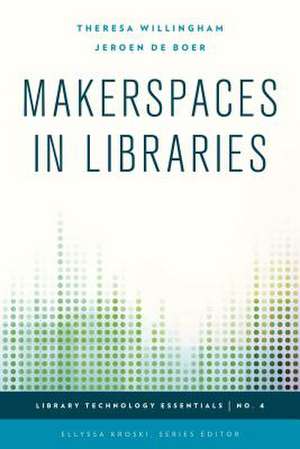
Makerspaces in Libraries: Library Technology Essentials
Autor Theresa Willingham, Jeroen de Boeren Limba Engleză Paperback – 20 aug 2015
This well researched, in-depth guide will serve libraries of all sizes seeking to implement the latest technologies and bring fresh life and engaging programming to their libraries. Highlights and best practices include:
budgeting and business planning for a librarymakerspace,creating operational documents,tools and resources overviews,national and international case studies,becoming familiar with 3D printers through practical printing projects (seed bombs),how to get started with Arduino (illuminate your library with a LED ambient mood light),how to host a FIRST Robotics Team at the library,how to develop hands-on engagement for senior makers (Squishy Circuits), andhow to host a Hackathon and build a coding community.
Preț: 363.14 lei
Preț vechi: 459.50 lei
-21%
Puncte Express: 545
Carte tipărită la comandă
Livrare economică 30 noiembrie-14 decembrie
Livrare prin curier în România Termenul estimat este afișat lângă disponibilitate.
Transport gratuit de la 400.00 lei Plată online sau ramburs, în funcție de opțiunile comenzii.
Retur gratuit în 14 zile Comandă securizată și suport în română.
Specificații
ISBN-13: 9781442253001
ISBN-10: 1442253002
Pagini: 158
Ilustrații: illustrations
Dimensiuni: 155 x 228 x 8 mm
Greutate: 0.23 kg
Editura: Bloomsbury Publishing
Colecția Rowman & Littlefield
Seria Library Technology Essentials
Locul publicării:New York, United States
ISBN-10: 1442253002
Pagini: 158
Ilustrații: illustrations
Dimensiuni: 155 x 228 x 8 mm
Greutate: 0.23 kg
Editura: Bloomsbury Publishing
Colecția Rowman & Littlefield
Seria Library Technology Essentials
Locul publicării:New York, United States
V-ar putea interesa
-
 The Intellectual Foundation of Information OrganizationElaine Svenonius-20%Preț: 213.68 lei267.10 lei
 -
 Preț: 380.40 lei
 -
 Preț: 467.81 lei
 -
 Less Is More: A Practical Guide to Weeding School Library CollectionsDonna J. BaumbachPreț: 321.78 lei
 -
 RDA and Cartographic ResourcesPaige G. AndrewPreț: 442.19 lei
 -
 Diversity in Youth Literature: Opening Doors Through ReadingJamie Campbell NaidooPreț: 373.86 lei
 -
 Library Management 101: A Practical GuideDiane L. VelasquezPreț: 487.99 lei
 -
 -21%Preț: 283.48 lei357.64 lei
 -
 -26%Preț: 265.87 lei358.27 lei
Cuprins
Foreword by Ellyssa Kroski
Preface
Acknowledgments
Chapter One: An Introduction to Makerspaces
Chapter Two: Getting Started with Makerspaces
Chapter Three: Tools and Applications
Chapter Four: Library Examples and Case Studies
Chapter Five: Step-by-Step Library Projects for Makerspaces
Chapter Six: Tips and Tricks
Chapter Seven: Future Trends
Chapter Eight: Recommended Reading
Index
About the Author
Preface
Acknowledgments
Chapter One: An Introduction to Makerspaces
Chapter Two: Getting Started with Makerspaces
Chapter Three: Tools and Applications
Chapter Four: Library Examples and Case Studies
Chapter Five: Step-by-Step Library Projects for Makerspaces
Chapter Six: Tips and Tricks
Chapter Seven: Future Trends
Chapter Eight: Recommended Reading
Index
About the Author
Recenzii
Libraries are different things to diverse populations. For some, the library is a place for study or research. For others, it's a community hub, a social meeting place. Increasingly, with the addition of multifunctional, interactive creative spaces where people gather to build, experiment, and innovate, the library as an idea incubator is coming into its own. Whether they host programming code camps or provide arts and crafts or fabrication tools, Hacker spaces, Fab Labs, and Maker spaces are examples of ways that both public and academic libraries in the United States and Europe are finding new ways to engage with users. Maker space advocates Willingham and De Boer provide a brief overview and history of Maker spaces in libraries before launching into a well-written practical guide to these innovation centers. Case studies, equipment, project and event ideas, tips and tricks for getting started, funding, policies and procedures, and recommended further reading are all included. Verdict: recommended for librarians, administrators, and staff considering a foray into Maker spaces.
I enthusiastically recommend the Library Technology Essentials series. Many libraries will want to invest in the entire set as a professional development resource since they will inevitably face some degree of involvement with each of the volume topics. Library technologists will want one of these books at their side as they launch new projects or initiatives. Ellyssa Kroski has shepherded a collection that makes an important contribution to the professional practice of library technology.
I enthusiastically recommend the Library Technology Essentials series. Many libraries will want to invest in the entire set as a professional development resource since they will inevitably face some degree of involvement with each of the volume topics. Library technologists will want one of these books at their side as they launch new projects or initiatives. Ellyssa Kroski has shepherded a collection that makes an important contribution to the professional practice of library technology.