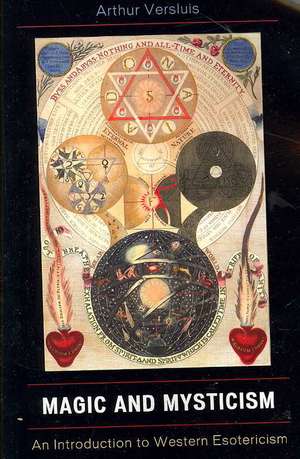
Magic and Mysticism: An Introduction to Western Esoteric Traditions
Autor Arthur Versluisen Limba Engleză Paperback – 22 mai 2007
Preț: 255.22 lei
Preț vechi: 334.02 lei
-24%
Puncte Express: 383
Carte tipărită la comandă
Livrare economică 30 noiembrie-14 decembrie
Livrare prin curier în România Termenul estimat este afișat lângă disponibilitate.
Transport gratuit de la 400.00 lei Plată online sau ramburs, în funcție de opțiunile comenzii.
Retur gratuit în 14 zile Comandă securizată și suport în română.
Specificații
ISBN-13: 9780742558366
ISBN-10: 0742558363
Pagini: 188
Dimensiuni: 150 x 226 x 16 mm
Greutate: 0.29 kg
Editura: Bloomsbury Publishing
Colecția Rowman & Littlefield
Locul publicării:New York, United States
ISBN-10: 0742558363
Pagini: 188
Dimensiuni: 150 x 226 x 16 mm
Greutate: 0.29 kg
Editura: Bloomsbury Publishing
Colecția Rowman & Littlefield
Locul publicării:New York, United States
V-ar putea interesa
-
 SupernaturalGraham Hancock-17%Preț: 79.95 lei96.04 lei
 -
 The Book of MagicBrian Copenhaver-27%Preț: 80.80 lei110.19 lei
 -
 American Gurus: From Transcendentalism to New Age ReligionArthur Versluis-31%Preț: 663.24 lei965.06 lei
 -
 Magic: A Very Short IntroductionOwen Davies-20%Preț: 56.65 lei70.82 lei
 -
 -17%Preț: 203.23 lei246.29 lei
 -
 Preț: 241.33 lei
 -
 Preț: 479.60 lei
 -
 The Alchemy ReaderStanton J. LindenPreț: 184.43 lei
 -
 Lucifer RisingGavin BaddeleyPreț: 115.26 lei
 -
 The Book of AbramelinAbraham von WormsPreț: 275.91 lei
 -
 Techniques of Graeco-Egyptian MagicDr Stephen Skinner, Ph.D.-13%Preț: 292.55 lei337.92 lei
 -
 Preț: 253.65 lei
 -
 Portable Complete Golden Dawn System of MagicDr Israel Regardie-14%Preț: 709.05 lei824.47 lei
 -
 Aha!: The Sevenfold Mystery of the Ineffable LoveAleister Crowley-18%Preț: 168.88 lei206.30 lei
 -
 -18%Preț: 112.13 lei137.27 lei
 -
 Alchemist's KitchenGuy OgilvyPreț: 52.17 lei
 -
 Art & AlchemyJacob Wamberg-18%Preț: 311.12 lei377.29 lei
Cuprins
Chapter 1 Introduction
Chapter 2 Antiquity
Chapter 3 Late Antiquity: Hermetism, Gnosticism, Jewish Mysticism, Christian Gnosis
Chapter 4 The Medieval Era
Chapter 5 The Renaissance
Chapter 6 Early Modern Esoteric Currents
Chapter 7 Modern Christian Theosophy
Chapter 8 Western Esotericism Today
Chapter 9 Conclusion
Chapter 2 Antiquity
Chapter 3 Late Antiquity: Hermetism, Gnosticism, Jewish Mysticism, Christian Gnosis
Chapter 4 The Medieval Era
Chapter 5 The Renaissance
Chapter 6 Early Modern Esoteric Currents
Chapter 7 Modern Christian Theosophy
Chapter 8 Western Esotericism Today
Chapter 9 Conclusion
Recenzii
Arthur Versluis' prolific writings on Western esoteric thought continue to shape and define the field. His current work, Magic and Mysticism, provides lucid insight into a scarcely known tradition that continues to exert a tremendous influence on the way we see our lives, and beyond. The breadth of his coverage alone is a reason to read the book.
Magic and Mysticism: An Introduction to Western Esoteric Traditions is an ambitious recasting of the gnostic insight that has inspired and influenced countless writers through the ages. Arthur Versluis, one of the generation's more prolific scholars of esotericism, has produced a volume that is both comprehensive in scope and exacting in detail. Moving beyond previous studies that separate mysticism and magic, Versluis argues that these two products of human imagination, which are not entirely reducible to rational analysis, need to be juxtaposed, as they help us define the larger spectrum of the esoteric. I have little doubt that this work will be of great interest to specialist and non-specialist alike, to historians of mysticism and esotericism in particular, and to students of comparative religion more generally.
Persecuted throughout the ages by orthodox Christians and marginalized by scholars until recently, esotericism and esotericists have finally come into their own. In this succinct, deftly organized, and lucidly written account, Arthur Versluis presents a history of western esotericism from antiquity to the present. His book will appeal to anyone interested in the 'third' or 'gnostic' component of western thought, which provided and still provides a middle path between faith and reason for those striving for spiritual enlightenment.
A remarkably clear, erudite, and concise guide to a field that has been far too long neglected. Versluis manages to compress an enormous amount of research and insight into a short space. This will be an extremely useful tool for scholars and seekers alike.
Versluis brings a delightful balance between scholarly attention to detail and a warm understanding of the subject and the characters involved. Magic and Mysticism is joy to read and ideal for anyone who wants to understand the importance of esotericism on Western culture and why it is still important to us today.
Arthur Versluis has written a wonderfully concise overview and analysis of Western esotericism. The scholarship is wide-ranging and up to date, yet the tone is quite readable and not overly academic.
This newest work by an outstanding American scholar of Western Esotericism offers an integrative interpretation of three critical themes: gnosis, magic, and mysticism. Surveying the intertwined histories of these themes, the author provides a multitude of insights on the creative interactions between various historical schools, individuals, and historic periods, all set against the social dynamics of anti-esoteric and heresiophobic rhetoric. This is a crucial, transdiciplinary review that brings new definition and nuance to the study of Western Esotericism. In addition, the section on Theosophy give new scope and depths to that topic and shows its formative influence on contemporary esoteric thought and practice. Highly recommended.
Magic and Mysticism: An Introduction to Western Esoteric Traditions is an ambitious recasting of the gnostic insight that has inspired and influenced countless writers through the ages. Arthur Versluis, one of the generation's more prolific scholars of esotericism, has produced a volume that is both comprehensive in scope and exacting in detail. Moving beyond previous studies that separate mysticism and magic, Versluis argues that these two products of human imagination, which are not entirely reducible to rational analysis, need to be juxtaposed, as they help us define the larger spectrum of the esoteric. I have little doubt that this work will be of great interest to specialist and non-specialist alike, to historians of mysticism and esotericism in particular, and to students of comparative religion more generally.
Persecuted throughout the ages by orthodox Christians and marginalized by scholars until recently, esotericism and esotericists have finally come into their own. In this succinct, deftly organized, and lucidly written account, Arthur Versluis presents a history of western esotericism from antiquity to the present. His book will appeal to anyone interested in the 'third' or 'gnostic' component of western thought, which provided and still provides a middle path between faith and reason for those striving for spiritual enlightenment.
A remarkably clear, erudite, and concise guide to a field that has been far too long neglected. Versluis manages to compress an enormous amount of research and insight into a short space. This will be an extremely useful tool for scholars and seekers alike.
Versluis brings a delightful balance between scholarly attention to detail and a warm understanding of the subject and the characters involved. Magic and Mysticism is joy to read and ideal for anyone who wants to understand the importance of esotericism on Western culture and why it is still important to us today.
Arthur Versluis has written a wonderfully concise overview and analysis of Western esotericism. The scholarship is wide-ranging and up to date, yet the tone is quite readable and not overly academic.
This newest work by an outstanding American scholar of Western Esotericism offers an integrative interpretation of three critical themes: gnosis, magic, and mysticism. Surveying the intertwined histories of these themes, the author provides a multitude of insights on the creative interactions between various historical schools, individuals, and historic periods, all set against the social dynamics of anti-esoteric and heresiophobic rhetoric. This is a crucial, transdiciplinary review that brings new definition and nuance to the study of Western Esotericism. In addition, the section on Theosophy give new scope and depths to that topic and shows its formative influence on contemporary esoteric thought and practice. Highly recommended.