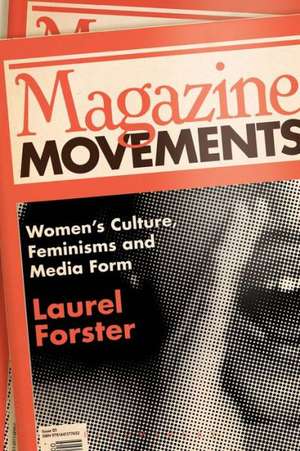
Magazine Movements: Women's Culture, Feminisms and Media Form
Autor Dr. Laurel Forsteren Limba Engleză Hardback – 23 apr 2015
The author first outlines the existing field of magazine studies, and analyzes the methodologies employed in accessing and assessing the cultural competence of magazines. Each chapter then provides a case study of a different kind of magazine: different in media form or style of presentation or audience connection, or all three. Forster not only extends our definition of a magazine, but most importantly, unearths the connections between women's cultures, specific magazines and the implied reader. In this way, fresh insights are provided into the long-standing importance of the magazine to the variety of feminisms on offer in Britain, from the mid twentieth century to the present day.
Preț: 774.01 lei
Preț vechi: 1022.65 lei
-24%
Puncte Express: 1161
Carte tipărită la comandă
Livrare economică 16-30 noiembrie
Livrare prin curier în România Termenul estimat este afișat lângă disponibilitate.
Transport gratuit pentru acest produs Plată online sau ramburs, în funcție de opțiunile comenzii.
Retur gratuit în 14 zile Comandă securizată și suport în română.
Specificații
ISBN-13: 9781441172631
ISBN-10: 1441172637
Pagini: 304
Ilustrații: 37 bw illus
Dimensiuni: 152 x 229 x 25 mm
Greutate: 0.59 kg
Editura: Bloomsbury Publishing
Colecția Bloomsbury Academic
Locul publicării:New York, United States
ISBN-10: 1441172637
Pagini: 304
Ilustrații: 37 bw illus
Dimensiuni: 152 x 229 x 25 mm
Greutate: 0.59 kg
Editura: Bloomsbury Publishing
Colecția Bloomsbury Academic
Locul publicării:New York, United States
V-ar putea interesa
-
 Autobiography Of A GeishaSayo MasudaPreț: 112.57 lei
 -
 Women's Fiction and the Great WarSuzanne Raitt-21%Preț: 294.76 lei371.02 lei
 -
 English Feminism, 1780-1980Barbara Caine-28%Preț: 406.19 lei566.49 lei
 -
 -31%Preț: 542.87 lei788.01 lei
 -
 -32%Preț: 719.40 lei1059.41 lei
 -
 Woman Defamed and Woman Defended: An Anthology of Medieval TextsAlcuin Blamires-28%Preț: 398.71 lei556.68 lei
 -
 Women at Work: An Economic PerspectiveTito Boeri-28%Preț: 379.48 lei529.11 lei
 -
 Preț: 104.40 lei
 -
 Food and FemininityDr Kate Cairns-25%Preț: 193.00 lei257.03 lei
 -
 -28%Preț: 189.48 lei262.48 lei
 -
 Women in Shakespeare: A DictionaryProfessor Alison Findlay-14%Preț: 296.21 lei343.93 lei
 -
 Fashion and Age: Dress, the Body and Later LifeJulia Twigg-17%Preț: 191.55 lei230.42 lei
 -
 Bound to Please: A History of the Victorian CorsetLeigh SummersPreț: 260.81 lei
 -
 A Suitable Job for a WomanVal McDermidPreț: 92.06 lei
Cuprins
Introduction
Chapter 1: Writing Friendship and Support in CCC
Chapter 2: Refashioning Femininity in Wartime Housewife
Chapter 3: Linking Private and Public Over the Airwaves in Woman's Hour
Chapter 4: Exploring Sexuality in Arena 3
Chapter 5: Politicising the Personal in Shrew
Chapter 6: Networking the Magazine Format in Houseparty
Chapter 7: Mukti: A Magazine 'Against Oppression as Women, Black People, and Workers'
Chapter 8: Feminism on the Internet in the f-word
Bibliography
Index
Chapter 1: Writing Friendship and Support in CCC
Chapter 2: Refashioning Femininity in Wartime Housewife
Chapter 3: Linking Private and Public Over the Airwaves in Woman's Hour
Chapter 4: Exploring Sexuality in Arena 3
Chapter 5: Politicising the Personal in Shrew
Chapter 6: Networking the Magazine Format in Houseparty
Chapter 7: Mukti: A Magazine 'Against Oppression as Women, Black People, and Workers'
Chapter 8: Feminism on the Internet in the f-word
Bibliography
Index
Recenzii
Ever since the publication of Betty Friedan's The Feminine Mystique in 1963, academic studies have sought to gauge the extent to which mass-market commercial magazines directed toward female readers in the US and UK have either contributed to gender stereotyping or offered arenas in which women could contest stifling gender roles. Forster (media studies, Univ. of Portsmouth, UK) makes a solid, important contribution to this ongoing debate by investigating a group of British "magazines" published from the mid-20th century to the present that have been almost entirely overlooked by scholars. These include not only print magazines-Arena Three (1964-71), the first openly lesbian magazine in Britain; Mukti (1983-87), aimed at South Asian women; and a number of overtly feminist magazines-but also the television magazine Houseparty (1972-81) and various radio magazines. The most fascinating chapter examines the history and significance of the Cooperative Correspondence Club (1935-90), a small group of women with diverse geographic, religious, and class affiliation, which twice monthly hand-produced a copy of a magazine, comprising individual women's letters, that circulated among the group's members. Forster's extensive archival research, incisive analysis, and jargon-free writing makes this book a pleasurable as well as an educational experience. Summing Up: Highly recommended. Lower-division undergraduates through faculty.
An enjoyable read.
Magazine Movements significantly broadens and deepens the historical treatment of women's magazines, and refuses easy generalisation about their meaning and role. Juxtaposing experimental, political and niche-audience titles to mainstream commercial products enables Forster to trace an inclusive, provocative history of British feminism across the second half of the twentieth century. Her innovative discussion of magazine formats, spanning print and broadcast media, charts the persistence and influence of the magazine genre for both commercial and counter-cultural negotiations of gender, race, sexuality and modernity. This is an authoritative and critical media history that makes important contributions to understanding women's lives and political engagement.
Laurel Forster's wide-ranging and thought-provoking case studies remind us that the 'magazine' format has not been confined to print. She reveals how the magazine has proven to be a highly adaptable mode for communicating and interacting with a range of audiences.
An enjoyable read.
Magazine Movements significantly broadens and deepens the historical treatment of women's magazines, and refuses easy generalisation about their meaning and role. Juxtaposing experimental, political and niche-audience titles to mainstream commercial products enables Forster to trace an inclusive, provocative history of British feminism across the second half of the twentieth century. Her innovative discussion of magazine formats, spanning print and broadcast media, charts the persistence and influence of the magazine genre for both commercial and counter-cultural negotiations of gender, race, sexuality and modernity. This is an authoritative and critical media history that makes important contributions to understanding women's lives and political engagement.
Laurel Forster's wide-ranging and thought-provoking case studies remind us that the 'magazine' format has not been confined to print. She reveals how the magazine has proven to be a highly adaptable mode for communicating and interacting with a range of audiences.