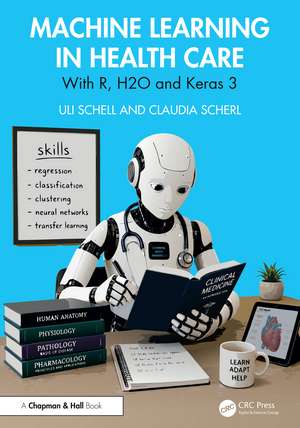
Machine Learning in Health Care: With R, H2O and Keras 3
Autor Uli Schell, Claudia Scherlen Limba Engleză Hardback – 9 dec 2026
This hands-on introduction uses numerous realistic examples from the field of health care to convey the basics and the various methods of machine learning with R, H2O and Keras 3. You will also learn how to prepare and visualize the data.
Both statistical methods (such as regression, classification, factor and cluster methods) and neural networks are covered. In transfer learning with convolutional networks, heatmaps are used to show how results in image classification can be explained.
Procedures and techniques in health care are subject to many regulations. This book explains what you need to do in order to achieve compliance.
Key Features:
- Addresses the basic concepts and methods in machine learning so that you can get an idea of “what’s under the hood”
- Shows how to create packages and configure version control in R
- Shows how to create “tidy data” and visualize it with ggplot
- Shows ready-to-run, downloadable examples in health care with R, H2O and the actual version 3 of Keras
- Explains the steps needed to achieve compliance in an approval process.
Preț: 1136.43 lei
Preț vechi: 1490.87 lei
-24% Precomandă
Puncte Express: 1705
Carte nepublicată încă
Livrare prin curier în România Precomanda se expediază când titlul devine disponibil.
Transport gratuit pentru acest produs Plată online sau ramburs, în funcție de opțiunile comenzii.
Retur gratuit în 14 zile Comandă securizată și suport în română.
Doresc să fiu notificat când acest titlu va fi disponibil:
Se trimite...
Specificații
ISBN-13: 9781041131663
ISBN-10: 1041131666
Pagini: 394
Ilustrații: 514
Dimensiuni: 178 x 254 mm
Ediția:1
Editura: CRC Press
Colecția Chapman and Hall/CRC
ISBN-10: 1041131666
Pagini: 394
Ilustrații: 514
Dimensiuni: 178 x 254 mm
Ediția:1
Editura: CRC Press
Colecția Chapman and Hall/CRC
Public țintă
Professional Practice & DevelopmentCuprins
Preface
List of Figures
List of Tables
Part I Getting In
1 Basic Ideas
2 Regulatory Affairs
3 Introduction to R and Rstudio
Part II Preparation
4 Visualize and Prepare Data, Data Plausibility
Part III Statistical Learning
5 Regression
6 Classification
7 Clustering Objects and Reducing Features
Part IV Neural Networks
8 Neural Networks
9 H2O
10 Keras 3
Index
Bibliography
List of Figures
List of Tables
Part I Getting In
1 Basic Ideas
2 Regulatory Affairs
3 Introduction to R and Rstudio
Part II Preparation
4 Visualize and Prepare Data, Data Plausibility
Part III Statistical Learning
5 Regression
6 Classification
7 Clustering Objects and Reducing Features
Part IV Neural Networks
8 Neural Networks
9 H2O
10 Keras 3
Index
Bibliography
Notă biografică
Uli Schell was a software developer and methodology consultant at BBC and SAP AG before becoming Professor at Kaiserslautern University of Applied Sciences. He is the Academic Director of the Technical Academy Southwest Kaiserslautern. He was awarded as one of the Top 10 Renowned Overseas Professors of the Shanghai Area (2023–2024) for his outstanding teaching achievements and innovative teaching philosophy.
Claudia Scherl is Professor and Chair of Otorhinolaryngology, Head & Neck Surgery at the University Hospital OWL, Campus Bielefeld. Previously, she worked at the University Hospitals in Mannheim and Erlangen. Her research focuses on developing digital transformation in healthcare, with a particular emphasis on artificial intelligence and data-driven applications.
Claudia Scherl is Professor and Chair of Otorhinolaryngology, Head & Neck Surgery at the University Hospital OWL, Campus Bielefeld. Previously, she worked at the University Hospitals in Mannheim and Erlangen. Her research focuses on developing digital transformation in healthcare, with a particular emphasis on artificial intelligence and data-driven applications.
Descriere
This hands-on introduction uses numerous realistic examples from the field of health care to convey the basics and the various methods of machine learning with R, H2O and Keras3. You will also learn how to prepare and visualize the data.