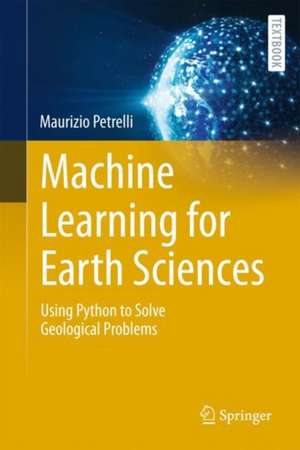
Machine Learning for Earth Sciences
Autor Maurizio Petrellien Limba Engleză Hardback – 23 sep 2023
Preț: 512.48 lei
Preț vechi: 602.91 lei
-15%
Puncte Express: 769
Carte tipărită la comandă
Livrare economică 18 noiembrie-02 decembrie
Livrare prin curier în România Termenul estimat este afișat lângă disponibilitate.
Transport gratuit pentru acest produs Plată online sau ramburs, în funcție de opțiunile comenzii.
Retur gratuit în 14 zile Comandă securizată și suport în română.
Specificații
ISBN-13: 9783031351136
ISBN-10: 3031351134
Pagini: 228
Ilustrații: XVI, 209 p. 102 illus., 99 illus. in color.
Dimensiuni: 160 x 241 x 18 mm
Greutate: 0.51 kg
Ediția:1st ed. 2023
Editura: Springer
Locul publicării:Cham, Switzerland
ISBN-10: 3031351134
Pagini: 228
Ilustrații: XVI, 209 p. 102 illus., 99 illus. in color.
Dimensiuni: 160 x 241 x 18 mm
Greutate: 0.51 kg
Ediția:1st ed. 2023
Editura: Springer
Locul publicării:Cham, Switzerland
Cuprins
Part 1: Basic Concepts of Machine Learning for Earth Scientists.- Chapter 1. Introduction to Machine Learning.- Chapter 2. Setting Up your Python Environments for Machine Learning.- Chapter 3. Machine Learning Workflow.- Part 2: Unsupervised Learning.- Chapter 4. Unsupervised Machine Learning Methods.- Chapter 5. Clustering and Dimensionality Reduction in Petrology.- Chapter 6. Clustering of Multi-Spectral Data.- Part 3: Supervised Learning.- Chapter 7. Supervised Machine Learning Methods.- Chapter 8. Classification of Well Log Data Facies by Machine Learning.- Chapter 9. Machine Learning Regression in Petrology.- Part 4: Scaling Machine Learning Models.- Chapter 10. Parallel Computing and Scaling with Dask.- Chapter 11. Scale Your Models in the Cloud.- Part 5: Next Step: Deep Learning.- Chapter 12. Introduction to Deep Learning.
Recenzii
“This book is essential for anyone planning to apply machine learning to earth science data (including multispectral and hyperspectral imaging). For maximum benefit, the reader should treat it as both an extensive tutorial as well as a bibliography: be prepared to code along with the examples and to look up the references.” (Creed Jones, Computing Reviews, January 1, 2024)
Notă biografică
Maurizio Petrelli is an associate professor in petrology and volcanology at the Department of Physics and Geology, University of Perugia. In 2001, he graduated in Geology and obtained his Ph.D. in February 2006 at the University of Perugia. His current studies are focused on the petrological, volcanological, and geochemical characterization of magmatic systems with particular emphasis on time-scales estimates of magmatic processes. He combines the use of numerical simulations, experimental petrology, and the study of natural samples. Since 2016, he has developed a new line of research at the Department of Physics and Geology (University of Perugia) focused on the application of Machine Learning techniques to petrological and volcanological studies.
Textul de pe ultima copertă
This textbook introduces the reader to Machine Learning (ML) applications in Earth Sciences. In detail, it starts by describing the basics of machine learning and its potentials in Earth Sciences to solve geological problems. It describes the main Python tools devoted to ML, the typical workflow of ML applications in Earth Sciences, and proceeds with reporting how ML algorithms work. The book provides many examples of ML application to Earth Sciences problems in many fields, such as the clustering and dimensionality reduction in petro-volcanological studies, the clustering of multi-spectral data, well-log data facies classification, and machine learning regression in petrology. Also, the book introduces the basics of parallel computing and how to scale ML models in the cloud. The book is devoted to Earth Scientists, at any level, from students to academics and professionals.
Caracteristici
Presents a step-by-step guide to Machine Learning for Earth Scientists Introduces Geologists to Machine Learning Contains example applications
Descriere
Descriere de la o altă ediție sau format:
This textbook introduces the reader to Machine Learning (ML) applications in Earth Sciences. It describes the main Python tools devoted to ML, the typical workflow of ML applications in Earth Sciences, and proceeds with reporting how ML algorithms work.
This textbook introduces the reader to Machine Learning (ML) applications in Earth Sciences. It describes the main Python tools devoted to ML, the typical workflow of ML applications in Earth Sciences, and proceeds with reporting how ML algorithms work.