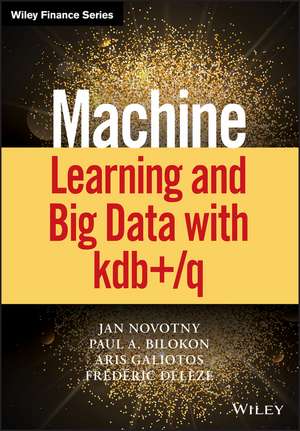
Machine Learning and Big Data with Kdb+/Q
Autor Jan Novotny, Paul A Bilokon, Aris Galiotos, Frederic Delezeen Limba Engleză Hardback – 8 ian 2020
Observăm în peisajul actual al tranzacționării algoritmice o limitare tot mai evidentă a limbajelor de programare tradiționale în fața volumului masiv de date. Machine Learning and Big Data with Kdb+/Q este structurată pentru a elimina această barieră, propunând un parcurs aplicat: începe cu fundamentarea necesară în baza de date kdb+ și limbajul q, continuă cu rezolvarea problemelor economice practice și culminează cu tehnici avansate de învățare automată. Ne-a atras atenția modul în care autorii evită abordarea de tip „enciclopedie teoretică”, preferând o organizare ce oglindește etapele reale de dezvoltare a unei strategii de tranzacționare. Subliniem că volumul nu se rezumă la sintaxă, ci ghidează cititorul prin operațiuni esențiale precum regresiile de bază, analiza cointegrării și estimarea volatilității, până la modelarea microstructurii pieței. Cititorul care a aplicat deja ideile din Advances in Financial Machine Learning de Marcos Lopez de Prado va găsi aici instrumentul tehnic specific (kdb+/q) necesar pentru a implementa acele concepte la viteza cerută de piețele de înaltă frecvență. În timp ce alte resurse se concentrează pe Python sau R, această lucrare publicată de Wiley demonstrează de ce q rămâne standardul de facto în instituțiile financiare de tip sell-side și buy-side datorită eficienței sale de neegalat în procesarea seriilor temporale complexe. Prin parcurgerea celor 640 de pagini, profesioniștii vor învăța să construiască rețele neuronale și să analizeze impactul pieței folosind un set de instrumente optimizat pentru latență minimă. Este o tranziție necesară de la programarea generalistă la cea specializată pentru mediul financiar contemporan.
Preț: 473.30 lei
Preț vechi: 584.33 lei
-19%
Carte disponibilă
Livrare economică 11-25 noiembrie
Livrare express 28 octombrie-03 noiembrie pentru 98.51 lei
Specificații
ISBN-10: 1119404754
Pagini: 640
Dimensiuni: 179 x 250 x 41 mm
Greutate: 1.2 kg
Editura: Wiley
Locul publicării:Chichester, United Kingdom
V-ar putea interesa
-
 Momentum, Direction, and DivergenceWilliam Blau-8%Preț: 482.01 lei523.92 lei
 -
 The New Science of Technical AnalysisThomas R. Demark-8%Preț: 458.77 lei498.67 lei
 -
 Style InvestingRichard Bernstein-8%Preț: 514.15 lei558.86 lei
 -
 -9%Preț: 970.64 lei1066.63 lei
 -
 Derivatives for Decision MakersGeorge CrawfordPreț: 248.13 lei
 -
 Trading Currency Cross RatesGary KlopfensteinPreț: 394.13 lei
 -
 Regulation, Deregulation, ReregulationAlan Gart-8%Preț: 452.69 lei492.05 lei
 -
 Fibonacci Applications and Strategies for TradersRobert Fischer-8%Preț: 532.79 lei579.12 lei
 -
 Global Asset AllocationJess Lederman-8%Preț: 453.34 lei492.75 lei
 -
 -23%Preț: 625.90 lei812.85 lei
 -
 Portfolio Theory and Investment ManagementRichard DobbinsPreț: 293.40 lei
 -
 MEASURING CORP ENVIRONMENTAL PMarc EpsteinPreț: 275.77 lei
 -
 Using Excel for Business and Financial ModellingDanielle Stein Fairhurst-20%Preț: 442.07 lei552.58 lei
 -
 The Wealth Dragon WayJohn LeePreț: 130.87 lei
 -
 Making Money SimplePeter LazaroffPreț: 165.13 lei
 -
 Business HackJohn LeePreț: 105.33 lei
 -
 Preț: 174.46 lei
 -
 Chaos Theory in the Financial MarketsRobert Trippi-9%Preț: 566.70 lei622.74 lei
 -
 -8%Preț: 423.69 lei460.53 lei
 -
 Hedge FundsJess Lederman-9%Preț: 364.15 lei400.16 lei
 -
 Financial Risk ManagementPhilippe Jorion-8%Preț: 599.48 lei651.60 lei
 -
 -8%Preț: 573.47 lei623.34 lei
Public țintă
The primary audience will be quants, programmers and algorithmic and electronic traders.The secondary audience will be students and academics working with kdb+ and q.
De ce să citești această carte
Această carte este esențială pentru specialiștii quants și traderii care au nevoie de performanță brută în procesarea datelor Big Data. Veți câștiga un avantaj competitiv învățând să utilizați kdb+/q, tehnologia din spatele celor mai rapide sisteme de tranzacționare din lume. Este recomandarea noastră pentru oricine dorește să treacă de la prototipuri teoretice la sisteme de producție capabile să gestioneze fluxuri de date de înaltă frecvență în timp real.
Despre autor
Jan Novotny, Paul A. Bilokon, Aris Galiotos și Frederic Deleze sunt experți recunoscuți în inginerie financiară și tranzacționare algoritmică. Paul A. Bilokon, de exemplu, este o figură proeminentă în comunitatea de tranzacționare electronică, cu o vastă experiență în instituții financiare de top și în mediul academic la Imperial College London. Expertiza colectivă a autorilor acoperă atât rigoarea matematică necesară modelării financiare, cât și implementarea practică a algoritmilor de învățare automată în medii de înaltă frecvență, transformând acest volum într-un ghid autoritar pentru utilizarea limbajului q.
Descriere scurtă
Machine Learning and Big Data with KDB+/Q offers quants, programmers and algorithmic traders a practical entry into the powerful but non-intuitive kdb+ database and q programming language. Ideally designed to handle the speed and volume of high-frequency financial data at sell- and buy-side institutions, these tools have become the de facto standard; this book provides the foundational knowledge practitioners need to work effectively with this rapidly-evolving approach to analytical trading.
The discussion follows the natural progression of working strategy development to allow hands-on learning in a familiar sphere, illustrating the contrast of efficiency and capability between the q language and other programming approaches. Rather than an all-encompassing "bible"-type reference, this book is designed with a focus on real-world practicality to help you quickly get up to speed and become productive with the language.
- Understand why kdb+/q is the ideal solution for high-frequency data
- Delve into "meat" of q programming to solve practical economic problems
- Perform everyday operations including basic regressions, cointegration, volatility estimation, modelling and more
- Learn advanced techniques from market impact and microstructure analyses to machine learning techniques including neural networks
Traditional programming languages are increasingly failing to accommodate the growing speed and volume of data, and lack the necessary flexibility that cutting-edge financial modelling demands. Machine Learning and Big Data with KDB+/Q opens up the technology and flattens the learning curve to help you quickly adopt a more effective set of tools.
Notă biografică
Cuprins
About the Authors xxiii
Part One Language Fundamentals
Chapter 1 Fundamentals of the q Programming Language 3
1.1 The (Not So Very) First Steps in q 3
1.2 Atoms and Lists 5
1.3 Basic Language Constructs 14
1.4 Basic Operators 19
1.5 Difference between Strings and Symbols 31
1.6 Matrices and Basic Linear Algebra in q 33
1.7 Launching the Session: Additional Options 35
1.8 Summary and How-To's 38
Chapter 2 Dictionaries and Tables: The q Fundamentals 41
2.1 Dictionary 41
2.2 Table 44
2.3 The Truth about Tables 48
2.4 Keyed Tables are Dictionaries 50
2.5 From a Vector Language to an Algebraic Language 51
Chapter 3 Functions 57
3.1 Namespace 59
3.2 The Six Adverbs 60
3.3 Apply 72
3.4 Protected Evaluations 75
3.5 Vector Operations 76
3.6 Convention for User-Defined Functions 79
Chapter 4 Editors and Other Tools 81
4.1 Console 81
4.2 Jupyter Notebook 82
4.3 GUIs 84
4.4 IDEs: IntelliJ IDEA 90
4.5 Conclusion 92
Chapter 5 Debugging q Code 93
5.1 Introduction to Making It Wrong: Errors 93
5.2 Debugging the Code 100
5.3 Debugging Server-Side 102
Part Two Data Operations
Chapter 6 Splayed and Partitioned Tables 107
6.1 Introduction 107
6.2 Saving a Table as a Single Binary File 108
6.3 Splayed Tables 110
6.4 Partitioned Tables 113
6.5 Conclusion 119
Chapter 7 Joins 121
7.1 Comma Operator 121
7.2 Join Functions 125
7.3 Advanced Example: Running TWAP 144
Chapter 8 Parallelisation 151
8.1 Parallel Vector Operations 152
8.2 Parallelisation over Processes 155
8.3 Map-Reduce 155
8.4 Advanced Topic: Parallel File/Directory Access 158
Chapter 9 Data Cleaning and Filtering 161
9.1 Predicate Filtering 161
9.2 Data Cleaning, Normalising and APIs 163
Chapter 10 Parse Trees 165
10.1 Definition 166
10.2 Functional Queries 171
Chapter 11 A Few Use Cases 181
11.1 Rolling VWAP 181
11.2 Weighted Mid for N Levels of an Order Book 183
11.3 Consecutive Runs of a Rule 185
11.4 Real-Time Signals and Alerts 186
Part Three Data Science
Chapter 12 Basic Overview of Statistics 191
12.1 Histogram 191
12.2 First Moments 196
12.3 Hypothesis Testing 198
Chapter 13 Linear Regression 229
13.1 Linear Regression 230
13.2 Ordinary Least Squares 231
13.3 The Geometric Representation of Linear Regression 233
13.4 Implementation of the OLS 240
13.5 Significance of Parameters 243
13.6 How Good is the Fit: R2 244
13.7 Relationship with Maximum Likelihood Estimation and AIC with Small Sample Correction 248
13.8 Estimation Suite 252
13.9 Comparing Two Nested Models: Towards a Stopping Rule 254
13.10 In-/Out-of-Sample Operations 257
13.11 Cross-validation 262
13.12 Conclusion 264
Chapter 14 Time Series Econometrics 265
14.1 Autoregressive and Moving Average Processes 265
14.2 Stationarity and Granger Causality 285
14.3 Vector Autoregression 287
Chapter 15 Fourier Transform 301
15.1 Complex Numbers 301
15.2 Discrete Fourier Transform 308
15.3 Addendum: Quaternions 314
15.4 Addendum: Fractals 321
Chapter 16 Eigensystem and PCA 325
16.1 Theory 325
16.2 Algorithms 327
16.3 Implementation of Eigensystem Calculation 332
16.4 The Data Matrix and the Principal Component Analysis 341
16.5 Implementation of PCA 351
16.6 Appendix: Determinant 354
Chapter 17 Outlier Detection 359
17.1 Local Outlier Factor 360
Chapter 18 Simulating Asset Prices 369
18.1 Stochastic Volatility Process with Price Jumps 369
18.2 Towards the Numerical Example 371
18.3 Conclusion 378
Part Four Machine Learning
Chapter 19 Basic Principles of Machine Learning 381
19.1 Non-Numeric Features and Normalisation 381
19.2 Iteration: Constructing Machine Learning Algorithms 386
Chapter 20 Linear Regression with Regularisation 391
20.1 Bias-Variance Trade-off 392
20.2 Regularisation 393
20.3 Ridge Regression 394
20.4 Implementation of the Ridge Regression 396
20.5 Lasso Regression 403
20.6 Implementation of the Lasso Regression 405
Chapter 21 Nearest Neighbours 419
21.1 k-Nearest Neighbours Classifier 419
21.2 Prototype Clustering 423
21.3 Feature Selection: Local Nearest Neighbours Approach 429
Chapter 22 Neural Networks 437
22.1 Theoretical Introduction 437
22.2 Implementation of Neural Networks 445
22.3 Examples 451
22.4 Possible Suggestions 463
Chapter 23 AdaBoost with Stumps 465
23.1 Boosting 465
23.2 Decision Stumps 466
23.3 AdaBoost 467
23.4 Implementation of AdaBoost 468
23.5 Recommendation for Readers 474
Chapter 24 Trees 477
24.1 Introduction to Trees 477
24.2 Regression Trees 479
24.3 Classification Tree 482
24.4 Miscellaneous 484
24.5 Implementation of Trees 485
Chapter 25 Forests 495
25.1 Bootstrap 495
25.2 Bagging 498
25.3 Implementation 500
Chapter 26 Unsupervised Machine Learning: The Apriori Algorithm 509
26.1 Apriori Algorithm 510
26.2 Implementation of the Apriori Algorithm 511
Chapter 27 Processing Information 523
27.1 Information Retrieval 523
27.2 Information as Features 532
Chapter 28 Towards AI - Monte Carlo Tree Search 541
28.1 Multi-Armed Bandit Problem 541
28.2 Monte Carlo Tree Search 558
28.3 Monte Carlo Tree Search Implementation - Tic-tac-toe 565
28.4 Monte Carlo Tree Search - Additional Comments 579
Chapter 29 Econophysics: The Agent-Based Computational Models 583
29.1 Agent-Based Modelling 584
29.2 Ising Agent-Based Model for Financial Markets 587
29.3 Conclusion 592
Chapter 30 Epilogue: Art 595
Bibliography 601
Index 607