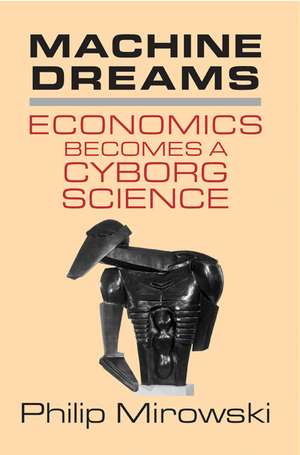
Machine Dreams: Economics Becomes a Cyborg Science
Autor Philip Mirowskien Limba Engleză Paperback – 2 dec 2001
Suntem de părere că volumul Machine Dreams reprezintă o lectură fundamentală pentru cercetători, istorici ai ideilor și studenți la nivel de master sau doctorat care doresc să înțeleagă arhitectura intelectuală a economiei contemporane. Philip Mirowski nu se limitează la o cronică a teoriilor, ci propune o teză curajoasă: transformarea economiei într-o „știință cyborg”, modelată masiv de imperativele tehnologice și militare ale Războiului Rece. Notăm cu interes modul în care autorul demonstrează că doctrine abstracte, precum teoria jocurilor sau programarea liniară, nu au fost doar exerciții matematice, ci piloni ai influenței globale americane.
Putem afirma că stilul narativ este unul dens, academic, dar extrem de revelator, oferind o perspectivă critică asupra modului în care economia neoclasică a participat la deconstrucția conceptului de individ autonom. Complementar volumului Ego de Frank Schirrmacher, care explorează geneza lui homo oeconomicus în context informațional, Machine Dreams acoperă zona tehnică și instituțională a modului în care calculatoarele au redefinit însăși natura cunoașterii economice. În timp ce Schirrmacher se concentrează pe impactul social al modelului egoist, Mirowski sapă în arhivele istoriei științei pentru a arăta cum mașina a devenit metafora centrală a disciplinei.
În contextul operei sale, această lucrare consolidează temele explorate în The Knowledge We Have Lost in Information, unde Philip Mirowski analizează confuziile legate de conceptul de informație. Dacă în alte lucrări precum Science Bought and Sold autorul investighează comercializarea cunoașterii, aici el oferă fundamentul istoric al acestui proces, legând indisolubil evoluția computerului de evoluția pieței.
Preț: 498.73 lei
Preț vechi: 560.37 lei
-11%
Carte tipărită la comandă
Livrare economică 29 iunie-13 iulie
Specificații
ISBN-10: 0521775264
Pagini: 672
Ilustrații: 5 b/w illus. 3 tables
Dimensiuni: 155 x 229 x 40 mm
Greutate: 0.99 kg
Ediția:New.
Editura: Cambridge University Press
Colecția Cambridge University Press
Locul publicării:New York, United States
V-ar putea interesa
-
 The Four-Dimensional HumanLaurence Scott-66%Preț: 42.00 lei122.23 lei
 -
 The Glass CageNicholas CarrPreț: 109.88 lei
 -
 The Master AlgorithmPedro Domingos-20%Preț: 62.81 lei78.37 lei
 -
 Controversies in Science and Technology: From Sustainability to SurveillanceDaniel Lee Kleinman-5%Preț: 578.29 lei608.72 lei
 -
 Science Bought and Sold: Essays in the Economics of SciencePhilip Mirowski-9%Preț: 815.57 lei896.24 lei
 -
 Preț: 321.20 lei
 -
 Preț: 168.58 lei
 -
 Preț: 277.04 lei
 -
 Preț: 133.49 lei
 -
 The Role of Astronomy in Society and Culture (IAU S260)David Valls-Gabaud-11%Preț: 605.35 lei680.16 lei
 -
 EVERYTHING IS MISCELLANEOUSDavid WeinbergerPreț: 118.67 lei
 -
 Preț: 114.54 lei
 -
 Preț: 106.95 lei
 -
 Preț: 78.34 lei
 -
 Ansorge, J: Identify and SortJosef Teboho Ansorge-21%Preț: 198.04 lei250.68 lei
De ce să citești această carte
Această carte este indispensabilă pentru cei care vor să înțeleagă de ce economia modernă arată mai degrabă ca o ramură a informaticii decât ca o știință socială tradițională. Cititorul va câștiga o perspectivă critică asupra originilor algoritmilor care guvernează astăzi deciziile globale, descoperind legăturile ascunse între strategiile militare de tip Cold War și teoriile economice de piață liberă.
Despre autor
Philip Mirowski este profesor de economie și de istoria și filosofia științei la Universitatea Notre Dame, ocupând catedra Carl Koch. Este recunoscut la nivel internațional pentru analizele sale interdisciplinare care combină economia, politica cunoașterii și studiile asupra științei și tehnologiei. Opera sa este marcată de o examinare critică a neoliberalismului și a modului în care structurile științifice sunt influențate de forțele economice, fiind laureat al premiului Ludwig Fleck pentru contribuțiile sale în domeniul studiilor sociale ale științei.
Descriere scurtă
Cuprins
Recenzii
'Phil Mirowski reminds me of an investigative reporter with a world-class story. He has gone straight to the heart of a really interesting problem - the emergence of economics' modern era in the crucible of World War II - and come back with a detailed account of events at The Cowles Commission and the RAND Corporation. It is news, the best that can be said quickly. It is opinion: cyborg economics (meaning purely cognitive economics) is not the sort of science Mirowski wants to see. And it is sensationally interesting.' David Warsh, The Boston Globe
'Machine Dreams is an astonishing performance of synthetic scholarship. Mirowski traces the present day predicaments of economic theory to its intellectual reformulation and institutional restructuring by military funding and in the crucibles of World War II and the Cold War. His demonstration that the mathematical economics of the postwar era is a complex response to the challenges of 'cyborg' science, the attempt to unify the study of human beings and intelligent machines through John von Neumann's general theory of automata, is bound to be controversial. His critics, however, will have to content with a breathtakingly wide range of published and unpublished evidence in fields ranging from psychology to operations research he presents. This noir history of economic thought will change its readers' understanding of twentieth-century economics.' Duncan Foley, New School University
'… this is an important book that all economists who are genuinely interested in the future of their discipline should read.' The Times Higher Education Supplement
'… a remarkable achievement. It is hard to imagine a historian who was not an economist (as Mirowski is) being able to encompass the economics of the second half of the 20th century in its diversity and technicality.' London Review of Books