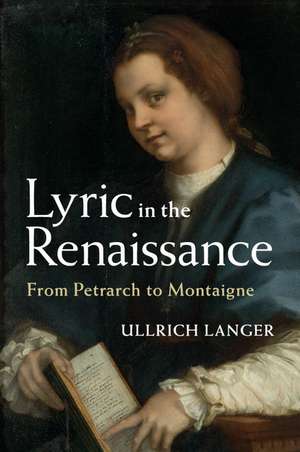
Lyric in the Renaissance
Autor Ullrich Langeren Limba Engleză Paperback – 22 iun 2017
Preț: 296.83 lei
Puncte Express: 445
Carte tipărită la comandă
Livrare economică 16-30 noiembrie
Livrare prin curier în România Termenul estimat este afișat lângă disponibilitate.
Transport gratuit de la 400.00 lei Plată online sau ramburs, în funcție de opțiunile comenzii.
Retur gratuit în 14 zile Comandă securizată și suport în română.
Specificații
ISBN-13: 9781107526990
ISBN-10: 110752699X
Pagini: 228
Dimensiuni: 152 x 229 x 12 mm
Greutate: 0.34 kg
Editura: Cambridge University Press
Locul publicării:New York, United States
ISBN-10: 110752699X
Pagini: 228
Dimensiuni: 152 x 229 x 12 mm
Greutate: 0.34 kg
Editura: Cambridge University Press
Locul publicării:New York, United States
V-ar putea interesa
-
 How to LiveSarah Bakewell-18%Preț: 77.86 lei94.78 lei
 -
 Five Revenge TragediesThomas KydPreț: 95.93 lei
 -
 -33%Preț: 2211.04 lei3289.56 lei
 -
 Shakespeare in PartsSimon Palfrey-12%Preț: 294.63 lei336.14 lei
 -
 Shakespeare and the Staging of English HistoryJanette Dillon-19%Preț: 207.77 lei255.17 lei
 -
 -31%Preț: 899.02 lei1308.09 lei
 -
 -22%Preț: 386.10 lei493.33 lei
 -
 30 Great Myths about ShakespeareEmma SmithPreț: 158.95 lei
 -
 Divine Poetry and Drama in Sixteenth-Century EnglandLily B. CampbellPreț: 273.16 lei
 -
 Preț: 374.11 lei
 -
 The Baroque Narrative of Carlos de Siguenza y GongoraKathleen RossPreț: 298.75 lei
 -
 Preț: 219.56 lei
 -
 The Cambridge Companion to English Renaissance DramaA. R. BraunmullerPreț: 330.42 lei
 -
 Shakespeare Beyond DoubtPaul Edmondson-17%Preț: 180.75 lei216.99 lei
 -
 The Cambridge Companion to Shakespearean TragedyClaire MceachernPreț: 216.39 lei
 -
 Shakespeare as Literary DramatistLukas ErnePreț: 376.45 lei
Cuprins
1. Introduction; 2. Petrarch and the existential singular; 3. Minimal lost worlds: the rondeaux of Charles d'Orléans; 4. Ronsard's singular erotic reciprocity (Les Amours de Cassandre); 5. Singularity as emptiness: Du Bellay's Regrets; 6. Montaigne and his 'sublime' lyric; 7. Conclusion; Bibliography.
Recenzii
'In this genuinely original and carefully meditated study, Langer is not interested in the lyric 'self' as usually construed or constructed, but rather in a series of textual phenomena that foreground the singularity and existence of individual objects and subjects. The power and the beauty of this book lie in its ability to give an alternate account of Renaissance lyric which avoids the Scylla of humanistic essentialism, on one hand, and the Charybidis of social-historical determinism, on the other, while offering a model of reading and understanding that is at once recognizable and 'estranging' in the very best sense.' Albert Russell Ascoli, Terrill Distinguished Professor, University of California, Berkeley
'Bringing his customary erudition and insight to bear on some of the most familiar works of the Renaissance, Ullrich Langer discovers surprisingly original effects of 'an 'existential singularity'', as distinct from classical ethos and pathos as it is from modern subjectivity. These sensitive, sympathetic readings offer an impressive reappraisal not only of first-person writing in the Renaissance but of the way Renaissance poetry was designed to act on its readers.' Edwin M. Duval, Yale University, Connecticut
'… offers a reading of early modern lyric that cuts obliquely across all of our usual categories for understanding the period, welcomingly unsettling both historicist and formalist perspectives alike.' Vanessa Glauser, Renaissance and Reformation
'… a rhetorically meticulous reading, historically informed without being historicizing, showing how a few carefully deployed rhetorical devices produce the startling affective jolts, the impression of wrenching selfhood and inexplicable, inexpiable yearnings that this poetry can still call forth.' William N. West, Modern Philology
'Bringing his customary erudition and insight to bear on some of the most familiar works of the Renaissance, Ullrich Langer discovers surprisingly original effects of 'an 'existential singularity'', as distinct from classical ethos and pathos as it is from modern subjectivity. These sensitive, sympathetic readings offer an impressive reappraisal not only of first-person writing in the Renaissance but of the way Renaissance poetry was designed to act on its readers.' Edwin M. Duval, Yale University, Connecticut
'… offers a reading of early modern lyric that cuts obliquely across all of our usual categories for understanding the period, welcomingly unsettling both historicist and formalist perspectives alike.' Vanessa Glauser, Renaissance and Reformation
'… a rhetorically meticulous reading, historically informed without being historicizing, showing how a few carefully deployed rhetorical devices produce the startling affective jolts, the impression of wrenching selfhood and inexplicable, inexpiable yearnings that this poetry can still call forth.' William N. West, Modern Philology
Descriere
A wide-ranging study of the lyric as a literary genre in Renaissance Europe, by a leading scholar of the period.