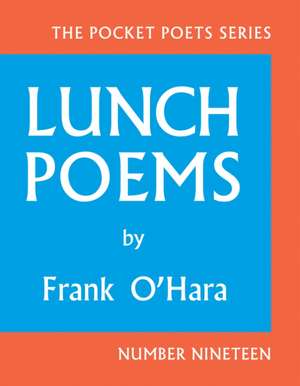
Lunch Poems
Autor Frank O'Haraen Limba Engleză Hardback – 15 iul 2014
Considerăm ediția aniversară a volumului Lunch Poems nu doar o simplă reeditare, ci un document istoric esențial pentru înțelegerea poeziei americane postbelice. Structura materialului respectă selecția originală din 1964, dar este îmbogățită metodologic prin includerea facsimilelor de corespondență dintre Frank O'Hara și Lawrence Ferlinghetti. Aceste scrisori dezvăluie procesul deliberat de construcție a volumului, de la ordinea poemelor până la ezitările privind titlul, oferind o perspectivă rară asupra colaborării editoriale dintre poet și City Lights Books. Notăm cu interes prefața semnată de John Ashbery, care oferă contextul necesar pentru a înțelege de ce aceste versuri, scrise adesea în grabă în pauza de prânz la MoMA, au păstrat o prospețime remarcabilă. Stilul este direct, intim, aproape ca o conversație telefonică, capturând ritmul Manhattanului prin referințe la cultura pop, artă și viață cotidiană. Cartea reprezintă o alternativă la City Lights Pocket Poets Anthology pentru cursurile de literatură americană modernă, cu avantajul de a oferi o analiză aprofundată a unui singur moment de cotitură în cariera autorului. În contextul operei sale, Lunch Poems rafinează estetica „oricând, oriunde” explorată în Selected Poems, dar cu o unitate tematică urbană mult mai precisă decât în colecțiile retrospective precum Poems Retrieved.
Preț: 91.74 lei
Carte disponibilă
Livrare economică 10-24 noiembrie
Livrare express 24-30 octombrie pentru 25.71 lei
Specificații
ISBN-10: 0872866173
Pagini: 104
Dimensiuni: 123 x 167 x 15 mm
Greutate: 0.18 kg
Ediția:Expanded, 50th Anniversary edition
Editura: City Lights Books
V-ar putea interesa
-
 City PoetBrad GoochPreț: 124.24 lei
 -
 Preț: 64.47 lei
 -
 Flaubert's ParrotJulian Barnes-36%Preț: 52.50 lei82.47 lei
 -
 Flaubert's ParrotJulian Barnes-19%Preț: 57.49 lei71.33 lei
 -
 -18%Preț: 53.26 lei65.07 lei
 -
 Selected PoemsWilliam Carlos WilliamsPreț: 93.10 lei
 -
 The Heart is a Lonely HunterCarson McCullers-25%Preț: 59.70 lei79.55 lei
 -
 Pedagogy of the OppressedPaulo Freire-27%Preț: 56.90 lei77.90 lei
 -
 Selected Poems of Frank O'HaraFrank O'Hara-26%Preț: 116.43 lei156.94 lei
 -
 Leaves of GrassWalt WhitmanPreț: 29.30 lei
 -
 The Poems of Seamus HeaneySeamus HeaneyPreț: 354.63 lei
 -
 Meditations in an EmergencyFrank O'HaraPreț: 88.54 lei
 -
 The Poetry of Robert FrostRobert FrostPreț: 155.70 lei
 -
 A Coney Island of the MindLawrence FerlinghettiPreț: 63.94 lei
 -
 Howl and Other PoemsAllen GinsbergPreț: 42.32 lei
 -
 Pictures of the Gone WorldLawrence FerlinghettiPreț: 51.96 lei
 -
 City Lights Pocket Poets AnthologyLawrence FerlinghettiPreț: 131.29 lei
 -
 -43%Preț: 88.78 lei154.71 lei
 -
 Why I'm Not a Painter and other poemsFrank O'HaraPreț: 70.33 lei
 -
 Selected PoemsFrank O'HaraPreț: 94.71 lei
De ce să citești această carte
Recomandăm acest volum oricărui cititor pasionat de modernismul urban și de istoria literară a New York-ului. Dincolo de valoarea estetică a poemelor, ediția oferă acces la culisele publicării, fiind un instrument util pentru studenții la filologie și litere. Câștigați o perspectivă autentică asupra modului în care viața cotidiană devine artă, într-un format compact, de buzunar, care a definit contracultura americană.
Despre autor
Frank O'Hara (1926–1966) a fost o figură centrală a Școlii de la New York, fiind în egală măsură poet, critic de artă și curator la Museum of Modern Art. Opera sa este definită prin spontaneitate și o capacitate unică de a integra elemente de suprarealism în observația cotidiană. Alături de John Ashbery și Kenneth Koch, a revoluționat limbajul poetic american, îndepărtându-se de academism în favoarea unei voci personale, imediate. Activitatea sa la MoMA și colaborările cu artiști plastici precum Jackson Pollock i-au influențat profund stilul, transformând orașul într-un laborator de experiment literar până la moartea sa prematură.
Descriere scurtă
Lunch Poems, first published in 1964 by City Lights Books as number nineteen in the Pocket Poets series, is widely considered to be Frank O'Hara's freshest and most accomplished collection of poetry. Edited by the poet in collaboration with Lawrence Ferlinghetti and Donald Allen, who had published O'Hara’s poems in his monumental The New American Poetry in 1960, it contains some of the poet’s best known works including "The Day Lady Died," "Ave Maria," and "Poem" [Lana Turner has collapsed!].
This new limited 50th anniversary edition contains a preface by John Ashbery and an editor’s note by City Lights publisher Lawrence Ferlinghetti, along with facsimile reproductions of a selection of previously unpublished correspondence between Ferlinghetti and O’Hara that shed new light on the preparation of Lunch.
"Frank O'Hara's Lunch Poems, the little black dress of American poetry books, redolent of cocktails and cigarettes and theater tickets and phonograph records, turns 50 this year. It seems barely to have aged . . . This is a book worth imbibing again, especially if you live in Manhattan, but really if you're awake and curious anywhere. O’Hara speaks directly across the decades to our hopes and fears and especially our delights; his lines are as intimate as a telephone call. Few books of his era show less age."--Dwight Garner, The New York Times
"City Lights' new reissue of the slim volume includes a clutch of correspondence between O'Hara and Lawrence Ferlinghetti . . . in which the two poets hash out the details of the book's publication: which poems to consider, their order, the dedication, and even the title. 'Do you still like the title Lunch Poems?' O’Hara asks Ferlinghetti. 'I wonder if it doesn't sound too much like an echo of Reality Sandwiches or Meat Science Essays.' 'What the hell,' Ferlinghetti replies, 'so we’ll have to change the name of City Lights to Lunch Counter Press.'"--Nicole Rudick, The Paris Review
"Frank O’Hara's famed collection was first published in 1964, and, to mark the fiftieth anniversary, City Lights is printing a special edition."--The New Yorker
"The volume has never gone out of print, in part because O’Hara expresses himself in the same way modern Americans do: Like many of us, he tries to overcome the absurdity and loneliness of modern life by addressing an audience of anonymous others."--Micah Mattix, The Atlantic
"I hope that everyone will delight in the new edition of Frank's LUNCH POEMS. The correspondence between Lawrence and Frank is great. Frank was just 33 when he wrote to Lawrence in 1959 and 38 when LUNCH POEMS was published! The fact that City Lights kept Frank's LUNCH POEMS in print all these years has been extraordinary, wonderful and a constant comfort. Hurray for independent publishers and independent bookstores. Many thanks always to Lawrence Ferlinghetti and everyone at City Lights."--Maureen O’Hara, sister of Frank O'Hara
"Frank O'Hara's Lunch Poems--which has just been reissued in a 50th anniversary hardcover edition--recalls a world of pop art, political and cultural upheaval and (in its own way) a surprising innocence."--David Ulin, Los Angeles Times
Recenzii
"We all know lunch hour isn't actually for eating lunch; it's for running to the bank, going shopping, or throwing back a few midday business shots. In the case of Frank O'Hara, it was for poetry, and his might have been the best use of those precious 60 minutes in the whole dreary history of the corporate custom."--Heather Baysa, The Village Voice
"Frank O’Hara’s delightful conversational volume Lunch Poems was published by City Lights in San Francisco fifty years ago, and has remained in print in its original Pocket Poets format ever since. In an anniversary hardback edition, Lawrence Ferlinghetti writes that the poems 'established a certain tone, a certain turn of phrase, a certain urbane wit, at once gay and straight, that came to identify the New York School of poets in the 1960s.'"--James Campbell, Times Literary Supplement UK
"O’Hara's mystique, and the seductive power of his work, have lingered, and in recent years have grown even stronger. What distinguishes O'Hara's poetry? It is not just a remarkable grasp of the zeitgeist but the way his poems manage to feel contemporary, no matter what the year, the ways in which he broke new ground."--Jane Ciabattari, BBC.com
"Don't miss out. With your fave libation in hand, celebrate Lunch Poems--the little book that's still the life of the party."--Kathi Wolfe, The Washington Blade
"Although scholars have discussed and quoted from the correspondence between O’Hara and Ferlinghetti about the publication of Lunch Poems before, this is the first time the letters have been published, so it's a real treat to see them in print."--Andrew Epstein, Associate Professor, English Dept, Florida State University
"'My life held precariously in the seeing / hands of others.' Fifty years since its now-iconic orange and blue cover re-entered the bustling, amorous New York City from which they were derived, City Lights has reissued the collection with a new introduction and a supplementary appendix with facsimile drafts, letters, and other wonders."--Staff at WORD Bookstore, Brooklyn, NY
"Nearly 50 years since his death, much American lyrical poetry today also seems timid by comparison, suggestive of pious poets in ascetic isolation from a vulgar, fallen world. . . . What is happening to him now is that his influence on both contemporary American poetry and on pop culture is greater than ever. . . . Lunch Poems has just been republished by City Lights Books in an expanded edition that includes a preface by O’Hara’s New York compatriot John Ashbery and an appendix filled with facsimiles of correspondence spanning 1963 to 1965 between O’Hara and the book’s publisher, Lawrence Ferlinghetti."--Tim Keane, The Brooklyn Rail
"In the 1950s people like me noticed O'Hara because his subjects were often the subjects we would have chosen if we had been poets--jazz, movie stars, abstract expressionist painting, race, the intensity of urban life. Music, art and their attached legends energized his lines. The poems were crafted with care but always seemed spontaneous, as if scrawled in his notebooks during parties, meetings, trips on the subway. They were always personal, city life woven into a rueful version of himself. To like him it was necessary to like irony."--Robert Fulford, National Post
"The expanded 50th anniversary edition of Lunch Poems by Frank O'Hara is a glorious tribute to the book, as well as to the genius of the poet himself. Poet John Ashbery wrote the preface, and publisher/poet Lawrence Ferlinghetti writes about the anniversary edition. If you haven't read this essential volume of poetry, including the amazing poem 'Ave Maria,' you don't know what you're missing."--Gregg Shapiro, Bay Area Reporter