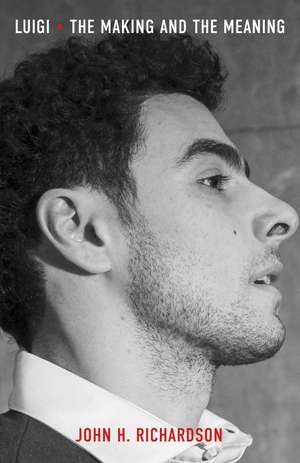
Luigi: The Making and the Meaning
Autor John H. Richardsonen Limba Engleză Hardback – 4 dec 2025
The explosion of glee and sympathy for Luigi surprised everyone, but it was everywhere. Hours after the shooting of the United Healthcare executive, his company put out a message out on Facebook saying their “hearts go out to Brian’s family and all who were close to him.” People replied with laughing emojis and comments like this one: “No one here is the judge of who deserves to live or die. That’s the job of the AI algorithm the insurance company designed to maximize profits on your health.” On TikTok, another commentator said, “Oh my god, y’all really raised the school shooter generation and now you’re asking us for sympathy?” she asks. “Welcome to a regular Tuesday at school in America.”
When he was arrested, TikTok exploded with more love for Luigi: “They could’ve been more gentle with him, he has back problems,” said one commentator. Others attempted to come to his rescue. “He is innocent, he was with me the whole time.” eBay said that while it had a policy prohibiting items that glorify violence, they were allowing the sale of items with the words “deny defend depose.” In Seattle, someone reprogrammed a couple of electric highway signs so they flashed: “One CEO down…many more to go.”
So where is all this coming from? Richardson has tracked the building blocks of this widespread alienation for three decades, finding it across not only the environmental movement but among those who reject capitalism itself, including the rules that govern everything from insurance to healthcare. He has followed the men and women who have gone to extremes to express that alienation, and studied the inspirations they found in other outlaws, most especially Ted Kaczynski (Luigi had posted a review of Kaczynski’s manifesto on Goodreads). The result is a book that will put Luigi in context and even illuminate how his appeal is likely to play out in the future.
Preț: 116.65 lei
Preț vechi: 143.50 lei
-19% Recomandat
Puncte Express: 175
Carte disponibilă
Livrare economică 20 noiembrie-02 decembrie
Livrare express 30 octombrie-05 noiembrie pentru 53.85 lei
Livrare prin curier în România Termenul estimat este afișat lângă disponibilitate.
Transport gratuit de la 400.00 lei Plată online sau ramburs, în funcție de opțiunile comenzii.
Retur gratuit în 14 zile Comandă securizată și suport în română.
Specificații
ISBN-13: 9781668209349
ISBN-10: 1668209349
Pagini: 272
Dimensiuni: 140 x 213 x 23 mm
Greutate: 0.36 kg
Editura: Simon&Schuster
Colecția Simon & Schuster
ISBN-10: 1668209349
Pagini: 272
Dimensiuni: 140 x 213 x 23 mm
Greutate: 0.36 kg
Editura: Simon&Schuster
Colecția Simon & Schuster
V-ar putea interesa
-
 Preț: 182.96 lei
 -
 To Kill a MockingbirdHarper Lee-18%Preț: 52.91 lei64.56 lei
 -
 -23%Preț: 96.75 lei125.55 lei
 -
 MeditationsMarcus AureliusPreț: 34.00 lei
 -
 Preț: 122.01 lei
 -
 All That We See or SeemKen Liu-25%Preț: 108.71 lei144.40 lei
 -
 -17%Preț: 91.14 lei109.69 lei
 -
 -19%Preț: 98.63 lei122.07 leiRecomandat
 -
 Gilded Rage: Elon Musk and the Radicalization of Silicon ValleyJacob Silverman-25%Preț: 81.65 lei109.31 lei
 -
 Start With Why (15th Anniversary Edition)Simon SinekPreț: 85.75 lei
 -
 -30%Preț: 135.96 lei194.31 lei
 -
 Preț: 112.43 leiRecomandat
 -
 -11%Preț: 78.45 lei88.53 lei
 -
 Hubris MaximusFaiz SiddiquiPreț: 123.10 lei
 -
 Lost BoysJames BloodworthPreț: 108.39 lei
 -
 Elon Musk: American OligarchDarryl Cunningham-19%Preț: 109.41 lei134.82 lei
 -
 Against AmbitionBill PeelPreț: 84.49 lei
 -
 Moriarty the Patriot, Vol. 18Ryosuke Takeuchi-18%Preț: 53.18 lei64.76 lei
 -
 -18%Preț: 95.34 lei115.98 leiRecomandat
Notă biografică
John H. Richardson was a writer-at-large for Esquire for eighteen years and was previously staff writer at New York magazine and Premiere. He is the author of My Father the Spy, In the Little World, and The Vipers’ Club. His work has appeared in The Atlantic, O. Henry Prize Stories, Best American Crime Writing, and Best American Magazine Writing. He lives in New York City.
Extras
Chapter 1: Magic IslandCHAPTER 1 MAGIC ISLAND
Let’s start with Luigi Mangione on that beach near Waikiki in the fall of 2022. Staring at the waves he couldn’t surf, back in pain, big hungry brain swimming with ideas. He posted one online and pinned it to the top of his feed:
7 years ago, I gave my hs senior speech on this topic: “Today, I will be talking to you about the future, about topics ranging from conscious artificial intelligence to human immortality…”
This was the speech he gave as his class’s valedictorian, literally speaking for his generation. Changes were coming like nothing the world had ever seen, he promised. “When we understand just how fast the rate of human progress is increasing, a revolutionary near future isn’t unbelievable, it’s actually the only logical conclusion.”
His advice: “Be excited for what the future holds for us.”
Seen from two and a half years later, this was a moment of touching optimism. He still believed in the power of knowledge to change things, still had a sense that history was moving forward in positive ways. He had a six-figure job too, working as a data engineer at an online car dealer called TrueCar.com. There, according to his LinkedIn page, he “spearheaded the transition and integration of lease / loan payments to a new API [a software interface], expanded pricing data sources, and improved call frequency and conditions, resulting in a 34% increase in new vehicle payments populated and more up-to-date payments.”
He spent his first six months in Hawaii in a shared living space called Surfbreak, a high-rise right by the water, with surfboards on a rack and communal spaces filled with attractive young people, then rented an apartment in another high-rise along with an office nearby. He spent his spare time hiking, rock climbing, working out and doing yoga. He even started a book club with his Surfbreak friends that focused on social issues, reading books like Tim Urban’s What’s Our Problem? A Self-Help Book for Societies and Steve Stewart-Williams’s The Ape That Understood the Universe: How the Mind and Culture Evolve. They’d spend afternoons talking them through out on Magic Island, a stunning beach that takes in the curve of Waikiki Beach with its hotels and Diamond Head crowning above. Luigi was a thoughtful reader, club members said later, gifted at parsing the nuances of an argument.
Then that book club decided to read Theodore John Kaczynski’s Industrial Society and Its Future, also known as the Unabomber Manifesto. It wasn’t even Luigi’s idea, and there are so many reasons that a person with his background should have hated it, from his degrees in computer science to the robot- and video game–designing clubs he started in high school and college to any higher ambitions he might ever want to pursue in the field he had studied. This is how it begins:
The industrial revolution and its consequences have been a disaster for the human race. They have greatly increased the life-expectancy of those of us who live in “advanced” countries, but they have destabilized society, have made life unfulfilling, have subjected human beings to indignities, have led to widespread psychological suffering (in the Third World to physical suffering as well) and have inflicted severe damage on the natural world.
Written in 232 numbered sections, like an instruction manual for some immense tool, the manifesto has two main themes. First, technology’s dark momentum can’t be stopped. With each improvement, the graceful schooner that sails our shorelines becomes the hulking mega-tanker that takes our jobs. Cars are a blast when bouncing along dirt roads at the reckless speed of twenty miles per hour, but pretty soon we’re stuck in rush-hour traffic, producing our license and registration and paying down car loans. We doze off while exploring a fun new thing called social media and wake up to Big Data, fake news and Total Information Awareness. And that isn’t even getting started with massive existential bureaucracies like the health care system. It’s all too big, too fast, too much.
The manifesto’s second theme is that we’ve become so dependent on technology that the real decisions about our lives are made by unseen forces like corporations and market flows that feel like conspiracies even when they’re not. Our lives are modified to fit the needs of these forces and the diseases of modern life are the result: “Boredom, demoralization, low self-esteem, inferiority feelings, defeatism, depression, anxiety, guilt, frustration, hostility, spouse or child abuse, insatiable hedonism, abnormal sexual behavior, sleep disorders, eating disorders, etc.”
As many have said, these ideas aren’t new. They’re in movies like The Matrix, I Am Legend, Avatar, and Wall-E, even FernGully: The Last Rainforest. They’re in books like The Road and Parable of the Sower. We live in a world where tech tycoons build bugout estates in New Zealand, smartphone executives refuse to let their kids use smartphones and data miners find ways to hide their own data. But Kaczynski wasn’t a filmmaker or a novelist or a climate scientist with carefully expressed concerns. He was a math genius who went to Harvard at sixteen and made breakthroughs in “boundary functions,” which has something to do with measuring curves in three dimensions. He joined the mathematics department at UC Berkeley when he was just twenty-five, the youngest hire in the university’s ninety-nine-year history. With economic prose and a ruthlessly matter-of-fact tone, he looks at the facts and comes to the logical conclusion, which he offers with the serene detachment of HAL, the computer in 2001: A Space Odyssey:
The bigger the system grows the more disastrous the results of its breakdown will be, so if it is to break down it had best break down sooner rather than later. We therefore advocate a revolution against the industrial system.
He doesn’t mince words on methods, either:
Power depends ultimately on physical force. By teaching people that violence is wrong (except, of course, when the system itself uses violence via the police or the military), the system maintains its monopoly on physical force and thus keeps all power in its own hands.
This was too much for the book club. Most of the other readers hadn’t wanted to read Industrial Society and Its Future in the first place. The club broke up.
Luigi’s reaction to the manifesto didn’t seem especially positive either. At least that’s the take from R. J. Martin, another member of the club: “Nothing that stood out at the time. No anger. No special affinity towards it. Just, you know, thought-provoking discussion.”
Kaczynski’s manifesto actually has a lot in common with What’s Our Problem? Tim Urban, also the creator of a popular blog called Wait But Why, opens his book on an even more alarming version of Kaczynski’s premise—that technology is not just growing but growing exponentially, moving faster and faster as it gets bigger and bigger. After 240,000 years as hunter-gatherers surviving on the fruits of nature and another 12,000 years developing agriculture, he says, we spent just 250 years developing modern technology, and all of a sudden we’ve got the internet, cell phones and modern medicine but also the atomic bomb, bioweapons, genetic engineering and AI so powerful it could destroy the world. If we get things right, Urban says, life could be “unfathomably awesome.” If not, “this might be the last page of the story.”
Urban’s book ends on a cheery note, trusting in the eternal power of human courage and ingenuity. Luigi gave it the ultimate rave: “I believe this book will go down in history as one of the most important philosophical texts of the early 21st century.”
But he couldn’t stop thinking about Kaczynski’s manifesto, and changes were coming at him one after another. A surfing accident aggravated his long-standing back problems, putting him in frequent pain for over a year. He quit his job at TrueCar early in 2023, telling a friend it was mind-numbingly dull. In July, he flew to the East Coast for back surgery.
By this time, his reading list included books like Merchants of Doubt: How a Handful of Scientists Obscured the Truth on Issues from Tobacco Smoke to Global Warming, by Naomi Oreskes and Erik M. Conway, and Bill Gates’s How to Avoid Climate Disaster: The Solutions We Have and the Breakthroughs We Need. One day, he reposted a photo of an old, yellowed newspaper clipping from 1912:
The furnaces of the world are now burning about 2,000,000,000 tons of coal a year. When this is burned, uniting with oxygen, it adds about 7,000,000,000 tons of carbon dioxide to the atmosphere yearly. This tends to make the air a more effective blanket for the earth and to raise its temperature. The effect may be considerable in a few centuries.
He retweeted posts about AI, which he had studied at Penn and taught to high school students at Stanford in the summer of 2019. AI worried him, but it was amazing too. He retweeted a thread about the fall of Rome that blamed it on an “unsustainable welfare state” where people ate for free and spent all their time at the Coliseum. “Out of 365 days, more than 200 were public holidays and 93 were ‘devoted to games at the public expense.’?” The thread ended on a cliff-hanger: “As welfare states expand around the world today, and entertainment options get ever more immersive, we are forced to ask a question: Is this Post-Industrial Civilization Rome, Part II?”
He worried about men. His reading list included Richard V. Reeves’s Of Boys and Men: Why the Modern Male Is Struggling, Why It Matters, and What to Do About It. He retweeted a video from a British online influencer named Jess Gill: “It’s sad that the question of ‘are men important?’ can’t be answered with a simple ‘yes.’ What message does this send to young boys when society says that they’re good at nothing?”
On X, he retweeted a lengthy post by a woman calling herself Daughter of Wolves:
If you want to understand men better, just look at all the movies they’ve made, books they’ve written, and games they invent when they’re young.
Almost every single one is about a young man being thrust into a position or situation he doesn’t know if he can overcome. Many times he actually believes he can’t, so he initially refuses the challenge…
In the end, he rises above, he wins, he conquers. He conquers first himself and then he conquers the threat.
Her conclusion: Men are made for impossible heroic feats, and women should encourage them.
On January 23, 2024, Luigi finally posted his review of the Unabomber Manifesto:
Clearly written by a mathematics prodigy. Reads like a series of lemmasI on the question of 21st century quality of life.
It’s easy to quickly and thoughtless [sic] write this off as the manifesto of a lunatic, in order to avoid facing some of the uncomfortable problems it identifies. But it’s simply impossible to ignore how prescient many of his predictions about modern society turned out.
He was a violent individual—rightfully imprisoned—who maimed innocent people. While these actions tend to be characterized as those of a crazy luddite, however, they are more accurately seen as those of an extreme political revolutionary.
Then he quoted an “interesting” post he had found online by a Reddit user called Bosspotatoness:
Had the balls to recognize that peaceful protest has gotten us absolutely nowhere, and at the end of the day he’s probably right. Oil barons haven’t listened to any environmentalists, but they feared him…
These companies don’t care about you, or your kids, or your grandkids. They have zero qualms about burning down the planet for a buck, so why should we have any qualms about burning them down to survive?…
“Violence never solved anything” is a statement uttered by cowards and predators.
Talk like this explains why YouTube once banned the use of “Uncle Ted,” a nickname often seen online and in graffiti. Reading Kaczynski has been shaking people up for years, from computer pioneers like Bill Joy (who almost lost his faith in technology) to public intellectuals like Paul Kingsnorth (who started to doubt his commitment to nonviolence) to the restless young men who want to start blowing things up as soon as they put the manifesto down. There’s a predictable sequence. Sometimes all at once, from reading, or more gradually just from living in the twenty-first century, the pieces come together, the picture shifts, and everyone else seems to be living in a dreamworld. That’s the Kaczynski Moment, Part One: Why are they talking about binge TV and the latest media outrage when we’re turning the goddamn atmosphere into a vast tanker of Zyklon B? Were we all gelded and put into harness without knowing it? Are we trapped in the Matrix for real?
Then you realize you’re sympathizing with a serial killer. That’s Part Two, the one that lands the hook. An odd but surprisingly common reaction often follows:
If this is all true, don’t I have a responsibility to do something?
This is a book about getting to that reaction. It’s about Luigi and his kindred spirits. It’s about the dark magic in extreme measures. And there’s some real darkness ahead, because Kaczynski’s ideas have also been taken up by radical right groups that range from neo-Nazis to a growing tribe of “accelerationists” and eco-fascists, who think we should destroy society by speeding it up instead of bringing it down and don’t mind throwing in a little race war while they’re at it. In the words of Pool Re Solutions, an insurance company that specializes in covering damages from terrorist attacks, “The eco-fascist narrative draws on an eclectic range of sources, though the writings of Theodore Kaczynski are especially prominent… This has potentially serious consequences in a context of increasingly serious impacts of climate change going forward.”
But here’s the crucial detail: Luigi gave the manifesto only four out of five stars. As with many people who read Kaczynski, he bought the analysis but balked at the cure. A long, secretive campaign to send mail bombs to people in science and technology wasn’t his style, and Kaczynski’s more considered solution was for a brilliant leader like Lenin or Mao to organize a guerrilla force to bring down technological society by crippling vital systems like refineries and power plants. Even for many of Kaczynski’s sympathizers, that never seemed like a realistic goal.
So what would work?
At the end of the summer, Luigi Mangione caught a plane back to the mainland and disappeared.
Let’s start with Luigi Mangione on that beach near Waikiki in the fall of 2022. Staring at the waves he couldn’t surf, back in pain, big hungry brain swimming with ideas. He posted one online and pinned it to the top of his feed:
7 years ago, I gave my hs senior speech on this topic: “Today, I will be talking to you about the future, about topics ranging from conscious artificial intelligence to human immortality…”
This was the speech he gave as his class’s valedictorian, literally speaking for his generation. Changes were coming like nothing the world had ever seen, he promised. “When we understand just how fast the rate of human progress is increasing, a revolutionary near future isn’t unbelievable, it’s actually the only logical conclusion.”
His advice: “Be excited for what the future holds for us.”
Seen from two and a half years later, this was a moment of touching optimism. He still believed in the power of knowledge to change things, still had a sense that history was moving forward in positive ways. He had a six-figure job too, working as a data engineer at an online car dealer called TrueCar.com. There, according to his LinkedIn page, he “spearheaded the transition and integration of lease / loan payments to a new API [a software interface], expanded pricing data sources, and improved call frequency and conditions, resulting in a 34% increase in new vehicle payments populated and more up-to-date payments.”
He spent his first six months in Hawaii in a shared living space called Surfbreak, a high-rise right by the water, with surfboards on a rack and communal spaces filled with attractive young people, then rented an apartment in another high-rise along with an office nearby. He spent his spare time hiking, rock climbing, working out and doing yoga. He even started a book club with his Surfbreak friends that focused on social issues, reading books like Tim Urban’s What’s Our Problem? A Self-Help Book for Societies and Steve Stewart-Williams’s The Ape That Understood the Universe: How the Mind and Culture Evolve. They’d spend afternoons talking them through out on Magic Island, a stunning beach that takes in the curve of Waikiki Beach with its hotels and Diamond Head crowning above. Luigi was a thoughtful reader, club members said later, gifted at parsing the nuances of an argument.
Then that book club decided to read Theodore John Kaczynski’s Industrial Society and Its Future, also known as the Unabomber Manifesto. It wasn’t even Luigi’s idea, and there are so many reasons that a person with his background should have hated it, from his degrees in computer science to the robot- and video game–designing clubs he started in high school and college to any higher ambitions he might ever want to pursue in the field he had studied. This is how it begins:
The industrial revolution and its consequences have been a disaster for the human race. They have greatly increased the life-expectancy of those of us who live in “advanced” countries, but they have destabilized society, have made life unfulfilling, have subjected human beings to indignities, have led to widespread psychological suffering (in the Third World to physical suffering as well) and have inflicted severe damage on the natural world.
Written in 232 numbered sections, like an instruction manual for some immense tool, the manifesto has two main themes. First, technology’s dark momentum can’t be stopped. With each improvement, the graceful schooner that sails our shorelines becomes the hulking mega-tanker that takes our jobs. Cars are a blast when bouncing along dirt roads at the reckless speed of twenty miles per hour, but pretty soon we’re stuck in rush-hour traffic, producing our license and registration and paying down car loans. We doze off while exploring a fun new thing called social media and wake up to Big Data, fake news and Total Information Awareness. And that isn’t even getting started with massive existential bureaucracies like the health care system. It’s all too big, too fast, too much.
The manifesto’s second theme is that we’ve become so dependent on technology that the real decisions about our lives are made by unseen forces like corporations and market flows that feel like conspiracies even when they’re not. Our lives are modified to fit the needs of these forces and the diseases of modern life are the result: “Boredom, demoralization, low self-esteem, inferiority feelings, defeatism, depression, anxiety, guilt, frustration, hostility, spouse or child abuse, insatiable hedonism, abnormal sexual behavior, sleep disorders, eating disorders, etc.”
As many have said, these ideas aren’t new. They’re in movies like The Matrix, I Am Legend, Avatar, and Wall-E, even FernGully: The Last Rainforest. They’re in books like The Road and Parable of the Sower. We live in a world where tech tycoons build bugout estates in New Zealand, smartphone executives refuse to let their kids use smartphones and data miners find ways to hide their own data. But Kaczynski wasn’t a filmmaker or a novelist or a climate scientist with carefully expressed concerns. He was a math genius who went to Harvard at sixteen and made breakthroughs in “boundary functions,” which has something to do with measuring curves in three dimensions. He joined the mathematics department at UC Berkeley when he was just twenty-five, the youngest hire in the university’s ninety-nine-year history. With economic prose and a ruthlessly matter-of-fact tone, he looks at the facts and comes to the logical conclusion, which he offers with the serene detachment of HAL, the computer in 2001: A Space Odyssey:
The bigger the system grows the more disastrous the results of its breakdown will be, so if it is to break down it had best break down sooner rather than later. We therefore advocate a revolution against the industrial system.
He doesn’t mince words on methods, either:
Power depends ultimately on physical force. By teaching people that violence is wrong (except, of course, when the system itself uses violence via the police or the military), the system maintains its monopoly on physical force and thus keeps all power in its own hands.
This was too much for the book club. Most of the other readers hadn’t wanted to read Industrial Society and Its Future in the first place. The club broke up.
Luigi’s reaction to the manifesto didn’t seem especially positive either. At least that’s the take from R. J. Martin, another member of the club: “Nothing that stood out at the time. No anger. No special affinity towards it. Just, you know, thought-provoking discussion.”
Kaczynski’s manifesto actually has a lot in common with What’s Our Problem? Tim Urban, also the creator of a popular blog called Wait But Why, opens his book on an even more alarming version of Kaczynski’s premise—that technology is not just growing but growing exponentially, moving faster and faster as it gets bigger and bigger. After 240,000 years as hunter-gatherers surviving on the fruits of nature and another 12,000 years developing agriculture, he says, we spent just 250 years developing modern technology, and all of a sudden we’ve got the internet, cell phones and modern medicine but also the atomic bomb, bioweapons, genetic engineering and AI so powerful it could destroy the world. If we get things right, Urban says, life could be “unfathomably awesome.” If not, “this might be the last page of the story.”
Urban’s book ends on a cheery note, trusting in the eternal power of human courage and ingenuity. Luigi gave it the ultimate rave: “I believe this book will go down in history as one of the most important philosophical texts of the early 21st century.”
But he couldn’t stop thinking about Kaczynski’s manifesto, and changes were coming at him one after another. A surfing accident aggravated his long-standing back problems, putting him in frequent pain for over a year. He quit his job at TrueCar early in 2023, telling a friend it was mind-numbingly dull. In July, he flew to the East Coast for back surgery.
By this time, his reading list included books like Merchants of Doubt: How a Handful of Scientists Obscured the Truth on Issues from Tobacco Smoke to Global Warming, by Naomi Oreskes and Erik M. Conway, and Bill Gates’s How to Avoid Climate Disaster: The Solutions We Have and the Breakthroughs We Need. One day, he reposted a photo of an old, yellowed newspaper clipping from 1912:
The furnaces of the world are now burning about 2,000,000,000 tons of coal a year. When this is burned, uniting with oxygen, it adds about 7,000,000,000 tons of carbon dioxide to the atmosphere yearly. This tends to make the air a more effective blanket for the earth and to raise its temperature. The effect may be considerable in a few centuries.
He retweeted posts about AI, which he had studied at Penn and taught to high school students at Stanford in the summer of 2019. AI worried him, but it was amazing too. He retweeted a thread about the fall of Rome that blamed it on an “unsustainable welfare state” where people ate for free and spent all their time at the Coliseum. “Out of 365 days, more than 200 were public holidays and 93 were ‘devoted to games at the public expense.’?” The thread ended on a cliff-hanger: “As welfare states expand around the world today, and entertainment options get ever more immersive, we are forced to ask a question: Is this Post-Industrial Civilization Rome, Part II?”
He worried about men. His reading list included Richard V. Reeves’s Of Boys and Men: Why the Modern Male Is Struggling, Why It Matters, and What to Do About It. He retweeted a video from a British online influencer named Jess Gill: “It’s sad that the question of ‘are men important?’ can’t be answered with a simple ‘yes.’ What message does this send to young boys when society says that they’re good at nothing?”
On X, he retweeted a lengthy post by a woman calling herself Daughter of Wolves:
If you want to understand men better, just look at all the movies they’ve made, books they’ve written, and games they invent when they’re young.
Almost every single one is about a young man being thrust into a position or situation he doesn’t know if he can overcome. Many times he actually believes he can’t, so he initially refuses the challenge…
In the end, he rises above, he wins, he conquers. He conquers first himself and then he conquers the threat.
Her conclusion: Men are made for impossible heroic feats, and women should encourage them.
On January 23, 2024, Luigi finally posted his review of the Unabomber Manifesto:
Clearly written by a mathematics prodigy. Reads like a series of lemmasI on the question of 21st century quality of life.
It’s easy to quickly and thoughtless [sic] write this off as the manifesto of a lunatic, in order to avoid facing some of the uncomfortable problems it identifies. But it’s simply impossible to ignore how prescient many of his predictions about modern society turned out.
He was a violent individual—rightfully imprisoned—who maimed innocent people. While these actions tend to be characterized as those of a crazy luddite, however, they are more accurately seen as those of an extreme political revolutionary.
Then he quoted an “interesting” post he had found online by a Reddit user called Bosspotatoness:
Had the balls to recognize that peaceful protest has gotten us absolutely nowhere, and at the end of the day he’s probably right. Oil barons haven’t listened to any environmentalists, but they feared him…
These companies don’t care about you, or your kids, or your grandkids. They have zero qualms about burning down the planet for a buck, so why should we have any qualms about burning them down to survive?…
“Violence never solved anything” is a statement uttered by cowards and predators.
Talk like this explains why YouTube once banned the use of “Uncle Ted,” a nickname often seen online and in graffiti. Reading Kaczynski has been shaking people up for years, from computer pioneers like Bill Joy (who almost lost his faith in technology) to public intellectuals like Paul Kingsnorth (who started to doubt his commitment to nonviolence) to the restless young men who want to start blowing things up as soon as they put the manifesto down. There’s a predictable sequence. Sometimes all at once, from reading, or more gradually just from living in the twenty-first century, the pieces come together, the picture shifts, and everyone else seems to be living in a dreamworld. That’s the Kaczynski Moment, Part One: Why are they talking about binge TV and the latest media outrage when we’re turning the goddamn atmosphere into a vast tanker of Zyklon B? Were we all gelded and put into harness without knowing it? Are we trapped in the Matrix for real?
Then you realize you’re sympathizing with a serial killer. That’s Part Two, the one that lands the hook. An odd but surprisingly common reaction often follows:
If this is all true, don’t I have a responsibility to do something?
This is a book about getting to that reaction. It’s about Luigi and his kindred spirits. It’s about the dark magic in extreme measures. And there’s some real darkness ahead, because Kaczynski’s ideas have also been taken up by radical right groups that range from neo-Nazis to a growing tribe of “accelerationists” and eco-fascists, who think we should destroy society by speeding it up instead of bringing it down and don’t mind throwing in a little race war while they’re at it. In the words of Pool Re Solutions, an insurance company that specializes in covering damages from terrorist attacks, “The eco-fascist narrative draws on an eclectic range of sources, though the writings of Theodore Kaczynski are especially prominent… This has potentially serious consequences in a context of increasingly serious impacts of climate change going forward.”
But here’s the crucial detail: Luigi gave the manifesto only four out of five stars. As with many people who read Kaczynski, he bought the analysis but balked at the cure. A long, secretive campaign to send mail bombs to people in science and technology wasn’t his style, and Kaczynski’s more considered solution was for a brilliant leader like Lenin or Mao to organize a guerrilla force to bring down technological society by crippling vital systems like refineries and power plants. Even for many of Kaczynski’s sympathizers, that never seemed like a realistic goal.
So what would work?
At the end of the summer, Luigi Mangione caught a plane back to the mainland and disappeared.
- I. Lemma is a math term for a kind of proposition.
Recenzii
"Riveting and uncomfortable. . . . Richardson’s book may not resolve the ultimate question of whether its subject is hero, criminal or casualty. But it leaves us with a more pressing one: What does it say about America that we can no longer tell the difference?"
"By Richardson’s account, if Mangione committed the crime of which he’s accused, then it might be the only murder in known history that can be ascribed to a book club—one that picked Theodore Kaczynski’s Industrial Society and Its Future. . . . Though Mangione didn’t accept every bit of Kaczynski’s analysis of the woes of the world, he took enough of it to heart to ask the inevitable question about what’s to be done—and to whom."
"By Richardson’s account, if Mangione committed the crime of which he’s accused, then it might be the only murder in known history that can be ascribed to a book club—one that picked Theodore Kaczynski’s Industrial Society and Its Future. . . . Though Mangione didn’t accept every bit of Kaczynski’s analysis of the woes of the world, he took enough of it to heart to ask the inevitable question about what’s to be done—and to whom."
Descriere
The first book to explain why the world was primed for the Luigi Mangione moment, showing the history that led him to be embraced as an avenger with an affection not seen since Jesse James or Robin Hood.