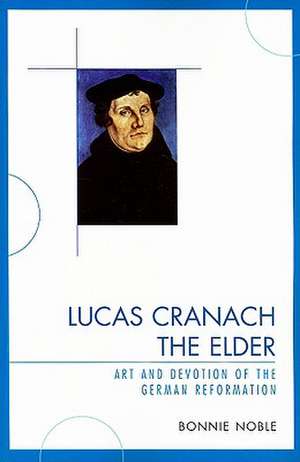
Lucas Cranach the Elder: Art and Devotion of the German Reformation
Autor Bonnie Nobleen Limba Engleză Paperback – 16 apr 2009
Preț: 328.98 lei
Preț vechi: 426.15 lei
-23%
Puncte Express: 493
Carte tipărită la comandă
Livrare economică 24 noiembrie-08 decembrie
Livrare prin curier în România Termenul estimat este afișat lângă disponibilitate.
Transport gratuit de la 400.00 lei Plată online sau ramburs, în funcție de opțiunile comenzii.
Retur gratuit în 14 zile Comandă securizată și suport în română.
Specificații
ISBN-13: 9780761843382
ISBN-10: 0761843388
Pagini: 227
Dimensiuni: 148 x 226 x 16 mm
Greutate: 0.34 kg
Editura: Bloomsbury Publishing
Colecția University Press of America
Locul publicării:New York, United States
ISBN-10: 0761843388
Pagini: 227
Dimensiuni: 148 x 226 x 16 mm
Greutate: 0.34 kg
Editura: Bloomsbury Publishing
Colecția University Press of America
Locul publicării:New York, United States
Cuprins
Chapter 1 1. Law and Gospel and the Strategies of Pictorial Rhetoric
Chapter 2 2. The Schneeberg Altarpiece and the Structure of Worship
Chapter 3 3. The Wittenberg Altarpiece: Communal Devotion and Identity
Chapter 4 4. Holy Visions and Pious Testimony: Weimar Altarpiece
Chapter 5 5. Public Worship to Private Devotion: Cranach's Reformation Madonna Panels
Chapter 2 2. The Schneeberg Altarpiece and the Structure of Worship
Chapter 3 3. The Wittenberg Altarpiece: Communal Devotion and Identity
Chapter 4 4. Holy Visions and Pious Testimony: Weimar Altarpiece
Chapter 5 5. Public Worship to Private Devotion: Cranach's Reformation Madonna Panels
Recenzii
Good literature on Cranach is very difficult to find in English. As a succinct and smart discussion of the material, Dr. Noble's text will prove quite useful.
Perhaps the text's greatest virtue is its relative uniqueness within the English language scholarship. The paintings and subjects included within the book have all been discussed at great length within the German scholarship. Dr. Noble usefully pulls this material together and summarizes it cogently. This is a real plus since there is so little than once can send students, especially undergraduate students, to read on Cranach's later art. In each chapter, she offers her won readings, which modify or amplify other interpretations. Also within the German literature, it is difficult finding a single voice or adept narrator who discusses all of these works. The consistency of Dr. Noble's voice or text is admirable.
This study is remarkable for its attention to detail throughout. Developed from Noble's dissertation, it provides extensive documentation of German scholarship on Cranach and the Reformation period. In addition, because the book was originally a dissertation, Noble meticulously attends to the respects in which her arguments differ from those of her predecessors, thus bringing a more contemporary and art historical approach. ... This is an excellent book for every Reformation historian to read. It offers a cogent argument for broadening one's perceptions of the way in which believers were instructed and shaped in the ways of Lutheran theology and practice... Noble's analysis is sophisticated for she understands well that many and varied factors played a role in how religious images were sought, created, placed, and perceived. She raises many fascinating questions and provides a well-developed approach for beginning to engage them.
Perhaps the text's greatest virtue is its relative uniqueness within the English language scholarship. The paintings and subjects included within the book have all been discussed at great length within the German scholarship. Dr. Noble usefully pulls this material together and summarizes it cogently. This is a real plus since there is so little than once can send students, especially undergraduate students, to read on Cranach's later art. In each chapter, she offers her won readings, which modify or amplify other interpretations. Also within the German literature, it is difficult finding a single voice or adept narrator who discusses all of these works. The consistency of Dr. Noble's voice or text is admirable.
This study is remarkable for its attention to detail throughout. Developed from Noble's dissertation, it provides extensive documentation of German scholarship on Cranach and the Reformation period. In addition, because the book was originally a dissertation, Noble meticulously attends to the respects in which her arguments differ from those of her predecessors, thus bringing a more contemporary and art historical approach. ... This is an excellent book for every Reformation historian to read. It offers a cogent argument for broadening one's perceptions of the way in which believers were instructed and shaped in the ways of Lutheran theology and practice... Noble's analysis is sophisticated for she understands well that many and varied factors played a role in how religious images were sought, created, placed, and perceived. She raises many fascinating questions and provides a well-developed approach for beginning to engage them.