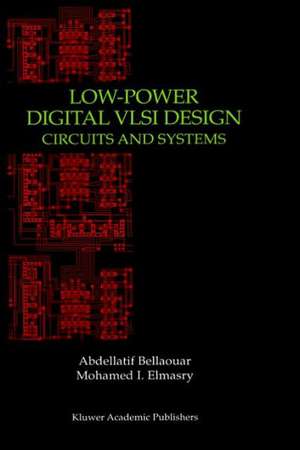
Low-Power Digital VLSI Design
Autor Mohamed Elmasry, Abdellatif Bellaouaren Limba Engleză Hardback – 30 iun 1995
Features:
- Low-voltage CMOS device modeling, technology files, design rules
- Switching activity concept, low-power guidelines to engineering practice
- Pass-transistor logic families
- Power dissipation of I/O circuits
- Multi- and low-VT CMOS logic, static power reduction circuit techniques
- State of the art design of low-voltage BiCMOS and CMOS circuits
- Low-power techniques in CMOS SRAMS and DRAMS
- Low-power on-chip voltage down converter design
- Numerous advanced CMOS subsystems (e.g. adders, multipliers, data path, memories, regular structures, phase-locked loops) with several design options trading power, delay and area
- Low-power design methodology, power estimation techniques
- Power reduction techniques at the logic, architecture and algorithm levels
- More than 190 circuits explained at the transistor level.
Preț: 1274.48 lei
Preț vechi: 1554.24 lei
-18%
Puncte Express: 1912
Carte tipărită la comandă
Livrare economică 03-17 decembrie
Livrare prin curier în România Termenul estimat este afișat lângă disponibilitate.
Transport gratuit pentru acest produs Plată online sau ramburs, în funcție de opțiunile comenzii.
Retur gratuit în 14 zile Comandă securizată și suport în română.
Specificații
ISBN-13: 9780792395874
ISBN-10: 0792395875
Pagini: 556
Ilustrații: XVII, 530 p.
Dimensiuni: 160 x 241 x 35 mm
Greutate: 0.94 kg
Ediția:1995
Editura: Springer Us
Locul publicării:New York, NY, United States
ISBN-10: 0792395875
Pagini: 556
Ilustrații: XVII, 530 p.
Dimensiuni: 160 x 241 x 35 mm
Greutate: 0.94 kg
Ediția:1995
Editura: Springer Us
Locul publicării:New York, NY, United States
V-ar putea interesa
-
 -28%Preț: 429.77 lei597.47 lei
 -
 Vlsi-Soc: Advanced Topics on Systems on a ChipRicardo Reis-20%Preț: 639.70 lei799.63 lei
 -
 Hierarchical Modeling for VLSI Circuit TestingDebashis Bhattacharya-20%Preț: 669.87 lei837.34 lei
 -
 Introduction to Analog VLSI Design AutomationMohammed Ismail-20%Preț: 671.26 lei839.08 lei
 -
 Principles of VLSI System PlanningAllen M Dewey-20%Preț: 1026.86 lei1283.57 lei
 -
 Digital BiCMOS Integrated Circuit DesignSherif H. K. Embabi-18%Preț: 991.61 lei1209.28 lei
 -
 Technologies for Wireless ComputingRobert W. Brodersen-20%Preț: 647.20 lei808.99 lei
 -
 Introduction to VLSI Silicon DevicesBadih El-Kareh-18%Preț: 971.43 lei1184.67 lei
 -
 The ZX Spectrum UlaChristopher David Smith-20%Preț: 246.85 lei308.57 lei
 -
 Digital Logic DesignGuy Even-20%Preț: 426.99 lei533.74 lei
 -
 Comp Arch Security CWang-9%Preț: 806.13 lei885.86 lei
 -
 Vision Architectures CHong Jeong-20%Preț: 899.94 lei1124.93 lei
 -
 Enterprise Content and Search Management for Building Digital PlatformsShailesh Kumar Shivakumar-20%Preț: 528.34 lei660.43 lei
 -
 Multi-Threshold CMOS Digital CircuitsMohab Anis-15%Preț: 647.67 lei761.97 lei
 -
 -20%Preț: 315.34 lei394.17 lei
 -
 CoCo: The Colorful History of Tandy’s Underdog ComputerBoisy G Pitre-20%Preț: 383.02 lei478.78 lei
 -
 Reconfigurable Multipipeline Computing StructuresIgor A Kalyaev-35%Preț: 1171.03 lei1811.74 lei
 -
 Transformation of Collective IntelligencesJean-Max Noyer-20%Preț: 959.44 lei1199.30 lei
 -
 System ArchitectureWolfgang J. Paul-20%Preț: 362.83 lei453.53 lei
 -
 Epistemological Aspects of Computer Simulation in the Social SciencesFlaminio Squazzoni-20%Preț: 329.26 lei411.58 lei
 -
 Decision Theory with Imperfect InformationRafik A. Aliev-20%Preț: 992.33 lei1240.41 lei
Public țintă
ResearchCuprins
1 Low-Power VLSI Design: An Overview.- 1.1 Why Low-Power?.- 1.2 Low-Power Applications.- 1.3 Low-Power Design Methodology.- 1.4 This Book.- References.- 2 Low-Voltage Process Technology.- 2.1 CMOS Process Technology.- 2.2 Bipolar Process Technology.- 2.3 Isolation in CMOS and Bipolar Technologies.- 2.4 CMOS and Bipolar Processes Convergence.- 2.5 BiCMOS Technology.- 2.6 Complementary BiCMOS Technology.- 2.7 BiCMOS Design Rules.- 2.8 Silicon On Insulator.- 2.9 Chapter Summary.- References.- 3 Low-Voltage Device Modeling.- 3.1 MOSFET Structure and Operation.- 3.2 SPICE Models of the MOS Transistor.- 3.3 CMOS Low-Voltage Analytical Model.- 3.4 CMOS Power Supply Voltage Scaling.- 3.5 Modeling of the Bipolar Transistor.- References.- 4 Low-Voltage Low-Power VLSI CMOS Circuit Design.- 4.1 CMOS Inverter: DC Characteristics.- 4.2 CMOS Inverter: Switching Characteristics.- 4.3 Power Dissipation.- 4.4 Capacitance Estimation.- 4.5 CMOS static Logic Design.- 4.6 CMOS Logic Styles.- 4.7 Clocking.-4.8 Pass-Transistor Logic Families.- 4.9 I/O Circuits.- 4.10 Low-Power Circuit Techniques.- 4.11 Adiabatic Computing.- 4.12 Chapter Summary.- References.- 5 Low-Voltage VLSI BiCMOS Circuit Design.- 5.1 Conventional BiCMOS Logic.- 5.2 BYNMOS Logic Family.- 5.3 Low-Voltage BiCMOS families.- 5.4 Low-Voltage BiCMOS Applications.- 5.5 Chapter Summary.- References.- 6 Low-Power CMOS Random Access Memory Circuits.- 6.1 Static RAM (SRAM).- 6.2 Dynamic RAM.- 6.3 On-Chip Voltage Down Converter.- 6.4 Chapter Summary.- References.- 7 VLSI CMOS Subsystem Design.- 7.1 Parallel Adders.- 7.2 Parallel Multipliers.- 7.3 Data Path.- 7.4 Regular Structures.- 7.5 Phase Locked Loops.- 7.6 Chapter Summary.- References.- 8 Low-Power VLSI Design Methodology.- 8.1 LP Physical Design.- 8.2 LP Gate-Level Design.- 8.3 LP Architecture-Level Design.- 8.4 Algorithmic-Level Power Reduction.- 8.5 Power Estimation Techniques.- 8.6 Chapter Summary.- References.- Reference.