
Low-Level Radio Frequency Systems: Particle Acceleration and Detection
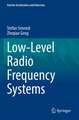
Autor Stefan Simrock, Zheqiao Gengen Limba Engleză Hardback – 3 mar 2022
Today, accelerators require increased RF stability and more complex operation scenarios, such as providing beam for different beam lines with various parameters, and as a result LLRF systems are becoming more critical and complex. This means that LLRF system developers need have extensive knowledge of the entire accelerator complex and a wide range of other areas, including RF and digital signal processing, noise analysis, accelerator physics and systems engineering.
Providing a comprehensive introduction to the basic theories, algorithms and technologies, this book enables LLRF system developers to systematically gain the knowledge required to specify, design and implement LLRF systems and integrate them with beam acceleration. It is intended for graduate students, professional engineers and researchers in accelerator physics.
Din seria Particle Acceleration and Detection
-
 Preț: 350.85 lei
- 15%
 Preț: 604.94 lei
- 18%
 Preț: 761.07 lei
- 18%
 Preț: 809.98 lei
-
 Preț: 440.54 lei
-
 Preț: 446.72 lei
- 18%
 Preț: 923.89 lei
- 18%
 Preț: 1117.31 lei
- 15%
 Preț: 680.81 lei
- 24%
 Preț: 839.91 lei
- 15%
 Preț: 626.26 lei
-
 Preț: 403.03 lei
- 24%
 Preț: 873.35 lei
- 24%
 Preț: 729.35 lei
- 15%
 Preț: 639.42 lei
- 18%
 Preț: 1275.29 lei
- 15%
 Preț: 621.03 lei
- 18%
 Preț: 1350.81 lei
- 15%
 Preț: 620.86 lei
-
 Preț: 173.43 lei
- 15%
 Preț: 636.24 lei
- 15%
 Preț: 635.69 lei
- 24%
 Preț: 936.98 lei
- 15%
 Preț: 649.85 lei
- 15%
 Preț: 557.54 lei
- 24%
 Preț: 840.29 lei
- 18%
 Preț: 762.44 lei
- 18%
 Preț: 1402.75 lei
- 18%
 Preț: 1011.75 lei
- 18%
 Preț: 1001.58 lei
- 14%
 Preț: 716.35 lei
Preț: 916.24 lei
Preț vechi: 1205.58 lei
-24%
Puncte Express: 1374
Carte tipărită la comandă
Livrare economică 26 noiembrie-02 decembrie
Livrare prin curier în România Termenul estimat este afișat lângă disponibilitate.
Transport gratuit pentru acest produs Plată online sau ramburs, în funcție de opțiunile comenzii.
Retur gratuit în 14 zile Comandă securizată și suport în română.
Specificații
ISBN-13: 9783030944186
ISBN-10: 3030944182
Pagini: 400
Ilustrații: XVII, 382 p. 1 illus.
Dimensiuni: 160 x 241 x 26 mm
Greutate: 0.79 kg
Ediția:1st ed. 2022
Editura: Springer
Colecția Particle Acceleration and Detection
Seria Particle Acceleration and Detection
Locul publicării:Cham, Switzerland
ISBN-10: 3030944182
Pagini: 400
Ilustrații: XVII, 382 p. 1 illus.
Dimensiuni: 160 x 241 x 26 mm
Greutate: 0.79 kg
Ediția:1st ed. 2022
Editura: Springer
Colecția Particle Acceleration and Detection
Seria Particle Acceleration and Detection
Locul publicării:Cham, Switzerland
Cuprins
Chapter 1. Introduction.- Chapter 2. RF Control Strategies.- Chapter 3. RF System Models.- Chapter 4. RF Field Control.- Chapter 5. RF Detection and Actuation.- Chapter 6. Noise in LLRF Systems.- Chapter 7. Nonlinearity in LLRF Systems.- Chapter 8. Timing and Synchronization.- Chapter 9. LLRF Applications and Automation.
Notă biografică
Zheqiao Geng is a senior electronic engineer at the Paul Scherrer Institute in Switzerland. He graduated with a bachelor's degree from Tsinghua University in Beijing, China, in 2002. In 2007 he received his Ph.D. degree in nuclear engineering from the Graduate School of Chinese Academy of Sciences. For more than ten years, he worked on accelerator RF and beam control systems in different labs, including IHEP (China), DESY (Germany), SLAC (USA) and PSI (Switzerland). He was the key developer of critical aspects of the LLRF systems for various accelerator projects such as the European XFEL, LCLS and SwissFEL. At SLAC, he led the system-level design of the LCLS-II LLRF system. At PSI, he developed the control strategy for setting up and stabilizing the two-bunch operation of SwissFEL. As an internationally acclaimed RF and beam control expert, he was appointed as a PSI Senior Expert in 2021.
Stefan Simrock is a control system coordinator atthe ITER Organization located in southern France. He studied physics and microwave engineering at the Technical University of Darmstadt where he received his Ph.D. in engineering physics in 1988. From 1988 to 1996, he worked at the Thomas Jefferson National Accelerator Facility as a RF controls group leader and the deputy for the technical performance of the accelerator. He joined DESY in 1996 as the leader of a multidisciplinary team responsible for the design, construction, and commissioning of the control system for the superconducting linac at the TESLA Test Facility. In 2004, he was an appointed group leader of beam controls group responsible for the timing, synchronization, and beam feedback systems of all 10 accelerators at DESY. At the same time, he was the project leader for the RF Control System for FLASH and the European XFEL. Since 2010, he is responsible for the integration of ITER diagnostics with the central control system, machine protection system, safety system, andplasma control system.
Together with Dr. Zheqiao Geng, he published a book "Low-Level Radio Frequency Systems (978-3-030-94418-6)" in the series of Particle Acceleration and Detection in 2022.
Textul de pe ultima copertă
This book begins with an overview of the RF control concepts and strategies. It then introduces RF system models for optimizing the system parameters to satisfy beam requirements and for controller design. In addition to systematically discussing the RF field control algorithms, it presents typical architecture and algorithms for RF signal detection and actuation. Further, the book addresses the analysis of the noise and nonlinearity in LLRF systems to provide a better understanding of the performance of the RF control system and to specify the performance requirements for different parts of the RF system. Today, accelerators require increased RF stability and more complex operation scenarios, such as providing beam for different beam lines with various parameters, and as a result LLRF systems are becoming more critical and complex. This means that LLRF system developers need have extensive knowledge of the entire accelerator complex and a wide range of other areas, including RF and digital signal processing, noise analysis, accelerator physics and systems engineering.
Providing a comprehensive introduction to the basic theories, algorithms and technologies, this book enables LLRF system developers to systematically gain the knowledge required to specify, design and implement LLRF systems and integrate them with beam acceleration. It is intended for graduate students, professional engineers and researchers in accelerator physics.
Providing a comprehensive introduction to the basic theories, algorithms and technologies, this book enables LLRF system developers to systematically gain the knowledge required to specify, design and implement LLRF systems and integrate them with beam acceleration. It is intended for graduate students, professional engineers and researchers in accelerator physics.
Caracteristici
Describes the LLRF applications and automation that are critical for the success of practical LLRF systems Provides essential theoretical insights for control and RF engineers Introduces timing and synchronization systems to complete the picture of the overall timing relations in an accelerator