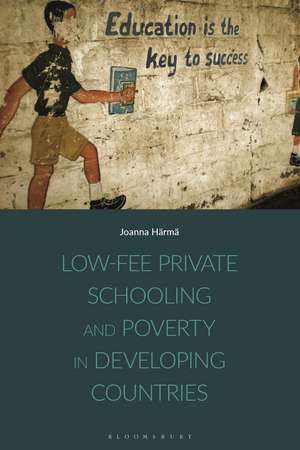
Low-fee Private Schooling and Poverty in Developing Countries
Autor Joanna Härmäen Limba Engleză Paperback – 25 aug 2022
Preț: 218.44 lei
Preț vechi: 293.43 lei
-26%
Puncte Express: 328
Carte tipărită la comandă
Livrare economică 07-21 decembrie
Livrare prin curier în România Termenul estimat este afișat lângă disponibilitate.
Transport gratuit de la 400.00 lei Plată online sau ramburs, în funcție de opțiunile comenzii.
Retur gratuit în 14 zile Comandă securizată și suport în română.
Specificații
ISBN-13: 9781350197527
ISBN-10: 1350197521
Pagini: 264
Dimensiuni: 154 x 232 x 16 mm
Greutate: 0.4 kg
Editura: Bloomsbury Publishing
Colecția Bloomsbury Academic
Locul publicării:London, United Kingdom
ISBN-10: 1350197521
Pagini: 264
Dimensiuni: 154 x 232 x 16 mm
Greutate: 0.4 kg
Editura: Bloomsbury Publishing
Colecția Bloomsbury Academic
Locul publicării:London, United Kingdom
Cuprins
Introduction: Low-Fee Private Schooling and Poverty
1. Creating the Fertile Ground for the 'Mushrooming' of Low-Fee Private Schools in Developing Countries
2. What Low-Fee Private Schools Look Like and Why Parents are Using Them
3. How the Poor are Failed by Governments
4. What is to Blame for Poor Learning Outcomes? The Role of Family Background and Environment
5. The Poor Are Being Bypassed by a 'Market' that They Cannot Afford to Enter
6. Cutting Their Bellies: The Quality of Low-Fee Private Schools Fails to Justify Parental Sacrifice
7. The Role of Profit, Corporations and Chains in the Provision of Education
8. Competition, High Stakes and Corruption in the Private Sector
9. The Role of Regulation
10. Mirroring the Privatization Push in Rich Countries
11. Investing in Teachers and Public Systems
Conclusion
Bibliography
Index
1. Creating the Fertile Ground for the 'Mushrooming' of Low-Fee Private Schools in Developing Countries
2. What Low-Fee Private Schools Look Like and Why Parents are Using Them
3. How the Poor are Failed by Governments
4. What is to Blame for Poor Learning Outcomes? The Role of Family Background and Environment
5. The Poor Are Being Bypassed by a 'Market' that They Cannot Afford to Enter
6. Cutting Their Bellies: The Quality of Low-Fee Private Schools Fails to Justify Parental Sacrifice
7. The Role of Profit, Corporations and Chains in the Provision of Education
8. Competition, High Stakes and Corruption in the Private Sector
9. The Role of Regulation
10. Mirroring the Privatization Push in Rich Countries
11. Investing in Teachers and Public Systems
Conclusion
Bibliography
Index
Recenzii
For its scope and detail, Low-Fee Private Schooling and Poverty in Developing Countries will prove indispensable to scholars and policymakers alike. Drawing on two decades of research and work in this field, Joanna Härmä explores the educational challenges facing governments across the developing world and assesses strategies to meet them.
Education has the power to transform lives. Yet millions of the world's poorest children are in education systems that deliver limited learning, failed by education systems that deliver limited learning, trapping them in a cycle of disadvantage and restricted opportunity. Low-fee private schools have often been embraced as the antidote to the failure of government educational - and as a route to opportunity and equity. In this thoughtful, intelligent, informative and highly accessible book, Joanna Härmä demolishes the free market myths underpinning the case for low-fee private schools, while recognising the deep structural failures of public education systems serving the poor. Grounded in her deep personal connections and with communities in India and Nigeria, as well as meticulous research, Joanna Härmä weaves the story that the children left behind would want her to tell - the story of a structural inequalities and unequal power relationships that rob so many children of their potential. Written with a rare mix of humility and indignation her book is a must-read for policy-makers, campaigners, and anyone who cares about the place of education in development.
Education has the power to transform lives. Yet millions of the world's poorest children are in education systems that deliver limited learning, failed by education systems that deliver limited learning, trapping them in a cycle of disadvantage and restricted opportunity. Low-fee private schools have often been embraced as the antidote to the failure of government educational - and as a route to opportunity and equity. In this thoughtful, intelligent, informative and highly accessible book, Joanna Härmä demolishes the free market myths underpinning the case for low-fee private schools, while recognising the deep structural failures of public education systems serving the poor. Grounded in her deep personal connections and with communities in India and Nigeria, as well as meticulous research, Joanna Härmä weaves the story that the children left behind would want her to tell - the story of a structural inequalities and unequal power relationships that rob so many children of their potential. Written with a rare mix of humility and indignation her book is a must-read for policy-makers, campaigners, and anyone who cares about the place of education in development.