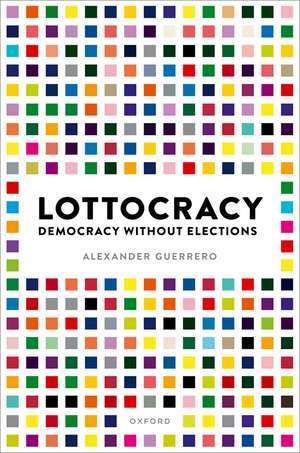
Lottocracy: Democracy Without Elections
Autor Alexander Guerreroen Limba Engleză Paperback – 12 sep 2024
Preț: 287.73 lei
Preț vechi: 344.82 lei
-17%
Puncte Express: 432
Carte tipărită la comandă
Livrare economică 30 octombrie-04 noiembrie
Livrare express 25 septembrie-01 octombrie pentru 103.29 lei
Livrare prin curier în România Termenul estimat este afișat lângă disponibilitate.
Transport gratuit de la 400.00 lei Plată online sau ramburs, în funcție de opțiunile comenzii.
Retur gratuit în 14 zile Comandă securizată și suport în română.
Specificații
ISBN-13: 9780198938989
ISBN-10: 0198938985
Pagini: 464
Dimensiuni: 158 x 235 x 25 mm
Greutate: 0.71 kg
Editura: OUP OXFORD
Colecția OUP Oxford
Locul publicării:Oxford, United Kingdom
ISBN-10: 0198938985
Pagini: 464
Dimensiuni: 158 x 235 x 25 mm
Greutate: 0.71 kg
Editura: OUP OXFORD
Colecția OUP Oxford
Locul publicării:Oxford, United Kingdom
Recenzii
...the book marks a significant advance in the presentation of lottocracy, in the institutional choices and 'choice-points' that it presents, and in the standards on which we might judge it.
Lottocracy... is imaginative, bold, forcefully argued, and highly provocative. In laying out a comprehensive case for lottery-based political institutions, it provides a critical touchstone for current debates at the heart of democratic theory.
...a landmark argument that must be reckoned with...
Lottocracy is the most ambitious and careful effort to imagine and defend a new form of government since the invention of modern representative systems. This is a remarkable feat…
Many scholars working on democracy today draw our attention only to its upsides or its downsides-the dream or the nightmare. ...Guerrero's Lottocracy: Democracy without Elections is an admirable exception. While he recognizes that the positive and negative potentials of democracy are intimately related, he gives us reason to hope that we can avoid the worst.
Lottocracy stands out for its combination of philosophical sophistication and careful, empirically informed institutional design, all in the service of a hugely ambitious all-things-considered case for sweeping constitutional change. Guerrero's approach throughout is thoughtful, intellectually honest, and morally serious, with an appropriate sense of the urgency of our collective political situation. It will be essential reading for anyone with an interest in democratic theory.
Lottocracy... is imaginative, bold, forcefully argued, and highly provocative. In laying out a comprehensive case for lottery-based political institutions, it provides a critical touchstone for current debates at the heart of democratic theory.
...a landmark argument that must be reckoned with...
Lottocracy is the most ambitious and careful effort to imagine and defend a new form of government since the invention of modern representative systems. This is a remarkable feat…
Many scholars working on democracy today draw our attention only to its upsides or its downsides-the dream or the nightmare. ...Guerrero's Lottocracy: Democracy without Elections is an admirable exception. While he recognizes that the positive and negative potentials of democracy are intimately related, he gives us reason to hope that we can avoid the worst.
Lottocracy stands out for its combination of philosophical sophistication and careful, empirically informed institutional design, all in the service of a hugely ambitious all-things-considered case for sweeping constitutional change. Guerrero's approach throughout is thoughtful, intellectually honest, and morally serious, with an appropriate sense of the urgency of our collective political situation. It will be essential reading for anyone with an interest in democratic theory.
Notă biografică
Alexander Guerrero is Professor of Philosophy at Rutgers University - New Brunswick. He writes about topics in moral philosophy, political philosophy, legal philosophy, and issues in epistemology that intersect with those areas. He is the recipient of the Lebowitz Prize from the American Philosophical Association and Phi Beta Kappa. He regularly teaches courses in African Philosophy, Chinese Philosophy, Latin American Philosophy, and Native American and Indigenous Philosophy. He is Editor-in-Chief of Philosophy Compass and an Associate Editor of Ethics. He has a JD from NYU School of Law, a PhD from NYU, and an AB from Harvard College.