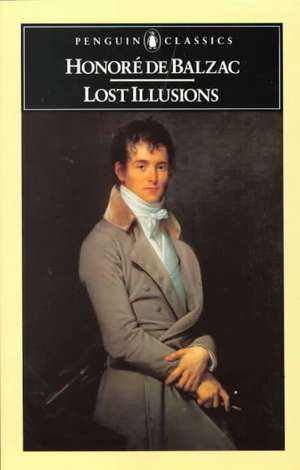
Lost Illusions
Autor Honoré de Balzac Traducere de Herbert J Hunten Limba Engleză Paperback – 28 oct 1976
Preț: 110.56 lei
Puncte Express: 166
Carte disponibilă
Livrare economică 11-25 noiembrie
Livrare express 27-31 octombrie pentru 33.57 lei
Livrare prin curier în România Termenul estimat este afișat lângă disponibilitate.
Transport gratuit de la 400.00 lei Plată online sau ramburs, în funcție de opțiunile comenzii.
Retur gratuit în 14 zile Comandă securizată și suport în română.
Specificații
ISBN-13: 9780140442519
ISBN-10: 0140442510
Pagini: 704
Dimensiuni: 194 x 128 x 35 mm
Greutate: 0.5 kg
Editura: Penguin Books
Locul publicării:London, United Kingdom
ISBN-10: 0140442510
Pagini: 704
Dimensiuni: 194 x 128 x 35 mm
Greutate: 0.5 kg
Editura: Penguin Books
Locul publicării:London, United Kingdom
V-ar putea interesa
-
 Madame BovaryGustave FlaubertPreț: 28.01 lei
 -
 In Search of Lost Time, Vol 3Marcel Proust-15%Preț: 69.74 lei82.32 lei
 -
 In Search of Lost Time, Vol 4Marcel Proust-16%Preț: 69.26 lei82.03 lei
 -
 A Harlot High and LowHonor de BalzacPreț: 93.50 lei
 -
 The Guermantes WayMarcel ProustPreț: 68.72 lei
 -
 The Ladies' ParadiseÉmile ZolaPreț: 66.59 lei
 -
 The KillÉmile ZolaPreț: 59.09 lei
 -
 Père GoriotHonoré de BalzacPreț: 53.20 lei
 -
 Cousin BetteHonoré de Balzac-17%Preț: 67.45 lei80.90 lei
 -
 CandideVoltairePreț: 32.48 lei
 -
 The French RunPaul AnnessPreț: 117.79 lei
 -
 -28%Preț: 66.47 lei92.00 lei
 -
 Le Père GoriotHonoré de BalzacPreț: 59.10 lei
 -
 Lost SoulsHonoré de BalzacPreț: 137.64 lei
 -
 Bel-AmiGuy de MaupassantPreț: 49.40 lei
 -
 PerfectionVincenzo LatronicoPreț: 97.45 lei
 -
 The MartinsDavid FoenkinosPreț: 86.41 lei
 -
 -17%Preț: 48.41 lei58.25 lei
 -
 Balzac's ParisEric HazanPreț: 123.10 lei
 -
 The Human ComedyHonoré de BalzacPreț: 104.08 lei
Notă biografică
Balzac was born in 1799, the son of a civil servant. At the age of thirty - heavily in debt and with an unsucessful past behind him - he started work on the first of what were to become a total of ninety novels and short stories that make up The Human Comedy. He died in 1850.
Herbert J. Hunt has been a Fellow at St. Edmund Hall, Oxford, Professor of French Language and Literature at London University, and Senior Fellow at Warwick University. He published books on literature and thought in nineteenth-century France, and was the author of a biography of Balzac. he died in 1973.
Herbert J. Hunt has been a Fellow at St. Edmund Hall, Oxford, Professor of French Language and Literature at London University, and Senior Fellow at Warwick University. He published books on literature and thought in nineteenth-century France, and was the author of a biography of Balzac. he died in 1973.
Descriere
Lucien Chardon, an aspiring young author, leaves his small provincial hometown and attempts to succeed in the Parisian literary circles of the early 19th century.
Cuprins
Contents
Translator’s Introduction
Raymond N. Mackenzie
Lost Illusions
1. The Two Poets
2. The Parisian Adventures of a Great Man from the Provinces
3. The Ordeals of an Inventor
Introduction: The Sorrowful Confessions of a Child of the Century
Part One. The History of a Legal Case
Part Two. The Fatal Member of the Family
Translator’s Notes
Translator’s Introduction
Raymond N. Mackenzie
Lost Illusions
1. The Two Poets
2. The Parisian Adventures of a Great Man from the Provinces
3. The Ordeals of an Inventor
Introduction: The Sorrowful Confessions of a Child of the Century
Part One. The History of a Legal Case
Part Two. The Fatal Member of the Family
Translator’s Notes
Recenzii
"Whether or not Lost Illusions counts as the greatest novel ever written, as the literary scholar Franco Moretti claims, it’s a pretty magnificent one. You can read it for its combination of social scope and psychological insight, and for its cinematically vivid portraits of faces . . . and many fine phrases. . . . And then you can read Lost Illusions, as Marx read Balzac, for its account of the double-edged nature of early capitalism."—Benjamin Kunkel, Salon
"Reading Balzac, one can experience that sauntering pace and steady gaze that our forebears gave to their surroundings, speculations, and soul-searching. It's as with reading Hugo and Dumas, Thackeray and Dickens, George Eliot and Flaubert."—Pop Matters
"Among the pleasures of the novel is how neatly it is tied into the times, from some of the events of the times to, especially, the worlds of literature and theater. Balzac bases several of his characters on real figures, too, and MacKenzie's helpful endnotes succinctly place the who and what."—The Complete Review
"Between Lost Illusions and Lost Souls, in two hefty, handsome paperbacks—with scholarly trimmings to help, not impede a reader—we now have both of the novels (technically all seven novels in a trilogy followed by a tetralogy… published between 1837 and 1847 in not entirely chronological order… because Balzac?) tracing the fate of Lucien de Rubempre, in print as though they belong together, on your to-be-read lists and your shelves. They are a remarkable itinerary."—LitHub
"Now we are treated to a handsomely produced, new annotated version by Raymond N. MacKenzie, a prolific translator of 19th century French Literature who knows Balzac well, as his instructive introduction amply shows. "—Metamorphoses
"Reading Balzac, one can experience that sauntering pace and steady gaze that our forebears gave to their surroundings, speculations, and soul-searching. It's as with reading Hugo and Dumas, Thackeray and Dickens, George Eliot and Flaubert."—Pop Matters
"Among the pleasures of the novel is how neatly it is tied into the times, from some of the events of the times to, especially, the worlds of literature and theater. Balzac bases several of his characters on real figures, too, and MacKenzie's helpful endnotes succinctly place the who and what."—The Complete Review
"Between Lost Illusions and Lost Souls, in two hefty, handsome paperbacks—with scholarly trimmings to help, not impede a reader—we now have both of the novels (technically all seven novels in a trilogy followed by a tetralogy… published between 1837 and 1847 in not entirely chronological order… because Balzac?) tracing the fate of Lucien de Rubempre, in print as though they belong together, on your to-be-read lists and your shelves. They are a remarkable itinerary."—LitHub
"Now we are treated to a handsomely produced, new annotated version by Raymond N. MacKenzie, a prolific translator of 19th century French Literature who knows Balzac well, as his instructive introduction amply shows. "—Metamorphoses