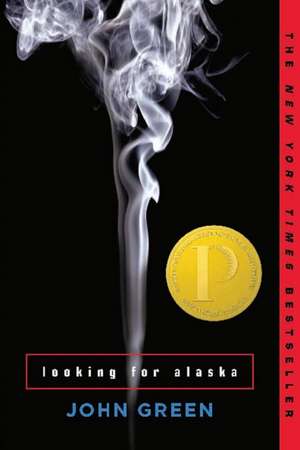
Looking for Alaska: Young Adult Literature. Originalausgaben
Autor John Greenen Limba Engleză Paperback – 27 aug 2009
Prin lectura romanului Looking for Alaska, adolescenții vor experimenta intensitatea primelor momente definitorii: prima prietenie adevărată, prima farsă memorabilă și acea dragoste imposibilă care pare să consume totul. Observăm cum Miles Halter, un tânăr pasionat de ultimele cuvinte ale personalităților istorice, părăsește confortul plictisitor al casei părintești pentru a căuta, la o școală cu internat, ceea ce Rabelais numea „Marele Poate”. Aici o întâlnește pe Alaska Young, o figură centrală fascinantă, autodestructivă și inteligentă, care devine catalizatorul transformării sale. Descoperim o narațiune construită pe un contrast puternic între spiritul ludic al farselor școlare și profunzimea dureroasă a pierderii. Atmosfera amintește de Paper Towns, unde căutarea unei fete misterioase ghidează acțiunea, dar aici mizele sunt mult mai ancorate în realitatea brutală a mortalității și a iertării de sine. Considerăm că forța acestui debut constă în onestitatea cu care John Green abordează vulnerabilitatea masculină și procesul de doliu. Față de lucrările sale ulterioare, precum The Fault in Our Stars, unde boala este prezentă de la început, în Looking for Alaska tragedia survine ca un punct de cotitură care forțează personajele să caute sens în mijlocul suferinței, transformând o poveste despre maturizare într-o meditație filosofică accesibilă.

Preț: 95.73 lei
Carte disponibilă
Livrare economică 04-10 noiembrie
Livrare express 23-29 octombrie pentru 18.87 lei
Specificații
ISBN-10: 3125737079
Pagini: 221
Dimensiuni: 139 x 208 x 18 mm
Greutate: 0.27 kg
Editura: Klett Sprachen GmbH
Seria Young Adult Literature. Originalausgaben
V-ar putea interesa
-
 HallowedCynthia HandPreț: 68.82 lei
 -
 Shatter MeTahereh MafiPreț: 91.50 lei
 -
 Vampire Academy : FrostbiteRichelle MeadPreț: 70.92 lei
 -
 The Fault in Our StarsJohn Green-25%Preț: 54.29 lei72.63 lei
 -
 Paper TownsJohn GreenPreț: 81.06 lei
 -
 If I StayGayle FormanPreț: 78.91 lei
 -
 Where She WentGayle FormanPreț: 78.42 lei
 -
 StolenLucy ChristopherPreț: 76.59 lei
 -
 The Remains of the DayKazuo IshiguroPreț: 72.26 lei
 -
 FangirlRainbow Rowell-10%Preț: 111.14 lei123.49 lei
 -
 The Winner's CurseMarie Rutkoski-24%Preț: 50.47 lei66.32 lei
 -
 Go Ask AliceAnonymousPreț: 72.29 lei
 -
 Amy & Roger's Epic DetourMorgan MatsonPreț: 70.00 lei
 -
 Mortal Instruments 06. City of Heavenly FireCassandra ClarePreț: 166.80 lei
 -
 Since You've Been GoneMorgan Matson-24%Preț: 45.51 lei59.98 lei
 -
 If I StayGayle Forman-19%Preț: 51.95 lei63.91 lei
De ce să citești această carte
Recomandăm această carte adolescenților de peste 14 ani care caută mai mult decât o simplă poveste de dragoste. Cititorul va câștiga o perspectivă matură asupra complexității emoțiilor umane și a modului în care ne raportăm la imprevizibilul vieții. Este un instrument excelent pentru a deschide dialogul despre responsabilitate, prietenie și procesarea traumelor, fiind scrisă într-un stil direct care rezonează profund cu tinerii de astăzi.
Despre autor
John Green este un autor american de succes, creator de conținut online și una dintre cele mai influente voci ale literaturii contemporane pentru tineri. Debutul său cu Looking for Alaska i-a adus prestigiosul premiu Printz în 2006, marcând începutul unei cariere remarcabile. Este cunoscut la nivel mondial pentru The Fault in Our Stars, roman care a dominat listele de bestselleruri și a fost adaptat într-un film de mare succes. Dincolo de beletristică, John Green este co-fondator al canalului educațional Vlogbrothers și al platformei Crash Course, demonstrând un angajament constant față de educație și cultura digitală.
Descriere scurtă
Recenzii
An ALA Quick Pick for Reluctant Young Readers
A 2005 Booklist Editors’ Choice
A Kirkus Best Book of 2005
A 2005 SLJ Best Book of the Year
A New York Public Library Book for the Teen Age
"What sets this novel apart is the brilliant, insightful, suffering but enduring voice of Miles Halter." --Chicago Tribune
"Funny, sad, inspiring, and always compelling." --Bookpage
"Stunning conclusion . . . one worthy of a book this good." --Philadelphia Enquirer
"The spirit of Holden Caulfield lives on." --Kliatt
"What sings and soars in this gorgeously told tale is Green’s mastery of language and the sweet, rough edges of Pudge’s voice. Girls will cry and boys will find love, lust, loss and longing in Alaska’s vanilla-and-cigarettes scent." Kirkus, starred review
"Miles’s narration is alive with sweet, self-deprecating humor, and his obvious struggle to tell the story truthfully adds to his believability. Like Phineas in John Knowles’s A Separate Peace, Green draws Alaska so lovingly, in self-loathing darkness as well as energetic light, that readers mourn her loss along with her friends." --SLJ, starred review
"...Miles is a witty narrator who manages to be credible as the overlooked kid, but he's also an articulate spokesperson for the legions of teen searching for life meaning (his taste for famous last words is a believable and entertaining quirk), and the Colonel's smarts, clannish loyalties, and relentlessly methodological approach to problems make him a true original....There's a certain recursive fitness here, since this is exactly the kind of book that makes kids like Miles certain that boarding school will bring them their destiny, but perceptive readers may also realize that their own lives await the discovery of meaning even as they vicariously experience Miles' quest." --Bulletin of the Center for Children’s Books, starred review
"Readers will only hope that this is not the last word from this promising new author." --Publishers Weekly
“John Green has written a powerful novel—one that plunges headlong into the labyrinth of life, love, and the mysteries of being human. This is a book that will touch your life, so don’t read it sitting down. Stand up, and take a step into the Great Perhaps.”
—K.L. Going, author of Fat Kid Rules the World, a Michael L. Printz Award Honor Book
Notă biografică
Descriere
In a stunning debut novel, Miles "Pudge" Halter befriends some fellow boarding school students whose lives are everything but boring. Pudge falls in love with Alaska, the razor-sharp and self-destructive nucleus. But when tragedy strikes, Pudge discovers the value of loving unconditionally.
Extras
She ran up beside me and grabbed my shoulder and pushed me back onto the porch swing.
“Yeah,” I said. And then hesitantly, I added, “You want to quiz me?”
“JFK,” she said.
“That’s obvious,” I answered.
“Oh, is it now?” she asked.
“No. Those were his last words. Someone said, ‘Mr. President, you can’t say Dallas doesn’t love you,’ and then he said, ‘That’s obvious,’ and then he got shot.”
She laughed. “God, that’s awful. I shouldn’t laugh. But I will,” and then she laughed again. “Okay, Mr. Famous Last Words Boy. I have one for you.” She reached into her overstuffed backpack and pulled out a book. “Gabriel García Márquez. The General in His Labyrinth. Absolutely one of my favorites. It’s about Simón Bolívar.” I didn’t know who Simón Bolívar was, but she didn’t give me time to ask. “It’s a historical novel, so I don’t know if this is true, but in the book, do you know what his last words are? No, you don’t. But I am about to tell you, Señor Parting Remarks.”
And then she lit a cigarette and sucked on it so hard for so long that I thought the entire thing might burn off in one drag. She exhaled and read to me:
“‘He’—that’s Simón Bolívar—‘was shaken by the overwhelming revelation that the headlong race between his misfortunes and his dreams was at that moment reaching the finish line. The rest was darkness. “Damn it,” he sighed. “How will I ever get out of this labyrinth!”’”
I knew great last words when I heard them, and I made a mental note to get ahold of a biography of this Simón Bolívar fellow. Beautiful last words, but I didn’t quite understand. “So what’s the labyrinth?” I asked her.
And now is as good a time as any to say that she was beautiful. In the dark beside me, she smelled of sweat and sunshine and vanilla, and on that thin-mooned night I could see little more than her silhouette except for when she smoked, when the burning cherry of the cigarette washed her face in pale red light. But even in the dark, I could see her eyes—fierce emeralds. She had the kind of eyes that predisposed you to supporting her every endeavor. And not just beautiful, but hot, too, with her breasts straining against her tight tank top, her curved legs swinging back and forth beneath the swing, flip-flops dangling from her electric-blue-painted toes. It was right then, between when I asked about the labyrinth and when she answered me, that I realized the importance of curves, of the thousand places where girls’ bodies ease from one place to another, from arc of the foot to ankle to calf, from calf to hip to waist to breast to neck to ski-slope nose to forehead to shoulder to the concave arch of the back to the butt to the etc. I’d noticed curves before, of course, but I had never quite apprehended their significance.
Her mouth close enough to me that I could feel her breath warmer than the air, she said, “That’s the mystery, isn’t it? Is the labyrinth living or dying? Which is he trying to escape—the world or the end of it?” I waited for her to keep talking, but after a while it became obvious she wanted an answer.
“Uh, I don’t know,” I said finally. “Have you really read all those books in your room?”
She laughed. “Oh God no. I’ve maybe read a third of ’em. But I’m going to read them all. I call it my Life’s Library. Every summer since I was little, I’ve gone to garage sales and bought all the books that looked interesting. So I always have something to read. But there is so much to do: cigarettes to smoke, sex to have, swings to swing on. I’ll have more time for reading when I’m old and boring.”
She told me that I reminded her of the Colonel when he came to Culver Creek. They were freshmen together, she said, both scholarship kids with, as she put it, “a shared interest in booze and mischief.” The phrase booze and mischief left me worrying I’d stumbled into what my mother referred to as “the wrong crowd,” but for the wrong crowd, they both seemed awfully smart. As she lit a new cigarette off the butt of her previous one, she told me that the Colonel was smart but hadn’t done much living when he got to the Creek.
“I got rid of that problem quickly.” She smiled. “By November, I’d gotten him his first girlfriend, a perfectly nice nonߝWeekday Warrior named Janice. He dumped her after a month because she was too rich for his poverty-soaked blood, but whatever. We pulled our first prank that year—we filled Classroom Four with a thin layer of marbles. We’ve progressed some since then, of course.” She laughed. So Chip became the Colonel—the military-style planner of their pranks, and Alaska was ever Alaska, the larger-than-life creative force behind them.
“You’re smart like him,” she said. “Quieter, though. And cuter, but I didn’t even just say that, because I love my boyfriend.”
“Yeah, you’re not bad either,” I said, overwhelmed by her compliment. “But I didn’t just say that, because I love my girlfriend. Oh, wait. Right. I don’t have one.”
She laughed. “Yeah, don’t worry, Pudge. If there’s one thing I can get you, it’s a girlfriend. Let’s make a deal: You figure out what the labyrinth is and how to get out of it, and I’ll get you laid.”
“Deal.” We shook on it.
Later, I walked toward the dorm circle beside Alaska. The cicadas hummed their one-note song, just as they had at home in Florida. She turned to me as we made our way through the darkness and said, “When you’re walking at night, do you ever get creeped out and even though it’s silly and embarrassing you just want to run home?”
It seemed too secret and personal to admit to a virtual stranger, but I told her, “Yeah, totally.”
For a moment, she was quiet. Then she grabbed my hand, whispered, “Run run run run run,” and took off, pulling me behind her.