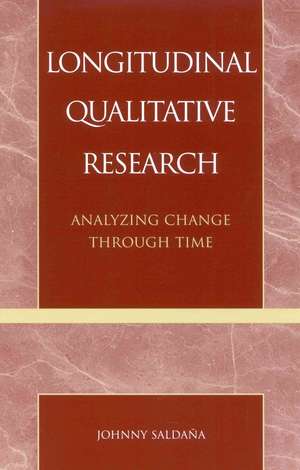
Longitudinal Qualitative Research: Analyzing Change Through Time
Autor Johnny Saldañaen Limba Engleză Paperback – 13 mai 2003
Preț: 321.63 lei
Preț vechi: 397.89 lei
-19%
Puncte Express: 482
Carte tipărită la comandă
Livrare economică 30 noiembrie-14 decembrie
Livrare prin curier în România Termenul estimat este afișat lângă disponibilitate.
Transport gratuit de la 400.00 lei Plată online sau ramburs, în funcție de opțiunile comenzii.
Retur gratuit în 14 zile Comandă securizată și suport în română.
Specificații
ISBN-13: 9780759102965
ISBN-10: 0759102961
Pagini: 212
Ilustrații: references, index
Dimensiuni: 150 x 226 x 14 mm
Greutate: 0.34 kg
Ediția:New.
Editura: Bloomsbury Publishing
Colecția AltaMira Press
Locul publicării:New York, United States
ISBN-10: 0759102961
Pagini: 212
Ilustrații: references, index
Dimensiuni: 150 x 226 x 14 mm
Greutate: 0.34 kg
Ediția:New.
Editura: Bloomsbury Publishing
Colecția AltaMira Press
Locul publicării:New York, United States
V-ar putea interesa
-
 Writing Qualitatively: The Selected Works of Johnny SaldañaJohnny SaldañaPreț: 442.08 lei
 -
 Preț: 477.59 lei
 -
 Preț: 429.31 lei
 -
 Researching Marginalized GroupsKalwant BhopalPreț: 424.32 lei
 -
 -35%Preț: 593.83 lei910.13 lei
 -
 White Logic, White Methods: Racism and MethodologyTukufu Zuberi-29%Preț: 363.36 lei509.61 lei
 -
 Handbook for Team-Based Qualitative ResearchGreg Guest-29%Preț: 393.55 lei553.05 lei
 -
 Cross-Cultural Research MethodsCarol R. EmberPreț: 397.72 lei
 -
 -26%Preț: 285.87 lei388.83 lei
 -
 Conceptual Statistics for BeginnersIsadore Newman-29%Preț: 392.83 lei552.57 lei
 -
 Rethinking Social Inquiry: Diverse Tools, Shared StandardsHenry E. Brady-30%Preț: 358.35 lei510.64 lei
 -
 Revealing Our Social WorldMark Plume-23%Preț: 1059.11 lei1375.46 lei
 -
 -19%Preț: 680.83 lei840.53 lei
 -
 Grounded Practical TheoryRobert T. CraigPreț: 521.03 lei
 -
 Social Studies of GenderChristine V Wood-19%Preț: 676.80 lei835.55 lei
 -
 Mundane MethodsHelen Holmes-23%Preț: 679.94 lei883.04 lei
 -
 Mundane MethodsSarah Marie HallPreț: 230.70 lei
 -
 Qualitative Data Analysis - International Student EditionMatthew B. B. Miles-22%Preț: 899.50 lei1153.20 lei
 -
 Modern SexMyron Magnet-15%Preț: 96.80 lei114.26 lei
 -
 Sleep and Learning: The Magic that Makes Us Healthy and SmartGary R. Plaford-25%Preț: 217.87 lei291.29 lei
 -
 The Relational Gaze on a Changing SocietyElisabetta Carrà-8%Preț: 467.61 lei508.27 lei
Descriere
Johnny Salda-a outlines the basic elements of longitudinal qualitative data, focusing on micro-levels of change observed within individual cases and groups of participants. He draws upon his primary experience in theater education to examine time and change in longitudinal qualitative studies; contending that 'playwrights and qualitative researchers write for the same purpose: to create a unique, insightful, and engaging text about the human condition.' Offering sixteen specific questions through which researchers may approach the analysis of longitudinal qualitative data, Professor Salda-a presents a text intended as a primer for fellow newcomers to long term inquiry, based on traditional social science methods from traditional qualitative and quantitative paradigms, but enriched by an artist-educator's unconventional perspective.
Cuprins
Chapter 1 Acknowledgments
Chapter 2 Introduction: Looking Toward the Journey
Chapter 3 Chapter 1: Longitudinal Qualitative Studies, Time, and Change
Chapter 4 Chapter 2: Longitudinal Qualitative Research Design
Chapter 5 Chapter 3: Longitudinal Qualitative Data Analysis
Chapter 6 Chapter 4: Framing Questions
Chapter 7 Chapter 5: Descriptive Questions
Chapter 8 Chapter 6: Analytic and Interpretive Questions
Chapter 9 Conclusion: Looking Back at the Journey
Chapter 10 References
Chapter 11 Footnotes
12 Appendix: Longitudinal Qualitative Data Summary
13 Index
Chapter 2 Introduction: Looking Toward the Journey
Chapter 3 Chapter 1: Longitudinal Qualitative Studies, Time, and Change
Chapter 4 Chapter 2: Longitudinal Qualitative Research Design
Chapter 5 Chapter 3: Longitudinal Qualitative Data Analysis
Chapter 6 Chapter 4: Framing Questions
Chapter 7 Chapter 5: Descriptive Questions
Chapter 8 Chapter 6: Analytic and Interpretive Questions
Chapter 9 Conclusion: Looking Back at the Journey
Chapter 10 References
Chapter 11 Footnotes
12 Appendix: Longitudinal Qualitative Data Summary
13 Index
Recenzii
Professor Saldaña's Longitudinal Qualitative Research explores the depth of information possible in longitudinal research as well as the potential pitfalls associated with these types of studies. It is a thoughtful book for those engaged in qualitative research.
Johnny Saldaña is one of the most creative minds working in qualitative research today. Here he offers an important option to qualitative researchers, explained in a fresh, interesting way. Using examples from a background combining theatre and educational research, he shows how to approach long-term studies, what kinds of questions can be addressed that shorter research projects cannot, and how the passage of time affects how we research and what we learn.
This book is welcomed addition to the books on qualitative analysis, none of which to this time have given the in-depth attention to process that Saldaña has. The book not only makes the case for process but gives clear strategies for how to bring process into analysis. This will be a great aid to students of qualitative analysis.
I think [his] book on qualitative research-longitudinal or just 'commonplace' is GREAT. . . .There are so many excellent references, descriptions and discussions for texts, support books, articles, journals, monographs, etc. in [his] book, that any doctoral student preparing to do a dissertation could benefit from, I feel [his] book-wheteher someone is doing longitudinal qualitative research or not, is a valuable offering and should be read by qualitative researchers, even if they are not contemplating longitudinal research.
There is much [in the book] for an advanced researcher: in particular, how to think of and track change. . . . This volume is trying to bring rigor to a method that was somewhat ad hoc, whose details had not been previously spelled out. The steps Saldana provides us with to do this kind of work go beyond longitudinal research. Indeed, they are both handy and abstract anough to be worth considering by many of us doing a broad range of different forms of qualitative research.
This book discusses approaches for seeking, identifying, and describing the qualitative dynamics of the processes associated with change over time. It has a conceptual depth based on new thinking as well as unique views of some traditional thinking about longitudinal studies. Saldaña provides an exceptionally broad and inclusive structural framework for thinking about what to initially expect in various types of qualitative longitudinal studies and how to gather the information that informs your expectations. Scholars (qualitative as well as quantitative) will find this to be a valuable book.
The heart and soul of Longitudinal Qualitative Research is to produce a text that is 'a supplement to introductory texts in qualitative inquiry or as a handbook for researchers conducting long term research.' Ultimately, he succeeds. Saldaña has produced a book that is a very competent, interesting, and useful addition to other work in the field.
I...believe this to be a very good book and one that will be of use to anyone in any field who wished to do longitudinal research!
Johnny Saldaña is one of the most creative minds working in qualitative research today. Here he offers an important option to qualitative researchers, explained in a fresh, interesting way. Using examples from a background combining theatre and educational research, he shows how to approach long-term studies, what kinds of questions can be addressed that shorter research projects cannot, and how the passage of time affects how we research and what we learn.
This book is welcomed addition to the books on qualitative analysis, none of which to this time have given the in-depth attention to process that Saldaña has. The book not only makes the case for process but gives clear strategies for how to bring process into analysis. This will be a great aid to students of qualitative analysis.
I think [his] book on qualitative research-longitudinal or just 'commonplace' is GREAT. . . .There are so many excellent references, descriptions and discussions for texts, support books, articles, journals, monographs, etc. in [his] book, that any doctoral student preparing to do a dissertation could benefit from, I feel [his] book-wheteher someone is doing longitudinal qualitative research or not, is a valuable offering and should be read by qualitative researchers, even if they are not contemplating longitudinal research.
There is much [in the book] for an advanced researcher: in particular, how to think of and track change. . . . This volume is trying to bring rigor to a method that was somewhat ad hoc, whose details had not been previously spelled out. The steps Saldana provides us with to do this kind of work go beyond longitudinal research. Indeed, they are both handy and abstract anough to be worth considering by many of us doing a broad range of different forms of qualitative research.
This book discusses approaches for seeking, identifying, and describing the qualitative dynamics of the processes associated with change over time. It has a conceptual depth based on new thinking as well as unique views of some traditional thinking about longitudinal studies. Saldaña provides an exceptionally broad and inclusive structural framework for thinking about what to initially expect in various types of qualitative longitudinal studies and how to gather the information that informs your expectations. Scholars (qualitative as well as quantitative) will find this to be a valuable book.
The heart and soul of Longitudinal Qualitative Research is to produce a text that is 'a supplement to introductory texts in qualitative inquiry or as a handbook for researchers conducting long term research.' Ultimately, he succeeds. Saldaña has produced a book that is a very competent, interesting, and useful addition to other work in the field.
I...believe this to be a very good book and one that will be of use to anyone in any field who wished to do longitudinal research!
Notă biografică
Johnny Saldaña is Professor Emeritus from Arizona State University's (ASU) School of Film, Dance, and Theatre in the Herberger Institute for Design and the Arts, where he taught from 1981 to 2014. He received his BFA in Drama and English Education in 1976, and MFA in Drama Education in 1979 from the University of Texas at Austin.
Saldaña is the author of Longitudinal Qualitative Research: Analyzing Change through Time (AltaMira Press, 2003); Fundamentals of Qualitative Research (Oxford University Press, 2011); Ethnotheatre: Research from Page to Stage (Left Coast Press, 2011); Thinking Qualitatively: Methods of Mind (Sage Publications, 2015); a commissioned title for Routledge's World Library of Educationalists Series, Writing Qualitatively: The Selected Works of Johnny Saldaña (Routledge, 2018); co-author with the late Matthew B. Miles and A. Michael Huberman for Qualitative Data Analysis: A Methods Sourcebook (4th ed., Sage Publications, 2020); co-author with Matt Omasta for Qualitative Research: Analyzing Life (Sage Publications, 2018); and the editor of Ethnodrama: An Anthology of Reality Theatre (AltaMira Press, 2005). Previous editions of The Coding Manual for Qualitative Researchers have been translated into Korean, Turkish, and Chinese-Simplified.
Saldaña's methods works have been cited and referenced in more than 16,000 research studies conducted in over 130 countries in disciplines such as K-12 and higher education, medicine and health care, technology and social media, business and economics, government and social services, the fine arts, the social sciences, human development, and communication. He has published a wide range of research articles in journals such as Research in Drama Education, The Qualitative Report, Multicultural Perspectives, Youth Theatre Journal, Journal of Curriculum and Pedagogy, Teaching Theatre, Research Studies in Music Education, Cultural Studies ? Critical Methodologies, the International Journal of Qualitative Methods, the International Review of Qualitative Research, and Qualitative Inquiry, and has contributed several chapters to research methods handbooks. His most popular journal article, "Blue-Collar Qualitative Research: A Rant" (Qualitative Inquiry, 2014), has been downloaded by over 3,000 readers, according to ResearchGate.
Saldaña's research in qualitative inquiry, data analysis, and performance ethnography has received awards from the American Alliance for Theatre & Education, the National Communication Association-Ethnography Division, the American Educational Research Association's Qualitative Research Special Interest Group, New York University's Program in Educational Theatre, the Children's Theatre Foundation of America, and the ASU Herberger Institute for Design and the Arts.