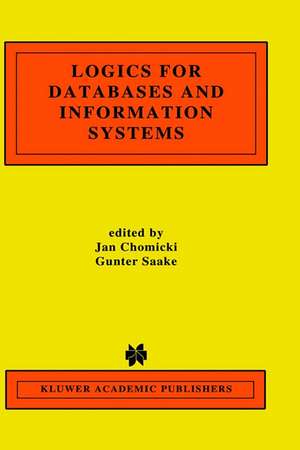
Logics for Databases and Information Systems: The Springer International Series in Engineering and Computer Science, cartea 436
Editat de Jan Chomicki, Gunter Saakeen Limba Engleză Hardback – 31 mar 1998
Din seria The Springer International Series in Engineering and Computer Science
- 18%
 Preț: 1263.85 lei
 - 18%
 Preț: 921.36 lei
 - 20%
 Preț: 633.65 lei
 - 20%
 Preț: 665.64 lei
 - 20%
 Preț: 662.69 lei
 - 24%
 Preț: 876.97 lei
 - 20%
 Preț: 663.58 lei
 - 20%
 Preț: 950.07 lei
 - 20%
 Preț: 665.12 lei
 - 18%
 Preț: 903.90 lei
 - 20%
 Preț: 950.72 lei
 - 18%
 Preț: 985.84 lei
 - 15%
 Preț: 621.23 lei
 - 18%
 Preț: 979.41 lei
 - 18%
 Preț: 907.54 lei
 - 18%
 Preț: 1173.85 lei
 - 15%
 Preț: 663.24 lei
 - 18%
 Preț: 976.26 lei
 - 18%
 Preț: 904.83 lei
 - 18%
 Preț: 904.83 lei
 - 20%
 Preț: 1325.05 lei
 - 20%
 Preț: 1725.82 lei
 - 20%
 Preț: 1326.15 lei
 - 20%
 Preț: 989.14 lei
 -
 Preț: 381.30 lei
 - 20%
 Preț: 635.71 lei
 - 18%
 Preț: 1193.58 lei
 - 20%
 Preț: 622.65 lei
 - 20%
 Preț: 1319.14 lei
 - 18%
 Preț: 974.15 lei
 - 20%
 Preț: 670.15 lei
 - 15%
 Preț: 664.58 lei
 - 18%
 Preț: 1179.97 lei
 - 15%
 Preț: 670.25 lei
 - 15%
 Preț: 663.36 lei
 - 20%
 Preț: 620.83 lei
 - 18%
 Preț: 990.04 lei
 - 15%
 Preț: 660.75 lei
 - 18%
 Preț: 1266.48 lei
Preț: 1325.93 lei
Preț vechi: 1657.41 lei
-20%
Puncte Express: 1989
Carte tipărită la comandă
Livrare economică 07-21 decembrie
Livrare prin curier în România Termenul estimat este afișat lângă disponibilitate.
Transport gratuit pentru acest produs Plată online sau ramburs, în funcție de opțiunile comenzii.
Retur gratuit în 14 zile Comandă securizată și suport în română.
Specificații
ISBN-13: 9780792381297
ISBN-10: 0792381297
Pagini: 448
Ilustrații: XIII, 430 p.
Dimensiuni: 160 x 241 x 29 mm
Greutate: 0.78 kg
Ediția:1998
Editura: Springer
Colecția The Springer International Series in Engineering and Computer Science
Seria The Springer International Series in Engineering and Computer Science
Locul publicării:New York, NY, United States
ISBN-10: 0792381297
Pagini: 448
Ilustrații: XIII, 430 p.
Dimensiuni: 160 x 241 x 29 mm
Greutate: 0.78 kg
Ediția:1998
Editura: Springer
Colecția The Springer International Series in Engineering and Computer Science
Seria The Springer International Series in Engineering and Computer Science
Locul publicării:New York, NY, United States
V-ar putea interesa
-
 The Development of Component-based Information SystemsSergio de Cesare-20%Preț: 466.12 lei582.65 lei
 -
 Managing Electronic ResourcesRyan WeirPreț: 484.85 lei
 -
 Cloud-Based Services for Your Library: A LITA GuideAmerican Library AssociationPreț: 476.33 lei
 -
 Using Libguides to Enhance Library Services: A Lita GuideAaron W. DobbsPreț: 484.27 lei
 -
 Responsive Web Design for Libraries: A LITA GuideAmerican Library AssociationPreț: 439.58 lei
 -
 OneNote For BeginnersJoseph JoynerPreț: 62.79 lei
 -
 Logics for Emerging Applications of DatabasesJan Chomicki-20%Preț: 676.52 lei845.65 lei
 -
 Transactions and Database DynamicsGunter Saake-20%Preț: 317.55 lei396.94 lei
 -
 Algorithmic Game TheoryBurkhard Monien-20%Preț: 339.52 lei424.40 lei
 -
 Advances in Blended LearningElvis Wai Chung Leung-20%Preț: 329.48 lei411.85 lei
 -
 Conceptual Modeling: Foundations and ApplicationsAlex T. Borgida-20%Preț: 347.39 lei434.23 lei
 -
 Advances in Web Based Learning - ICWL 2009Marc Spaniol-20%Preț: 345.45 lei431.82 lei
 -
 Semantic Technologies for E-GovernmentTomas Vitvar-20%Preț: 628.77 lei785.96 lei
 -
 Advances in Information Retrieval TheoryLeif Azzopardi-20%Preț: 340.57 lei425.71 lei
 -
 Music Recommendation and DiscoveryÒscar Celma-20%Preț: 343.83 lei429.79 lei
 -
 Feature-Oriented Software Product LinesSven Apel-20%Preț: 617.85 lei772.32 lei
 -
 Verteiltes und Paralleles DatenmanagementErhard Rahm-20%Preț: 241.82 lei302.28 lei
 -
 Preț: 341.13 lei
Public țintă
ResearchCuprins
1 Introduction to Logics for Databases and Information Systems.- References.- 2 A Logic Primer.- 2.1 Introduction.- 2.2 First-Order Logic (FOL).- 2.3 Modal Logics.- 2.4 Logic Programming.- 2.5 Conclusion.- References.- 3 Temporal Logic in Information Systems.- 3.1 Introduction.- 3.2 Temporal Databases.- 3.3 Temporal Queries.- 3.4 Temporal Integrity Constraints.- 3.5 Multidimensional Time.- 3.6 Beyond First-order Temporal Logic.- 3.7 Conclusions.- References.- 4 The Role of Deontic Logic in the Specification of Information Systems.- 4.1 Introduction: Soft Constraints and Deontic Logic.- 4.2 Standard Deontic Logic (SDL).- 4.3 The Paradoxes of Deontic Logic.- 4.4 A Diagnosis of the Problems.- 4.5 A Solution to the ‘Ought-to-Be’ Version of the Chisholm Paradox: S5O(n).- 4.6 Ought-to-Do: The Dynamic Perspective.- 4.7 An Integrated Logic of Ought-to-Be and Ought-to-Do Constraints.- 4.8 Applications.- References.- 5 A Logic for Programming Database Transactions.- 5.1 Introduction.- 5.2 Overview and Introductory Examples.- 5.3 Syntax.- 5.4 Elementary Operations.- 5.5 Model Theory.- 5.6 Proof Theory.- 5.7 Related Work.- References.- 6 Logics for Specifying Concurrent Information Systems.- 6.1 Introduction.- 6.2 Overview.- 6.3 Local Logic L.- 6.4 Distributed Logics.- 6.5 Reduction.- 6.6 Extended Example.- 6.7 Related Work.- 6.8 Concluding Remarks.- References.- 7 Evolving Logical Specification in Information Systems.- 7.1 Introduction.- 7.2 Motivation and Language.- 7.3 Syntax and Semantics of the Logic.- 7.4 Translation of Language into Logic.- 7.5 Using the Logical Framework.- 7.6 Concluding Remarks.- References.- 8 Description Logics for Conceptual Data Modeling.- 8.1 Introduction.- 8.2 Description Logics.- 8.3 Semantic Data Models.- 8.4 Object-Oriented Data Models.- 8.5Support for Data Modeling.- 8.6 Conclusions.- References.- 9 Integrity Constraints: Semantics and Applications.- 9.1 Introduction.- 9.2 Background.- 9.3 Semantics of Integrity Constraints.- 9.4 Reasoning with Integrity Constraints.- 9.5 Applications of Integrity Constraints.- 9.6 Conclusion and Future Directions.- References.- 10 Logical Approaches to Incomplete Information: A Survey.- 10.1 Introduction.- 10.2 Sources of Indefiniteness.- 10.3 A Semantic Framework for Incomplete Databases.- 10.4 Algebraic Models of Nulls.- 10.5 Logical Databases.- 10.6 Complexity of Queries.- 10.7 Negative Information.- 10.8 Integrity Constraints.- 10.9 Updates of Incomplete Databases.- 10.10 Other Issues.- 10.11 Incomplete Information in Current Technology.- References.- 11 Declarative Frameworks for Inheritance.- 11.1 Introduction.- 11.2 Motivation for Inheritance.- 11.3 Main Issues and Problems.- 11.4 Logic-based Approaches to Inheritance.- 11.5 Research Directions.- References.- 12 On Logical Foundations of Active Databases.- 12.1 Introduction.- 12.2 Basics of Active Rules.- 12.3 Research on Foundations of Active Rules.- 12.4 A Deductive State-Oriented Core Language.- 12.5 A Framework for Active Rules.- 12.6 Conclusion.- References.