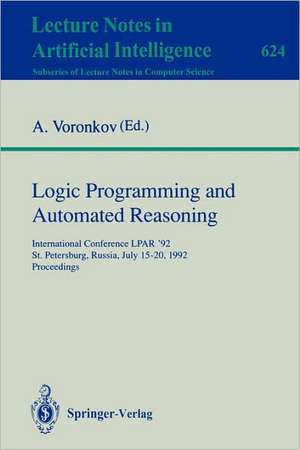
Logic Programming and Automated Reasoning
Editat de Andrei Voronkoven Limba Engleză Paperback – 29 iun 1993
Preț: 327.69 lei
Preț vechi: 409.62 lei
-20%
Puncte Express: 492
Carte tipărită la comandă
Livrare economică 17 noiembrie-01 decembrie
Livrare prin curier în România Termenul estimat este afișat lângă disponibilitate.
Transport gratuit de la 400.00 lei Plată online sau ramburs, în funcție de opțiunile comenzii.
Retur gratuit în 14 zile Comandă securizată și suport în română.
Specificații
ISBN-13: 9783540569442
ISBN-10: 3540569448
Pagini: 408
Ilustrații: XIV, 394 p.
Dimensiuni: 155 x 235 x 23 mm
Greutate: 0.62 kg
Ediția:1993
Editura: Springer
Locul publicării:Berlin, Heidelberg, Germany
ISBN-10: 3540569448
Pagini: 408
Ilustrații: XIV, 394 p.
Dimensiuni: 155 x 235 x 23 mm
Greutate: 0.62 kg
Ediția:1993
Editura: Springer
Locul publicării:Berlin, Heidelberg, Germany
V-ar putea interesa
-
 -20%Preț: 89.95 lei112.23 lei
 -
 Computer VisionSimon J. D. Prince-20%Preț: 574.23 lei717.78 lei
 -
 Machine LearningPeter Flach-20%Preț: 386.84 lei483.55 lei
 -
 Multi-Agent Machine LearningSchwartz-20%Preț: 658.33 lei822.91 lei
 -
 Wavelet Neural NetworksAntonis K Alexandridis-20%Preț: 615.48 lei769.35 lei
 -
 Practical Introduction to CompDawson-Howe-20%Preț: 501.15 lei626.44 lei
 -
 Machine Learning: An Algorithmic Perspective, Second EditionStephen Marsland-20%Preț: 614.34 lei767.93 lei
 -
 -9%Preț: 987.33 lei1084.98 lei
 -
 Perspectives of System InformaticsManuel Mazzara-20%Preț: 337.80 lei422.24 lei
 -
 Modern Approaches to Agent-based Complex Automated NegotiationKatsuhide Fujita-20%Preț: 653.07 lei816.34 lei
 -
 Smart Energy Control Systems for Sustainable BuildingsJohn Littlewood-20%Preț: 1005.65 lei1257.06 lei
 -
 Advances in Intelligent Process-Aware Information SystemsGregor Grambow-20%Preț: 938.25 lei1172.81 lei
 -
 -20%Preț: 619.09 lei773.86 lei
 -
 State-Space Approaches for Modelling and Control in Financial EngineeringGerasimos G. Rigatos-20%Preț: 675.14 lei843.92 lei
 -
 Learning Analytics: Fundaments, Applications, and TrendsAlejandro Peña-Ayala-20%Preț: 1084.55 lei1355.69 lei
 -
 Intelligent Decision Support Systems for Sustainable ComputingArun Kumar Sangaiah-20%Preț: 629.88 lei787.35 lei
 -
 -20%Preț: 684.17 lei855.21 lei
 -
 Logic for Programming, Artificial Intelligence, and ReasoningGeoff Sutcliffe-20%Preț: 647.64 lei809.56 lei
 -
 Perspectives of Systems InformaticsAndrei Voronkov-20%Preț: 333.24 lei416.55 lei
 -
 Computer Science - Theory and ApplicationsVolker Diekert-20%Preț: 342.29 lei427.86 lei
 -
 Believable BotsPhilip Hingston-20%Preț: 656.24 lei820.30 lei
 -
 Perspectives of System InformaticsAndrei Voronkov-20%Preț: 328.93 lei411.16 lei
 -
 -20%Preț: 340.38 lei425.47 lei
Public țintă
ResearchCuprins
Entailment and disentailment of order-sorted feature constraints.- Computing extensions of default logic — Preliminary report.- Prolog with arrays and bounded quantifications.- Linear 0–1 inequalities and extended clauses.- Search space pruning by checking dynamic term growth.- A proof search system for a modal substructural logic based on labelled deductive systems.- Consistency checking of automata functional specifications.- Yet another application for Toupie: Verification of mutual exclusion algorithms.- Parsing with DCG-terms.- A first order resolution calculus with symmetries.- Ordered paramodulation and resolution as decision procedure.- Static analysis of Prolog with cut.- A new type theory for representing logics.- Verification of Switch-level designs with many-valued logic.- Deciding in HFS-theory via linear integer programming.- The completion of typed logic programs and SLDNF-resolution.- Increasing the versatility of heuristic based theorem provers.- Sequentialization of parallel logic programs with mode analysis.- Refinements and extensions of model elimination.- Executable specifications based on dynamic algebras.- Generic resolution in propositional modal systems.- Optimized translation of multi modal logic into predicate logic.- Default reasoning with a constraint resolution principle.- Non-clausal deductive techniques for computing prime implicants and prime implicates.- Unification under one-sided distributivity with a multiplicative unit.- Unification in Order-Sorted Logic with Term Declarations.- Extracting inheritance hierarchies from Prolog programs: A system based on the inference of type relations.- A comparison of mechanisms for avoiding repetition of subdeductions in chain format linear deduction systems.- Neutralization and preemption inextended logic programs.- MULTLOG: A system for axiomatizing many-valued logics.- SKIL: A system for programming with proofs.- Reasoning about the reals: the marriage of HOL and maple.- System description of LAMBDALG.- Mixing metafor.- A complete axiom system for isomorphism of types in closed categories.- Reasoning, modeling, and component-based technology.