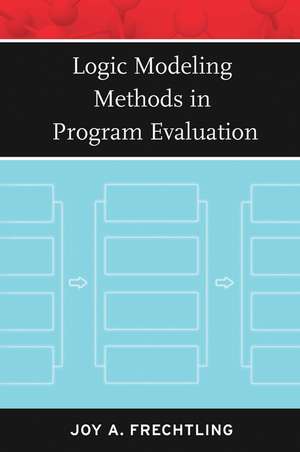
Logic Modeling Methods in Program Evaluation
Autor Joy A. Frechtlingen Limba Engleză Paperback – mar 2007
Logic Modeling Methods in Program Evaluation's comprehensive approach:
- Shows how the logic model can be used to clarify assumptions, reach group consensus, and bridge between various disciplines;
- Identifies the specific components of logic modeling and discusses inputs, activities, outputs, short and long-term outcomes, contextual factors, and optional components and variations;
- Focuses on the critical role of consensus in the development of a logic model, including factors such as teaming, timing, and collaborative learning;
- Explores issues such as the most common mistakes in the development and implementation of logic models and the use of logic models in projects with different levels of complexity or different durations;
- Discusses how the logic model can be used to identify the range of outcomes to be examined and how summative questions can be prioritized;
- Includes a variety of illustrative case studies of simple, multi-year, and complex projects and demonstrates the use of the logic model to establish project goals and evaluate the project's outcome.
Preț: 518.76 lei
Puncte Express: 778
Carte tipărită la comandă
Livrare economică 21 octombrie-04 noiembrie
Livrare prin curier în România Termenul estimat este afișat lângă disponibilitate.
Transport gratuit pentru acest produs Plată online sau ramburs, în funcție de opțiunile comenzii.
Retur gratuit în 14 zile Comandă securizată și suport în română.
Specificații
ISBN-13: 9780787981969
ISBN-10: 0787981966
Pagini: 162
Dimensiuni: 152 x 229 x 9 mm
Greutate: 0.25 kg
Editura: Wiley
Locul publicării:Hoboken, United States
ISBN-10: 0787981966
Pagini: 162
Dimensiuni: 152 x 229 x 9 mm
Greutate: 0.25 kg
Editura: Wiley
Locul publicării:Hoboken, United States
V-ar putea interesa
-
 EDUCATION REFORMStephen Ball-29%Preț: 209.56 lei294.37 lei
 -
 Changing School SubjectsCarrie F PaechterPreț: 356.89 lei
 -
 Assessment for Learning without LimitsAlison Peacock-30%Preț: 155.44 lei222.93 lei
 -
 Essential Primary EnglishJane Medwell-29%Preț: 159.71 lei223.43 lei
 -
 Introduction to Childhood StudiesMary Jane Kehily-28%Preț: 172.70 lei241.03 lei
 -
 The Course SyllabusJudith Grunert O'BrienPreț: 232.41 lei
 -
 Media EducationDavid BuckinghamPreț: 156.55 lei
 -
 Shaping the College CurriculumLisa R LattucaPreț: 389.03 lei
 -
 The Learner-Centered CurriculumRoxanne CullenPreț: 300.90 lei
 -
 Creating Significant Learning ExperiencesL. Dee FinkPreț: 320.12 lei
 -
 Positively Smarter CConyersPreț: 365.15 lei
 -
 Preț: 419.51 lei
 -
 Preț: 422.92 lei
 -
 Preț: 366.09 lei
Public țintă
Students, professionals and consultants in the folliwing areas; education, policy sciences, public administration, sociology, psychology and health, needs assessment and action research.Notă biografică
Joy A. Frechtling is a vice president and associate director in Westat's Education Studies Group. She has more than thirty years' experience in conducting educational evaluation, addressing all levels of the educational system.
Cuprins
List of Figures. Preface.
1. Evaluation and Logic Models.
2. The Uses of Logic Models.
3. The Components of a Logic Model.
4. The Connections in a Logic Model.
5. Developing Logic Models to Support Evaluation.
6. Developing Logic Models of Differing Complexity.
7. Using a Logic Model to Identify Evaluation Questions.
8. Using a Logic Model to Support Explanatory Evaluation.
9. Challenges in Developing Logic Models.
10. Developing Logic Models for Complex Projects.
11. Using Logic Models to Evaluate a Family of Projects.
12. Using the Logic Model to Provide Technical Assistance.
Appendix: The Phases of an Evaluation.
About the Author.
Glossary.
References.
1. Evaluation and Logic Models.
2. The Uses of Logic Models.
3. The Components of a Logic Model.
4. The Connections in a Logic Model.
5. Developing Logic Models to Support Evaluation.
6. Developing Logic Models of Differing Complexity.
7. Using a Logic Model to Identify Evaluation Questions.
8. Using a Logic Model to Support Explanatory Evaluation.
9. Challenges in Developing Logic Models.
10. Developing Logic Models for Complex Projects.
11. Using Logic Models to Evaluate a Family of Projects.
12. Using the Logic Model to Provide Technical Assistance.
Appendix: The Phases of an Evaluation.
About the Author.
Glossary.
References.